
 Florida
 Hildesheim
Why the Beechcraft King Air Remains the Turboprop Standard
The Beechcraft King Air has been in continuous production for over six decades. More than 7,600 aircraft have been delivered worldwide. It has served as an executive transport, charter aircraft, air ambulance, military utility platform, and special mission operator across virtually every operating environment on earth. That longevity is not accidental. It reflects a design that works.
The King Air occupies a premium position in the turboprop market: more capable than single-engine turboprops at a meaningfully lower operating cost than light jets. For operators who need pressurized cabin comfort, genuine all-weather capability, and the ability to use shorter runways and smaller airports, the King Air delivers on all counts.
The breadth of the King Air family means buyers can match their budget and mission profile to a specific series. From the entry-level C90B to the large-cabin King Air 350ER, there is a King Air configuration for almost every turboprop mission.
King Air listings on CollectAirs
Browse verified Beechcraft King Air listings with full documentation and transparent auction terms.
History and Design of the Beechcraft King Air
Beechcraft launched the King Air program in 1964 with the Model 90, a pressurized twin-turboprop derived from the earlier Beechcraft Queen Air. The decision to pair the airframe with Pratt & Whitney Canada PT6 engines proved transformative: the combination set the standard for light turboprop design that competitors have spent decades trying to match.
Model Series Overview
The King Air family has evolved through several distinct series, each expanding capability and refining the design:
- King Air 90 series (1964–present): Entry-level turboprop; C90, E90, C90B, C90GTx variants all offering pressurized six-seat cabin capability
- King Air 100 series (1969–1983): Stretched fuselage for eight-passenger cabin; produced as Models A100 and B100
- King Air 200 / B200 / B200GT (1974–present): T-tail design, PT6A-41/-42 engines, greater range and payload; the most widely operated series
- King Air 300 / 350 / 350ER (1984–present): PT6A-60A engines, increased gross weight, winglets, larger cabin cross-section, extended range capability
Military and Special Mission Heritage
The U.S. military has operated King Airs in multiple roles under designations including the C-12 Huron and RC-12 Guardrail series. Numerous allied nations operate King Airs for transport, surveillance, and special mission roles. Military-origin aircraft occasionally appear on the civilian market; their logbook history, modification status, and conversion documentation require careful review before purchase.
Series Differences Matter Significantly
Performance, operating costs, cabin dimensions, avionics compatibility, and parts availability differ materially between King Air series. A King Air C90B and a King Air B200 are fundamentally different aircraft in terms of capability and cost structure. Define your mission and budget clearly before narrowing your search to a specific series.
Beechcraft King Air Performance and Mission Capability
The Beechcraft King Air delivers genuine turboprop performance: pressurized, all-weather operations at altitudes and speeds that connect city pairs efficiently. The specific numbers depend on the series, but the King Air family consistently outperforms piston twins and competes directly with light jets on short-to-medium routes.
270–310 KTAS Cruise
Typical cruise speeds at FL250–FL310 give the King Air genuine speed advantages over piston aircraft on any route over 200 nautical miles.
1,000–3,000 NM Range
Model-dependent range covers regional and transcontinental missions. The 350ER extended range variant is capable of transatlantic legs with favorable winds.
Pressurized Cabin
Cabin altitude of approximately 8,000 ft at FL290 provides meaningful passenger comfort during long legs, a core advantage over unpressurized alternatives.
High-altitude performance is a practical King Air advantage. Operating at FL250–FL310, the King Air flies above much of the weather that forces lower-altitude aircraft to deviate or hold. For operators in mountainous regions or areas with frequent convective activity, this altitude capability translates directly into schedule reliability and operational safety.
Performance note: Published figures represent ideal conditions. Real-world performance depends on aircraft weight, density altitude, weather, and specific configuration. Always evaluate performance against your actual mission profile, not manufacturer maximum figures.
PT6 Engines: The Heart of the King Air
The Pratt & Whitney Canada PT6 turboprop has accumulated over 400 million flight hours across thousands of applications. In the Beechcraft King Air, it delivers the combination of reliability, power, and responsive handling that defines the type. Understanding PT6 engine economics is essential to understanding King Air ownership.
PT6 Variants by Series
- PT6A-20/-21/-28: King Air 90 series, 550–680 shp, TBO 3,500 hrs
- PT6A-41/-42: King Air 200 / B200, 850 shp, TBO 3,600 hrs
- PT6A-60A: King Air 350, 1,050 shp, TBO 3,500 hrs
- Hot section inspection typically required at 1,800–2,000 hours
Engine Program Considerations
- Major programs: JSSI, Eagle Service Plan, ProParts
- On-program aircraft command a $100,000–$500,000+ premium depending on model
- Off-program: full overhaul per engine ranges $150,000–$350,000+ at overhaul facilities
- Oil analysis history is a key health indicator, request all available records
Cockpit, Avionics, and Cabin
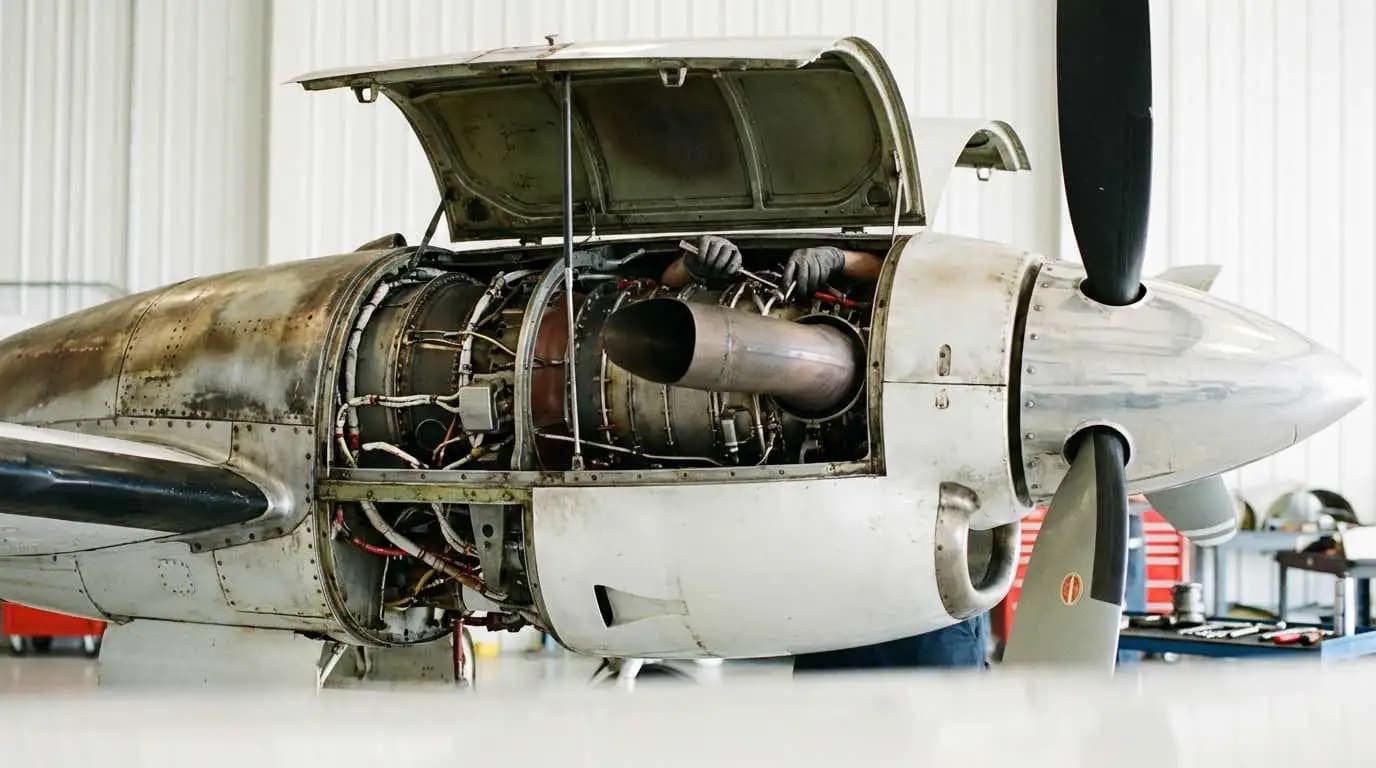
Avionics generation is one of the most significant value and capability differentiators in the Beechcraft King Air used market. Aircraft can range from round-gauge legacy panels on older 90-series variants to full Garmin G1000 NXi or Pro Line Fusion glass cockpit installations on late-model 350s. The cockpit heavily influences both operator capability and resale value.
Legacy Round-Gauge Panels
Older King Air 90 and early 200-series aircraft frequently retain their original Bendix/King or Collins round-gauge instrumentation. These panels are functional and proven but do not offer the situational awareness and WAAS/LPV approach capability of modern glass. Upgrade costs to modern avionics suites range from $150,000 to $400,000 or more depending on scope.
Glass Cockpit Upgrades
Many mid-generation King Airs have been retrofitted with Garmin GNS 530/430, GTN 750/650, or Garmin G600/G1000 NXi suites. These upgrades substantially improve capability and resale value. Verify the STC documentation, installation quality, and software currency for each avionics system during pre-purchase.
Current Production Avionics
Late-model King Air 250 and 350 aircraft are delivered with Pro Line Fusion or Garmin G1000 NXi integrated avionics, synthetic vision, ADS-B Out compliance, and FADEC-equivalent engine monitoring. These panels set current-production capability and command premium used market pricing.
Cabin Configuration
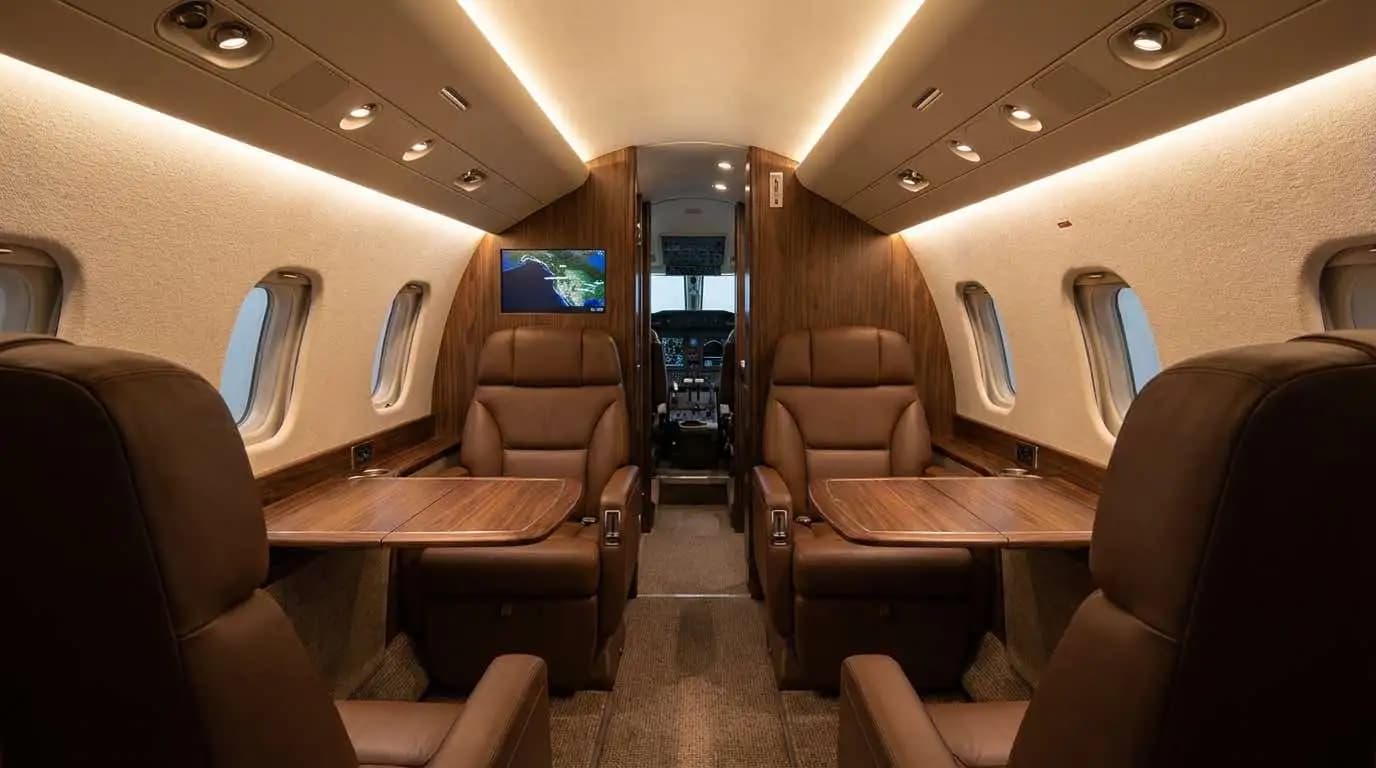
The King Air cabin offers flexible configuration for executive, charter, or utility missions. Standard executive layouts typically seat six to eight passengers with club seating, fold-out tables, and an aft lavatory. Cabin width on the 200/350 series is a genuine comfort advantage for passengers on longer legs.
Maintenance, AD Compliance, and Ownership Reality
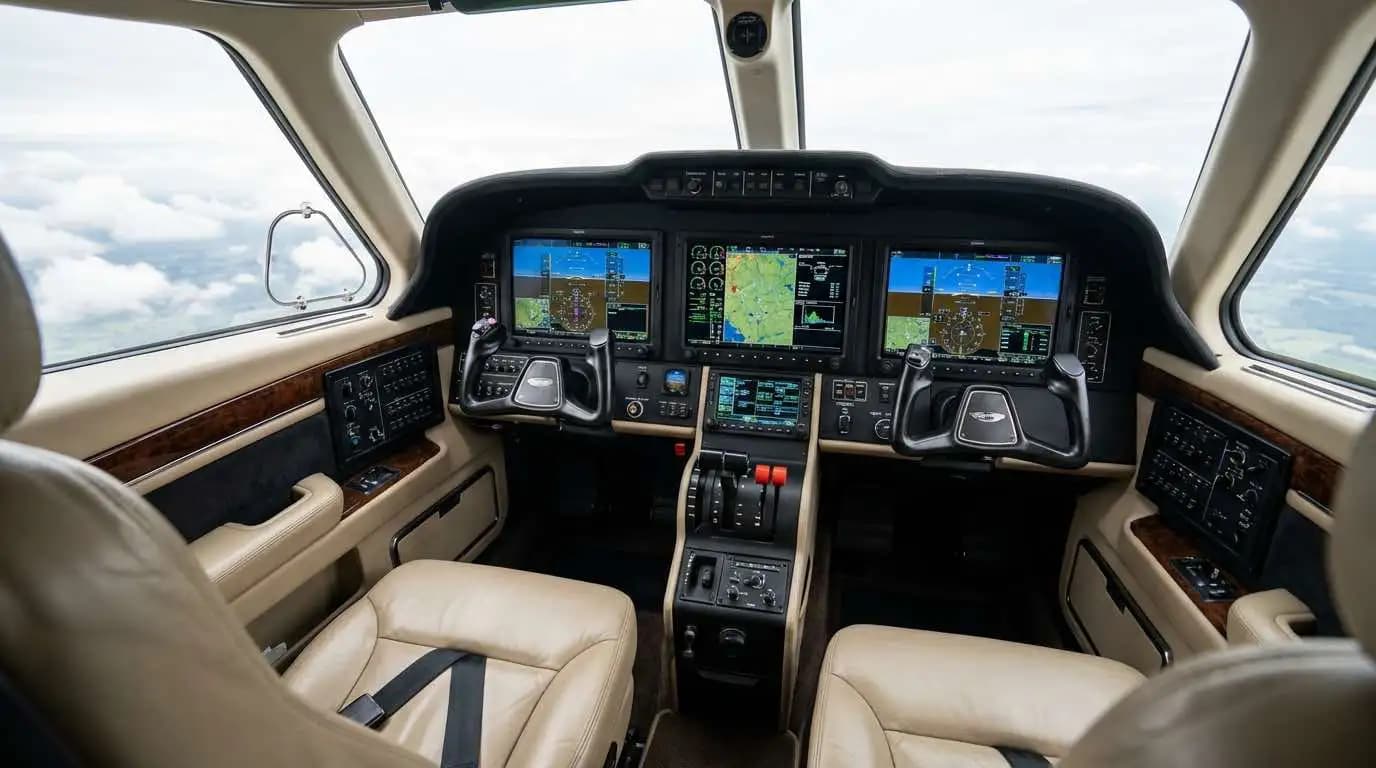
The Beechcraft King Air is a certificated turboprop aircraft with a structured maintenance program. Operators who follow the published inspection intervals and use King Air-authorized service centers generally achieve excellent dispatch reliability. The type is well supported by Textron Aviation (current manufacturer), a network of authorized service centers worldwide, and an active owner and operator community.
Pressurization System: The Most Common Surprise
Pressurization system condition is the single most common source of expensive post-purchase surprises on used King Airs. Door seals, outflow valves, pressurization controllers, and bulkhead integrity all require evaluation. A pressurization check, both ground and flight, is mandatory on any pre-purchase inspection. Leaking systems can be expensive to diagnose and repair, with some issues requiring structural work.
AD Compliance
The King Air has accumulated Airworthiness Directives across its production life. Recurring ADs covering propeller systems, fuel systems, de-ice boots, landing gear, and pressurization components must be current. Engine ADs for the installed PT6 variant add to the compliance list. Request a full AD compliance spreadsheet for the airframe and both engines. Any undocumented or non-compliant AD items must be resolved before purchase is completed.
De-Ice and Anti-Ice Systems
The King Air is typically operated in known icing conditions. Pneumatic de-ice boots on the wing and tail leading edges, heated pitot and static ports, prop de-ice, windshield heat, and fuel vent heat are all system components that require attention. Boot condition degrades with age; replacement costs for full wing and tail boots on a B200 can exceed $30,000 depending on labor market. Verify boot condition and age during pre-purchase.
Authorized Service Center Network
Textron Aviation maintains a worldwide network of authorized King Air service centers. Using authorized centers provides access to factory-trained technicians, current service bulletin compliance, and warranty coverage where applicable. For pre-purchase inspections, selecting a center that regularly maintains the specific King Air series under evaluation is strongly advisable, their familiarity with common problem areas for that series is valuable.
Buying a Beechcraft King Air: Pre-Purchase Checklist
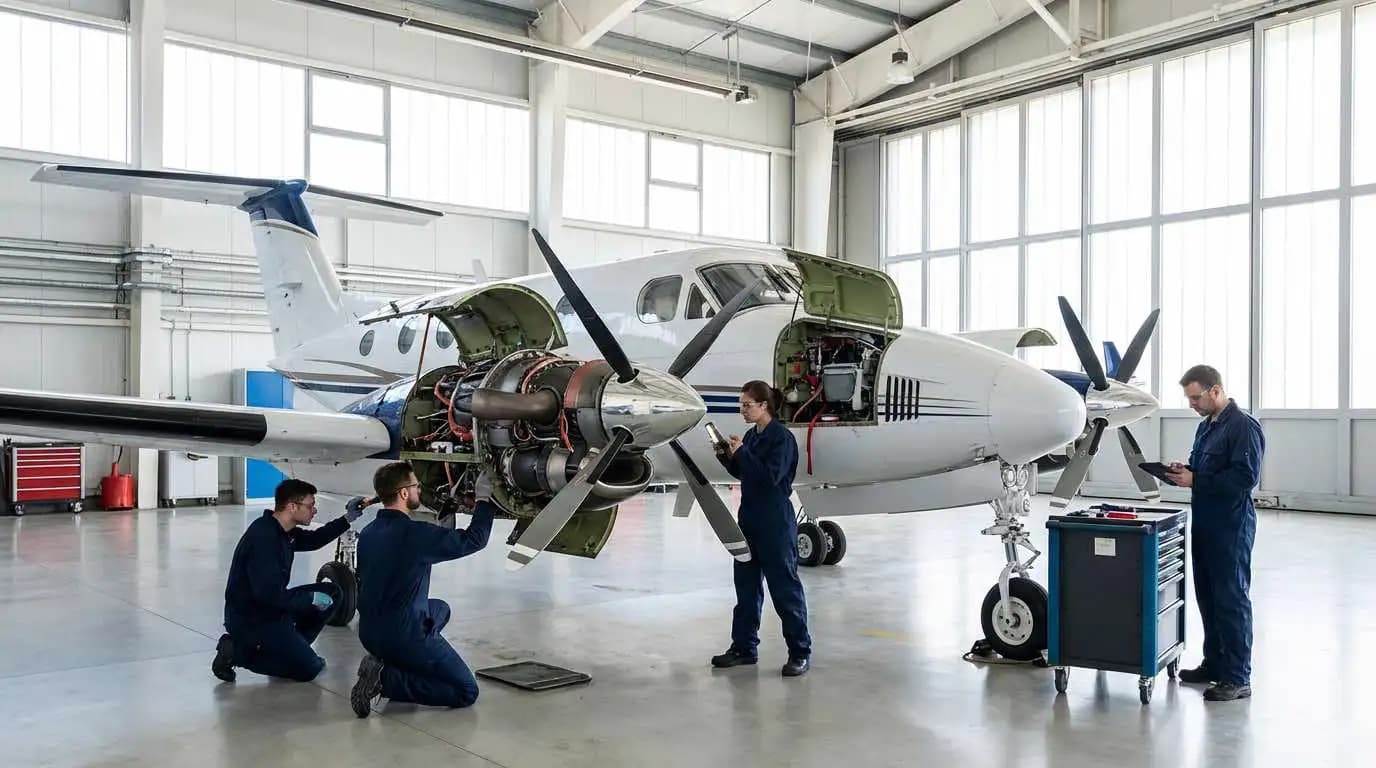
A King Air transaction warrants structured, thorough due diligence. These aircraft operate in demanding environments and their systems complexity demands type-specific inspection expertise. Shortcutting the pre-purchase process on a King Air creates significant financial risk.
Documentation & Records
- Confirm complete, unbroken airframe logbooks. Total time and cycles (where applicable) must be clearly traceable.
- Review engine logbooks for both engines: total time, time since last hot section, overhaul records, and any event history (rapid shutdowns, compressor stalls, foreign object ingestion).
- Verify full AD compliance documentation for airframe, both PT6 engines, and propellers.
- Check for 337 forms, STCs, and field approvals covering all installed avionics and modifications.
- Confirm engine program enrollment status: carrier, enrolled hours, transferability, and any outstanding exposure.
- Verify title clear: no liens, no encumbrances. Use an aviation title search service.
Technical Inspection Priorities
- Select a King Air-authorized service center for the inspection, type-specific knowledge is non-negotiable.
- Ground and flight pressurization test. Verify door seal condition, outflow valve function, and differential pressure capability.
- PT6 engine borescope and oil analysis interpretation. Review hot section condition, compressor wash history, and propeller shaft seal status.
- Propeller inspection: blade condition, hub condition, prop governor response, and prop de-ice system functionality.
- Full de-ice system check: boots, heated surfaces, windshield heat, pitot heat, fuel vent heat.
- Landing gear: retraction test, hydraulic fluid condition, actuator and door integrity, squat switch function.
- Avionics: functionality test of all installed systems, software currency, ADS-B Out compliance verification.
- Corrosion inspection: wing lower surface, spar caps, fuselage belly, fuel tank sumps, and gear bays.
Deal Process & Risk Control
- Use aviation escrow for funds and document transfer. King Air transactions warrant professional protection given the asset values involved.
- Make the purchase conditional on inspection findings with clear, pre-agreed deal-breaker thresholds.
- Confirm insurance availability and confirm premium costs before committing to purchase, turboprop insurance requires documented turbine PIC time.
- Budget for type-specific initial training: FlightSafety or SimuFlite King Air courses for the specific series.
- Verify hangar availability and maintenance partner selection in your base airport region before finalizing the deal.
Market Snapshot and Pricing Drivers
The Beechcraft King Air used market is deep, with hundreds of aircraft traded globally each year. Pricing ranges widely by series, condition, and configuration: from entry-level C90B examples to late-model 350ER aircraft at the top of the market.
Engine Program Enrollment
The most significant single value driver across all King Air series. On-program aircraft with both engines enrolled in a reputable hourly-cost program can command premiums of $100,000–$500,000+ over off-program equivalents, reflecting the cost certainty they provide to buyers.
Total Airframe Time and Cycles
Low-time King Airs command premium. High-time airframes are not necessarily problematic if maintenance history is thorough and documented, but they require more careful structural evaluation, particularly for pressurization fatigue and corrosion.
Avionics Generation
Glass cockpit upgrades with Garmin G1000 NXi, GTN 750, or Pro Line Fusion significantly increase practical value and resale marketability. Legacy round-gauge panels are functional but limit the buyer pool and require buyers to budget for eventual upgrades.
Maintenance History Quality
Aircraft with consistent annual inspections at authorized service centers, no deferred maintenance items, and complete logbooks from new command premium pricing. Deferred maintenance, incomplete records, or unofficial maintenance history are red flags that suppress value rightly.
Configuration and Mission Equipment
Executive interiors, air ambulance configurations, cargo conversions, and special mission equipment all affect value differently. Confirm the installed configuration matches your intended use and budget for any reconfiguration costs before factoring them into offer price.
Beechcraft King Air Key Facts
| Specification | Typical Range / Value | Why It Matters |
|---|---|---|
| Engine Family | Pratt & Whitney Canada PT6A series | One of the most reliable turboprop engines ever built; strong global service network |
| Power Output (King Air B200) | 850 shp per side (PT6A-42) | Generous power-to-weight for climb performance and hot-and-high operations |
| Cruise Speed (King Air B200) | ~270–310 KTAS at FL250–FL310 | Meaningful speed advantage over piston twins; competes with light jets on short-to-medium routes |
| Range (King Air B200) | ~1,600–1,970 NM | True cross-country capability; nonstop city-pair missions become viable |
| Pressurization | Differential ~6.0–6.5 psi (model dependent) | Cabin altitude of ~8,000 ft at FL290; substantially more comfortable than unpressurized operations |
| Seating | 6–9 passengers typical (configuration dependent) | Flexible cabin layouts for executive, charter, or air ambulance missions |
| Fuel Capacity (King Air B200) | ~544 gallons usable | Supports the type's long-range mission profile with sensible reserves |
| Fuel Burn (King Air B200) | ~80–110 GPH total at cruise | Primary direct operating cost driver; fuel cost per hour must match mission economics |
| Engine TBO (PT6A-42) | 3,600 hours | Long TBO relative to piston engines; overhaul cost per hour is manageable when budgeted correctly |
| Market Asking Price (Used) | $400,000–$6,000,000+ (model/condition dependent) | Engine program status, avionics generation, and total time drive value across the entire range |
Beechcraft King Air on CollectAirs
Browse our verified King Air listings with detailed documentation, transparent auction terms, and escrow-protected transactions. CollectAirs connects serious King Air buyers with thoroughly vetted aircraft.
Frequently Asked Questions About the Beechcraft King Air
How much does a Beechcraft King Air cost?
Used Beechcraft King Air prices vary significantly by model and condition. King Air C90 and E90 variants typically range from $400,000 to $1.2 million. King Air 200 and B200 examples span roughly $1 million to $4 million. King Air 350 and 350ER aircraft can reach $6 million or more for well-equipped, low-time examples. Engine program enrollment, avionics generation, airframe hours, and logbook completeness drive the range at every tier.
What engines does the Beechcraft King Air use?
The Beechcraft King Air family uses Pratt & Whitney Canada PT6 turboprop engines across its variants. The specific PT6 model depends on the aircraft series: the King Air 90 series uses PT6A-20 or PT6A-21/-28 variants, the King Air 200 uses PT6A-41/-42 (850 shp), and the King Air 350 uses PT6A-60A engines producing 1,050 shp per side. The PT6 is one of the most proven turboprop engines in aviation history, known for reliability and strong operator support worldwide.
Is the Beechcraft King Air hard to fly?
The Beechcraft King Air is generally considered approachable for appropriately rated turboprop pilots. It requires a multi-engine instrument rating and turbine transition training. Most operators pursue a formal type-specific training program (FlightSafety, SimuFlite, or equivalent). The aircraft's handling qualities are predictable; pilots who invest in quality initial training typically transition smoothly.
What are the main maintenance concerns on a Beechcraft King Air?
Key maintenance areas include PT6 engine hot section condition and time remaining to overhaul, propeller and prop governor health, pressurization system integrity, de-ice boot condition, avionics serviceability, and landing gear system status. On older airframes, corrosion in the wing and fuselage structure is a concern. A pre-purchase inspection by a King Air-authorized service center is essential.
How far can a Beechcraft King Air fly?
Range varies by model. The King Air C90 has a range of approximately 1,000–1,200 nautical miles. The King Air B200 can cover roughly 1,600–1,970 nautical miles at economy cruise. The King Air 350ER with extended-range tanks can approach 3,000 nautical miles.
What should I know about engine programs for the Beechcraft King Air?
Engine programs such as JSSI, Pratt & Whitney Canada Eagle Service Plan, or ProParts provide hour-based cost-per-hour coverage for PT6 engine maintenance and overhauls. Enrollment status is one of the most important value drivers in the King Air market. Aircraft with both engines on a reputable program command significant premium because the operator's exposure to unplanned engine costs is dramatically reduced.
Sources
Used for: certification reference, approved engine configurations, and performance specification framework for the King Air series.
Used for: current production specifications, authorized service center network, and cabin configuration details.
Used for: PT6A engine specifications, TBO data, hot section intervals, and engine program overview.
Used for: owner and operator community context, type-specific operational guidance, and maintenance community knowledge.
Related Resources
About the Author

Phillip Müller
CEO, CollectAirs
Long-time pilot and CEO of multiple scenic flight and aircraft sales websites. Passionate about making aircraft transactions more transparent and accessible.
Connect on LinkedIn