
 Florida
 Hildesheim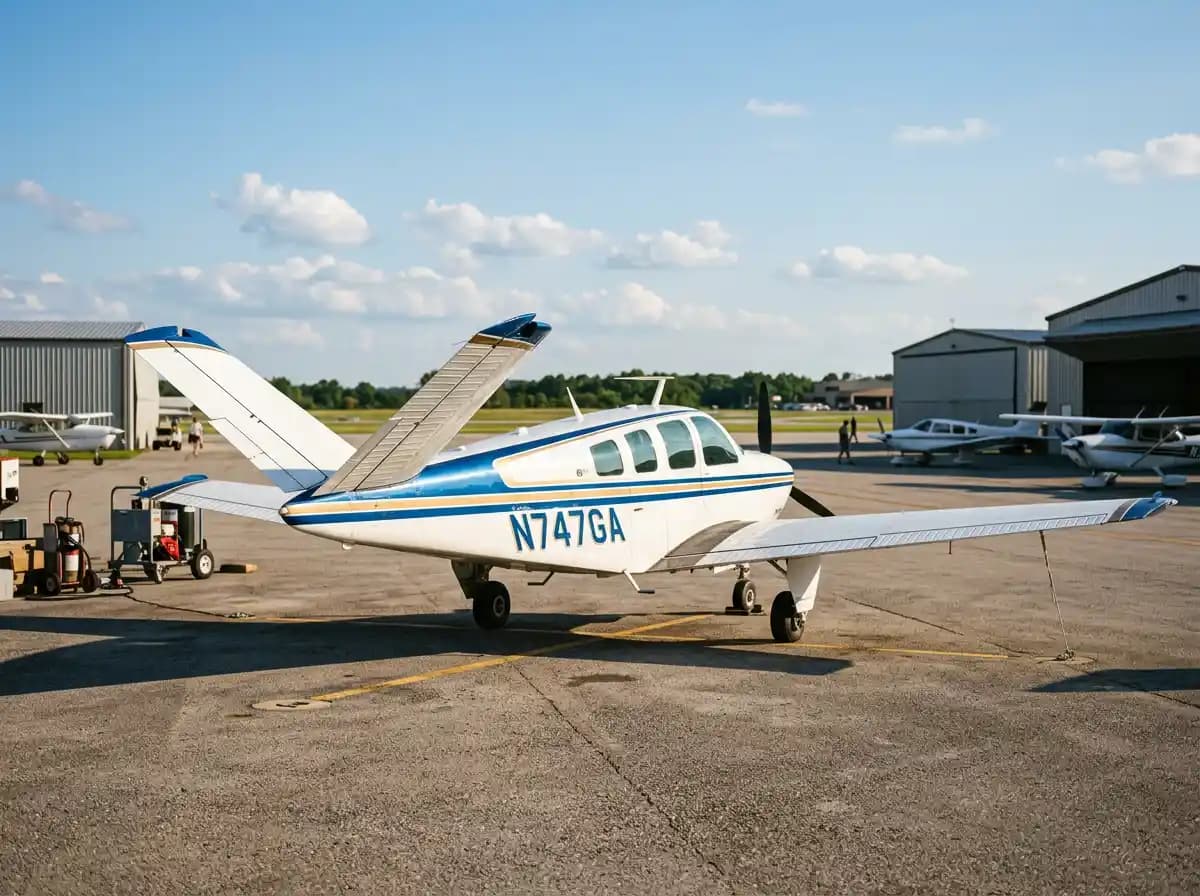
Beechcraft V-Tail Bonanza: Aircraft Overview and Heritage
The Beechcraft V-tail Bonanza first flew on December 22, 1945, and received its type certificate in 1947. Walter Beech and his engineering team designed the aircraft to push the boundaries of what a post-war general aviation aircraft could achieve, combining retractable landing gear, a low-wing cantilever structure, generous fuel capacity, and the aerodynamically unconventional V-tail configuration. The result was an aircraft that cruised faster than almost anything in its class and set a standard for personal transportation that held for decades.
Over its 35-year production run, Beechcraft refined the Bonanza through numerous model designations: upgrading engines, increasing gross weight, improving avionics integration, and progressively enhancing cabin comfort. Approximately 10,400 V-tail variants were produced before Beechcraft discontinued the configuration in 1982 in favour of the straight-tail Model 36. Today, several thousand examples remain on the FAA registry, supported by one of general aviation's most active owner communities through the American Bonanza Society.
A Design Ahead of Its Time
When the Bonanza was introduced in 1947, most personal aircraft were high-wing, fixed-gear designs with modest performance. The V-tail offered retractable gear, a low wing, and 165–170 mph cruise speed, capabilities that placed it firmly in the territory of aircraft costing far more. It entered the market at $8,945 and redefined what a production personal aircraft could do.
The Ruddervator: An Aerodynamic Experiment at Scale
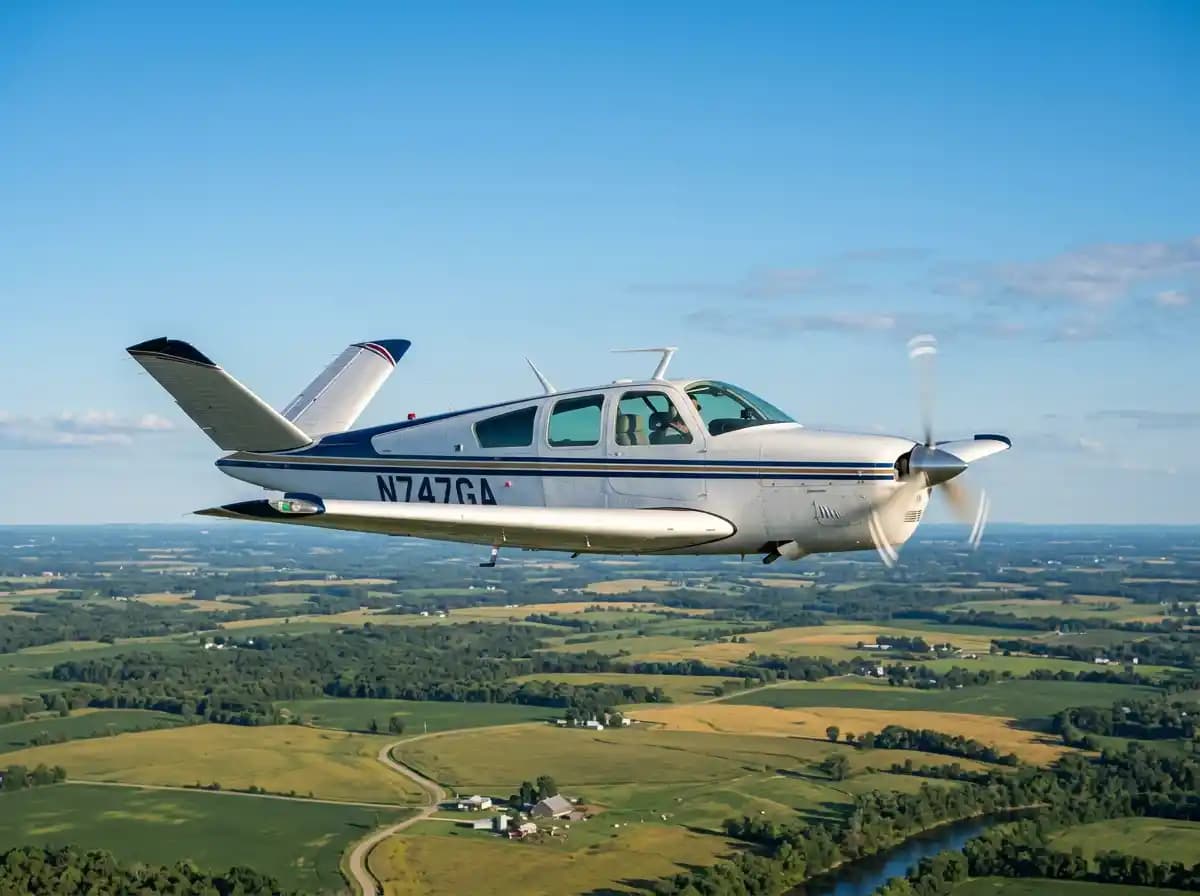
The V-tail's defining feature is the ruddervator, a combined control surface that acts as both rudder and elevator. Two surfaces set at approximately 33° from horizontal replace the conventional vertical fin, horizontal stabilizer, rudder, and elevator. A mechanical mixing unit translates pilot control inputs into the appropriate deflection patterns. The theoretical benefit: fewer surfaces, less wetted area, reduced parasitic drag. The practical outcome: modest efficiency gain at the cost of greater handling complexity.
Market Position Today
The V-tail Bonanza occupies a unique position. It is both a capable working aircraft and a collectible. It competes with the Piper Comanche, Cessna 182RG, Mooney M20 series, and the straight-tail Beechcraft Bonanza 36 in the high-performance single-engine piston market. The V-tail commands a small premium over comparable straight-tail models due to its aesthetics and collectability, though the Model 36 is preferred by mission-oriented buyers prioritizing load capacity and handling simplicity.
Looking for a Beechcraft Bonanza for sale?
Browse verified aircraft listings on CollectAirs with transparent auction terms, full documentation review, and escrow-protected transactions.
The V-Tail Design: How the Ruddervator System Works
The Beechcraft V-tail Bonanza's tail is its defining engineering feature. The two control surfaces: each set at approximately 33 degrees above the horizontal, are called ruddervators. A mechanical mixing box behind the cockpit translates elevator and rudder control inputs into the correct combination of symmetrical and differential surface deflections. When the pilot pushes forward (nose down), both ruddervators deflect upward together. When the pilot applies right rudder, the right ruddervator deflects downward and the left deflects upward. In combined pitch-and-yaw inputs, the mixing mechanism calculates the appropriate combination.
Aerodynamic Efficiency: Theory vs. Reality
The V-tail theoretically reduces wetted surface area compared to a conventional empennage, producing a small drag reduction. In practice, the efficiency gain is modest, estimated at 1–3% in cruise depending on configuration. The V-tail generates a noticeable Dutch roll tendency at low speeds and in turbulent conditions, which requires active damping through rudder input or, on later aircraft, yaw damper installation.
The Mixing Mechanism: Maintenance Priority
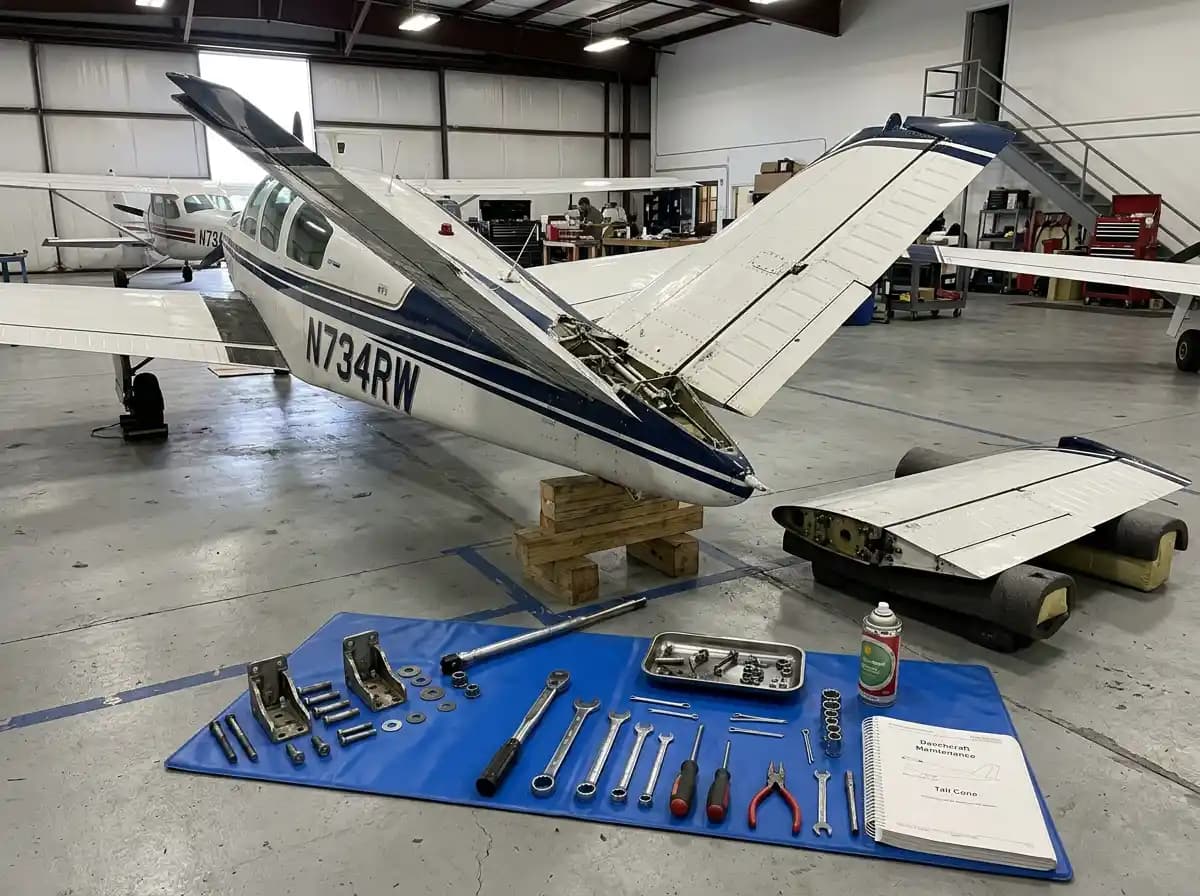
The mechanical mixing box and the ruddervator hinge system are the highest-priority maintenance items on the V-tail Bonanza. Hinge bolt wear, bearing condition, and mixing unit rigging affect both handling quality and structural integrity. FAA Airworthiness Directives addressing the ruddervator system have been issued multiple times. Inspection at every annual and any time a handling anomaly is observed is mandatory.
Dutch Roll and Handling Characteristics
The V-tail Bonanza has a mild Dutch roll tendency, a coupled rolling and yawing oscillation, that is more pronounced than in conventional-tail aircraft. In early models, pilots must actively damp this tendency with rudder inputs. Later V35B models can be equipped with a yaw damper STC that substantially improves ride quality and reduces pilot workload in turbulence. Any V-tail transition training program should include deliberate Dutch roll recognition and recovery practice.
Structural Integrity and Overstress
The V-tail's inflight structural failure history is documented. NTSB and FAA studies identified cases where the ruddervator system was subject to flutter or structural overload in severe turbulence, particularly when aircraft were flown at high speed in IMC. Beechcraft and the FAA addressed these through multiple ADs and service instructions. Current AD-compliant V-tail Bonanzas that are properly maintained and flown within limitations have a substantially better safety record than historical data implies.
Beechcraft V-Tail Bonanza Model Variants: 35 Through V35B
Beechcraft produced the V-tail Bonanza through numerous model designations over its 35-year run, with each variant bringing meaningful improvements in engine power, gross weight, avionics integration, and systems reliability. Understanding the variant you are evaluating is essential to setting accurate performance, maintenance, and value expectations.
Early Models: 35 / A35 / B35 / C35 (1947–1952)
Original Continental E-185 engine (185 HP), later upgraded to E-225 (225 HP). Fixed-pitch or controllable-pitch propeller. MTOW 2,550–2,650 lbs. These are the most affordable variants ($35,000–$60,000) but carry the highest maintenance exposure due to age, limited parts availability for early-specific components, and the longest AD accumulation period. Best suited for low-utilization owners who prioritize collectability over mission utility.
Mid-Generation: D35 Through N35 (1953–1963)
Transition to Continental O-470 and later IO-470 engines (230–260 HP). Introduction of swept tail, larger fuel capacity options, and improved interior configurations. Gross weight grew to 2,900–3,050 lbs. Performance improved meaningfully from early models. These are the most plentiful variants and represent good value at $55,000–$110,000 when logbooks are complete and engines are in good time.
Later Models: P35 / S35 / V35 (1963–1969)
Continental IO-520 engine (285 HP) introduced on S35 in 1964, a major performance step. MTOW grew to 3,300–3,400 lbs. Fuel capacity options expanded. Modern panel layouts became available. Used pricing for S35 and V35: $90,000–$150,000 depending on condition, engine time, and avionics. The IO-520's 1,700-hour TBO is a significant operational advantage over earlier engine types.
Final Variant: V35A / V35B (1966–1982)
The most desirable V-tail variants. Continental IO-520-BA (285 HP), MTOW 3,400 lbs, maximum 74-gallon fuel. Standardized on electric fuel pump, improved systems, and factory avionics packages. The V35B (1970–1982) is the last and most refined V-tail Bonanza, best engines, most modern systems, most extensive factory support documentation. Well-maintained V35B examples with complete logs and modern avionics command $130,000–$200,000.
Variant Selection Has Major Maintenance Implications
Early Model 35 variants have accumulated 75+ years of AD history. Parts availability for early Continental engine variants (E-185, E-225) is increasingly difficult. Unless you have specific reasons to prefer an early model, the IO- 520-equipped variants (S35 onward) offer substantially better parts support, higher performance, and a more active maintenance community.
Beechcraft V-Tail Bonanza Performance: Speed, Range and Fuel Burn
The Beechcraft V-tail Bonanza was designed for genuine cross-country speed in a single-engine package. The V35B achieves 168–180 KTAS at cruise: performance that competes with light twins of the same era and remains impressive by modern personal aircraft standards.
168–180 KTAS Cruise
At 65–75% power, 7,500–10,000 ft. Among the fastest normally aspirated piston singles produced.
850–1,050 NM Range
With 74-gallon standard fuel; economy cruise extends range further. Genuine IFR cross-country capability.
13–16 GPH Fuel Burn
At 65–75% power. Higher than lighter singles; reasonable for performance class. Economy cruise reduces to ~12 GPH.
Single-Engine Reliability Profile
The V-tail Bonanza is a single-engine aircraft. Its performance advantage over twins is operational simplicity and significantly lower ownership cost. The Continental IO-520-BA is a proven, well-supported engine with an extensive parts network and a deep pool of experienced overhaul shops. Engine reliability, however, depends entirely on maintenance quality, oil analysis history, compression trends, and overhaul shop credentials should be examined carefully during pre-purchase.
Altitude and IFR Utility
The V35B's 17,858-ft service ceiling is adequate for most IFR routing in the continental United States. In mountainous terrain (Rockies, Sierra Nevada), pilots may find the normally aspirated ceiling limiting on westbound routes with standard ISA conditions. A yaw damper STC significantly improves IFR ride quality and reduces turbulence-related workload. Buyers planning frequent Rocky Mountain or high-altitude operations should factor this into their variant and equipment selection.
V-Tail Bonanza Ownership Costs and Operating Economics
The V-tail Bonanza offers strong performance at a single-engine operating cost: significantly less expensive to run than a twin with comparable speed. Buyers should budget for engine-overhaul reserves, recurring AD compliance, and the higher-than-average annual inspection cost that comes with a complex retractable-gear aircraft.
V35B Annual Cost Structure (150 hours)
- Fuel (150 hrs × 14 GPH × $6.50/gal): ~$13,650
- Engine overhaul reserve (IO-520-BA, $38K overhaul ÷ 1,700 TBO × 150 hrs): ~$3,353
- Annual inspection: $2,500–$6,000 (condition dependent)
- Unscheduled maintenance and recurring ADs: $3,000–$8,000/yr
- Insurance (hull $150K + liability): $3,500–$7,000/yr
- Hangar: $3,600–$9,600/yr (regional variation)
- Avionics database subscriptions: $800–$1,500/yr
- Total annual: ~$30,000–$49,000 at 150 hours
- Total loaded hourly cost: ~$200–$326/hr
Engine Overhaul: Plan Before You Buy
Continental IO-520-BA overhaul costs $30,000–$45,000 at a reputable shop. Buyers should assess time since major overhaul (SMOH) and calculate the overhaul cost exposure remaining. An aircraft with 1,400 hours SMOH on a 1,700-hour TBO carries approximately $26,000–$35,000 in near-term overhaul exposure. This must be reflected in the purchase price. Engines overhauled by recognized shops (Continental Motors, Penn Yan Aero, Mattituck Aviation) carry more confidence than field overhauls.
Maintenance, AD Compliance, and the V-Tail Safety Record
The Beechcraft V-tail Bonanza has a complex maintenance profile driven by its age, its unique ruddervator system, and the accumulated regulatory response to its accident history. Understanding this complexity is essential for prospective buyers.
Ruddervator System ADs
Multiple FAA Airworthiness Directives address the ruddervator system, with the hinge bolt and bearing inspection being the most critical recurring item. Flutter events in the ruddervator system contributed to several fatal inflight structural failures. Current ADs require regular dimensional inspection of hinge hardware and replacement at specified intervals. Any aircraft with undocumented or non-compliant ruddervator ADs is unairworthy, verify carefully.
Wing Spar Corrosion Inspection
The V-tail Bonanza wing spar is subject to corrosion ADs that require periodic inspection and, in some cases, replacement of corroded sections. This is a significant cost item when triggered, spar repair or replacement can reach $15,000–$40,000 depending on severity. Aircraft operated in coastal or humid environments, or stored outdoors, are at elevated risk. Full spar inspection documentation should be requested as part of any pre-purchase due diligence.
Fuel Bladder Tank Condition
Many V-tail Bonanzas use fuel bladder tanks that deteriorate with age. Cracked or deteriorating bladders cause fuel contamination, leaks, and potential fire hazard. Bladder replacement costs $4,000–$8,000 per tank. Ask for the most recent fuel bladder inspection or replacement records. Aircraft with original bladders from the 1970s or early 1980s should be considered near-term bladder replacement candidates.
Landing Gear System
The retractable gear system on the V-tail Bonanza uses an electric actuator and mechanical linkage. Gear actuator wear, door seal condition, micro-switch calibration, and emergency gear extension mechanism are all recurring inspection items. Gear failures or uncommanded retraction events are rare on well-maintained aircraft but have occurred on poorly maintained examples. A thorough gear rigging check is part of any competent pre-purchase inspection.
The Safety Record in Context
The V-tail Bonanza earned the nickname 'doctor killer' in aviation circles, a reference to its pilot demographic (successful professionals flying demanding IFR missions) as much as the aircraft's characteristics. NTSB data showed the V-tail had a higher inflight structural failure rate than comparable aircraft, primarily associated with overstress in severe turbulence. Modern AD compliance, yaw damper installation, and proper pilot training substantially reduce this risk. The American Bonanza Society's safety program has demonstrably improved the fleet's accident rate over the past three decades.
Buying a Beechcraft V-Tail Bonanza: Due Diligence Checklist
Purchasing a V-tail Bonanza demands more careful due diligence than most comparable singles. The aircraft's age, the ruddervator system's AD history, and the consequences of deferred maintenance in a high-performance retractable make thorough pre-purchase inspection non-negotiable. CollectAirs coordinates the following verification steps for all high-performance single transactions.
Documentation & Records
- Complete, unbroken logbooks from original delivery or earliest available date. Logbook gaps on V-tail Bonanzas, common on aircraft with multiple ownership changes, reduce value by 20–35% and complicate insurance.
- Full AD compliance documentation for the specific airframe serial number, engine serial number, and installed propeller. Cross-reference against the current FAA AD list for Beechcraft 35-series aircraft.
- Engine time since major overhaul (SMOH) with overhaul shop records. Verify the overhaul shop's reputation, factory or recognized independent shops provide more confidence than field overhauls.
- 337 forms and STCs documenting all modifications: avionics, yaw damper, fuel bladder upgrades, engine modifications, and any structural repairs.
- Aviation title search to confirm no liens, judgements, or accidents in the aircraft's ownership history.
Technical Inspection Priorities
- Ruddervator system inspection by a Beechcraft 35-series experienced mechanic: hinge bolt dimensions, bearing condition, mixing unit rigging, and surface travel range.
- Wing spar corrosion inspection per the applicable AD, document inspection results and any previous repair history.
- Engine compression test: all cylinders within acceptable range. Oil analysis history review for metal content trends.
- Fuel bladder condition: visual inspection of accessible areas, fuel sample clarity, and documentation of last bladder service.
- Retractable gear system: actuator function, door alignment, micro-switch calibration, and emergency extension test.
- Avionics functionality: all systems tested including autopilot coupling, GPS functionality, ADS-B Out compliance verification.
- Airframe corrosion: fuselage belly, wing root areas, control surface hinges, and all inspection panel areas.
Transaction Protection
- Use escrow for all funds and title transfer, protects both parties and ensures conditional purchase terms are honored.
- Make the purchase conditional on a satisfactory pre-purchase inspection with clearly defined deal-breaker criteria agreed in writing before the inspection.
- Confirm insurance availability and rate before closing. V-tail Bonanzas may carry higher premiums due to the type's historical safety record, verify with your aviation insurer.
- Establish a maintenance relationship with a Beechcraft-experienced shop in your home airport region before taking delivery.
- Enroll in the American Bonanza Society, their technical resources, maintenance clinics, and pilot safety programs are among the best in general aviation for this type.
Beechcraft V-Tail Bonanza Specifications: Complete Data Table
| Specification | Value | Why It Matters |
|---|---|---|
| Engine (V35B) | Continental IO-520-BA (285 HP) | Fuel-injected, normally aspirated; TBO 1,700 hours; factory overhaul $30,000–$45,000; field overhaul $28,000–$38,000 |
| Engines (early models) | Continental E-185 / E-225 / O-470 / IO-470 | Progressive upgrades across model variants; TBO 1,200–1,500 hours depending on engine type; parts availability increasingly limited for earliest variants |
| Cruise Speed (V35B) | 168–180 KTAS at 65–75% power | One of the fastest single-engine piston aircraft at its introduction; T-tail and turbocharged variants achieve 185+ KTAS |
| Range (V35B) | 850–1,050 NM with aux fuel | Standard 74-gallon usable configuration; NBAA IFR reserves; approximately 550–650 NM with standard tanks only |
| Fuel Burn (V35B) | 13–16 GPH at 65–75% power | Higher burn than lighter piston singles; economy cruise (55% power) reduces to ~12–13 GPH and extends range significantly |
| Service Ceiling | 17,858 ft (V35B) | Normally aspirated; practical cruise altitude 8,000–12,000 ft; turbocharged variants (not V-tail) reach FL250 |
| MTOW (V35B) | 3,400 lbs (1,542 kg) | Increased from 2,550 lbs on 1947 Model 35; growing MTOW across variants reflects progressive structural upgrades |
| Useful Load (V35B) | ~1,100–1,300 lbs (config dependent) | Full-fuel payload with 74 gallons (~444 lbs) leaves roughly 650–850 lbs for occupants and baggage |
| Ruddervator Dihedral | 33° from horizontal (each surface) | Butterfly V-tail configuration; surfaces combine elevator and rudder function via mixing mechanism; unique to Model 35 series |
| Seating | 4–5 (standard); 6 in some configurations | Typical: 2 crew forward, 2 rear passengers; some aircraft with optional rear bench; cabin width 42 inches |
| Production Run | 1947–1982 (~10,400 V-tail variants) | Models 35 through V35B; straight-tail Model 33 introduced 1960, Model 36 introduced 1968; V-tail discontinued 1982 |
| FAA Registry (V-tail) | ~5,500–6,500 active registrations | Large, active fleet with strong community support through American Bonanza Society (ABS) |
| Used Price Range | $40,000–$200,000 | Early models from $40K; V35B with mid-time IO-520 and modern avionics: $130K–$200K; logbook quality is the primary value lever |
| Takeoff Distance (V35B) | ~1,290 ft ground roll (SL, ISA, MTOW) | Over 50 ft obstacle: ~1,800 ft; short-field performance is good for a retractable single of this performance class |
Looking for a Beechcraft Bonanza for Sale?
CollectAirs lists verified Beechcraft aircraft with complete documentation review, escrow-protected transactions, pre-purchase inspection coordination, and transparent auction terms on every deal.
Frequently Asked Questions: Beechcraft V-Tail Bonanza
Are V-tail Bonanzas hard to fly?
The Beechcraft V-tail Bonanza is not inherently difficult to fly, but it requires deliberate type-specific training. The ruddervator system produces slightly different handling characteristics than conventional tails, particularly in Dutch roll tendencies and crosswind correction technique. Most pilots with a solid instrument foundation transition without difficulty. The 'hard to fly' reputation is largely rooted in the aircraft being flown by high-achieving but sometimes over-confident pilots in challenging IFR conditions. Type-specific transition training is strongly recommended for all new V-tail owners.
How many V-tail Bonanzas are still flying?
Approximately 5,500–6,500 Beechcraft V-tail Bonanzas remain on the FAA civil aircraft registry. Out of approximately 10,400 V-tail variants produced between 1947 and 1982, a significant proportion remain airworthy, a testament to the aircraft's robust construction and the depth of owner community support through organizations like the American Bonanza Society (ABS).
How much does a V-tail Bonanza cost?
A used V-tail Bonanza typically costs $40,000–$200,000. Early Model 35 variants start around $35,000–$60,000. Mid-generation models (C35–N35) in good condition range from $55,000–$110,000. Late-model V35B examples with mid-time Continental IO-520 engines, modern avionics, and complete logbooks command $130,000–$200,000. Logbook completeness, AD compliance, and engine program enrollment are the key value drivers.
Why don't more planes use V-tails?
V-tail designs offer theoretical drag reduction, fewer surfaces mean less wetted area, but introduce engineering and handling complexity that conventional tails avoid. The ruddervator mixing mechanism adds mechanical complexity and cross-coupling between pitch and yaw control. V-tails also produce Dutch roll tendencies in certain flight regimes. Most manufacturers concluded the marginal efficiency gains did not justify the added complexity. Beechcraft itself discontinued the V-tail in 1982, and the Bonanza V-tail remains the most prominent production aircraft to use the configuration in large numbers.
What is the difference between the V-tail Bonanza and the straight-tail Bonanza?
The primary structural difference is the tail. The V-tail (Model 35 series) uses two surfaces set at ~33° from horizontal, combining rudder and elevator function into 'ruddervators.' The straight-tail Bonanza (Models 33 and 36) uses a conventional vertical and horizontal stabilizer arrangement. The Model 36 also has a longer fuselage, larger cabin with double rear doors, and six seats. In performance, the V35B and A36 are broadly comparable. The straight-tail models have a cleaner inflight structural failure record; the V-tail is the more collectible and recognizable variant.
What are the main AD compliance concerns on a V-tail Bonanza?
Key recurring ADs address ruddervator hinge bolt and bearing inspection (critical, ruddervator flutter events contributed to several fatal accidents), wing spar corrosion inspection, main landing gear actuator system, fuel bladder tank condition, and Continental engine crankcase and cylinder base studs. AD compliance documentation must be complete and current for the specific serial number and engine. Any pre-purchase inspection should include a focused ruddervator system evaluation by a Beechcraft 35-series experienced mechanic.
Sources
Used for: certified performance data, weight limitations, approved engine configurations, and model-specific specifications for all Beechcraft 35-series V-tail variants.
Used for: type-specific maintenance guidance, AD tracking resources, owner safety programs, and real-world operational data across the V-tail Bonanza fleet.
Used for: engine power ratings, TBO intervals, fuel injection system specifications, and overhaul cost benchmarks for the Continental IO-520-BA engine.
Used for: historical accident data, inflight structural failure analysis, and NTSB safety recommendations addressing the V-tail Bonanza's accident record.
Related Resources
Beechcraft Twin Bonanza Guide
The twin-engine evolution: supercharged Lycoming engines, performance data, ownership costs, and buyer checklist.
Read GuideBeechcraft King Air Guide
The turboprop step-up from the Bonanza family, PT6 power, pressurized cabin, and ownership costs.
Read GuidePlanes for Sale Guide
How to find the right aircraft, evaluate listings, and close without expensive surprises.
Read GuideAdditional Services
Pre-purchase inspection coordination, aviation insurance, title search, escrow, and ferry pilot services.
Explore ServicesAbout the Author

Phillip Müller
CEO, CollectAirs
Long-time pilot and CEO of multiple scenic flight and aircraft sales websites. Passionate about making aircraft transactions more transparent and accessible.
Connect on LinkedIn