
 Florida
 Hildesheim
Cessna 206 vs Cessna 210: Overview and Design Philosophy
The Cessna 206 Stationair was designed from the outset as a utility transport, Cessna's answer to the need for a rugged, high-payload, go-anywhere six-seat single. First certified in 1964, the 206 evolved steadily through multiple Continental engine variants and avionics generations while retaining its core identity: fixed gear, large cargo door, and maximum useful load in a high-wing platform. It remains in production today as the Cessna Turbo Stationair HD: a rare distinction among piston singles.
The Cessna 210 Centurion was designed for performance, a six-seat high-performance single optimized for speed and cross-country range. First certified in 1960, the 210 introduced retractable gear to the Cessna high-wing family, progressively adding turbocharging, pressurization (P210), and cantilever wing construction. Production ended in 1986 during the general aviation liability crisis and has never resumed.
Cessna 206: Utility First
- Fixed tricycle gear, lower maintenance cost and complexity
- Large rear right-side cargo door: utility and medevac operations
- Highest useful load in the six-seat Cessna piston family
- Float and ski conversion compatible airframe
- Current production: new Turbo Stationair HD available
- Ideal mission: bush flying, cargo, medevac, skydiving, patrol
Cessna 210: Performance First
- Retractable tricycle gear: 25–30 KTAS faster than the 206
- Cantilever wing (no wing strut): aerodynamically clean
- Turbocharged T210: 175–185 KTAS at altitude
- Pressurized P210 variant for high-altitude operations
- Discontinued 1986: used market only, parts tightening
- Ideal mission: cross-country transport, IFR, time-sensitive missions
Cessna 206 and 210 listings on CollectAirs
Browse verified Cessna listings with full documentation and transparent auction terms.
Performance Comparison: Speed, Range, and Altitude
The performance gap between the Cessna 206 and Cessna 210 is primarily a function of gear drag. The 210's retractable gear eliminates approximately 25–30 KTAS of cruise drag relative to the 206 with equivalent engine power. For turbocharged variants, this gap widens: the T210 Centurion accesses altitude where true airspeed increases significantly, while the T206 and NA 206 share a similar cruise altitude ceiling around 15,000–17,000 ft.
The Turbocharged Variant Factor
Both the 206 and 210 are available in turbocharged variants: the T206 Stationair and the T210/P210 Centurion. The turbocharged 210's combination of retractable gear and turbocharging produces a cumulative performance advantage that is substantially larger than either factor alone. A turbocharged 210 at FL200 cruise delivers approximately 175–185 KTAS, roughly 30–40 KTAS faster than a turbocharged 206 at the same altitude. If speed is the primary purchase driver, the turbocharged 210 should be the benchmark comparison, not the naturally-aspirated 206.
206: ~148–155 KTAS
Naturally-aspirated cruise at 8,000–10,000 ft. Turbocharged T206 adds altitude but not meaningfully more speed, the fixed gear remains the limiting factor.
210: ~165–185 KTAS
Naturally-aspirated 210 at 165 KTAS; turbocharged T210 reaches 175–185 KTAS at altitude. Pressurized P210 adds altitude for further true airspeed gains.
Range: Both ~750–1,000 NM
Similar IFR range on comparable fuel loads; 210 covers distance faster but doesn't offer dramatically longer range than the 206 in absolute nautical miles.

Continental Engines: Maintenance, TBO, and Overhaul Costs
Both the Cessna 206 and Cessna 210 are powered by variants of the Continental IO-520 and IO-550 engine family: among the most widely used and best-supported piston aircraft engines in the world. Engine condition is the single most important variable in any used 206 or 210 acquisition, and overhaul timing must be budgeted carefully from first purchase.
Cessna 206 Engine Options
- IO-520-F: 300 hp; 1964–1986 production; 1,700-hour TBO; most common in early 206 fleet
- IO-550-F: 310 hp; 1998+ current production; 2,000-hour TBO; fuel-injected; improved reliability over IO-520
- TSIO-550-C (T206H): 310 hp turbocharged; current Turbo Stationair HD; 1,600-hour TBO; FADEC option available
- Overhaul cost: $25,000–$40,000 at a qualified shop; major vs. field overhaul scope distinction important for valuation
Cessna 210 Engine Options
- IO-520-L: 285 hp; early 210 models; 1,700-hour TBO; naturally aspirated
- IO-550-L: 310 hp; later 210R models; 2,000-hour TBO; improved over IO-520-L
- TSIO-520-R/CE (T210): 285–325 hp turbocharged; T210 Centurion; 1,400–1,600 hour TBO; requires intercooler maintenance
- Overhaul cost: $28,000–$45,000 for naturally aspirated; $35,000–$55,000+ for turbocharged TSIO variants due to intercooler and turbo work
Time Since Overhaul (TSOH): The Most Important Purchase Variable
On both the 206 and 210, engine time since overhaul is the primary financial variable in acquisition. A Continental IO-520 or IO-550 approaching TBO represents $25,000–$45,000 in near-term expense. Buyers should calculate remaining TBO hours and pro-rate overhaul cost into offer pricing accordingly. A high-time engine at or beyond TBO should negotiate a full overhaul cost deduction. Major factory overhaul by a Continental-authorized shop is strongly preferred over field overhaul for both value retention and insurance purposes.
Useful Load, Cabin, and the Cargo Door Advantage
The Cessna 206 wins decisively on useful load: typically carrying 150–250 lbs more than a comparable 210 with equivalent fuel. This translates directly into real-world mission capability: a full-fuel 206 can typically accommodate four occupants with luggage, while a full-fuel 210 at equivalent configuration often reaches its weight limit with fewer passengers.
Cessna 206 Useful Load: ~1,500–1,600 lbs
Fixed gear saves the weight that retractable gear hardware adds to the 210. With full fuel (~92 gallons, ~552 lbs), a 206 typically leaves 950–1,000 lbs for passengers and baggage, enough for four adults with luggage or significant cargo payload.
Cessna 210 Useful Load: ~1,250–1,350 lbs
Retractable gear hardware adds weight that reduces the 210's payload advantage vs. the 206. With full fuel (~89 gallons, ~534 lbs), a 210 leaves approximately 750–800 lbs for passengers and baggage, enough for three adults with luggage in practical operations.
The 206 Cargo Door
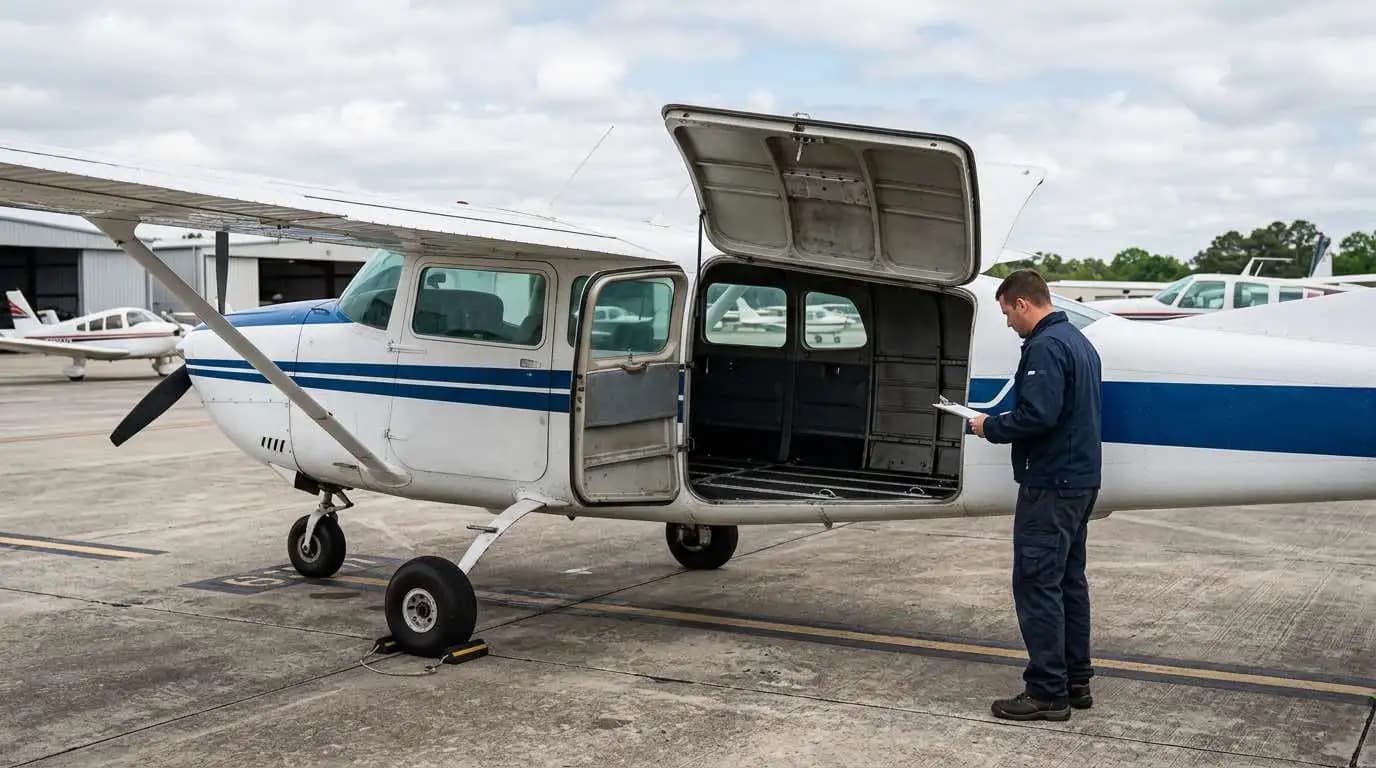
The 206's large right-rear cargo door is a fundamental operational differentiator. It enables loading of cargo, medical stretchers, equipment, and animals that cannot be loaded through a standard cabin door. No variant of the 210 offers this feature. For operators requiring this capability, the 210 is simply not a practical alternative.
Float and Bush Operations
The 206's fixed gear makes it the dominant choice for float conversion, retractable gear and float installations are incompatible. For remote strip and unpaved surface operations, the 206's simpler gear system eliminates gear-related risk in environments where hydraulic seals may be challenged by dirt, gravel, and temperature extremes.
Avionics, Equipment, and Production Generation
Avionics capability in both the Cessna 206 and 210 varies enormously by year and prior owner investment. Used aircraft from the 1970s and 1980s may retain legacy analog panels, while later examples, particularly post-1998 206 production and 210s with prior avionics upgrades, can feature full Garmin G1000 or equivalent glass cockpit installations. Avionics generation is a significant value differentiator in both used markets.
Cessna 206, Current Production (2004+): Garmin G1000 NXi
Current Cessna Turbo Stationair HD includes Garmin G1000 NXi with synthetic vision, GFC 700 autopilot, WAAS/LPV approach capability, and ADS-B In/Out as standard. New production 206 avionics represent the most capable standard avionics of any aircraft in this comparison.
Cessna 210: Used Market Avionics Variation
210 avionics vary entirely by prior owner investment. Early 1960s–1980s aircraft may have legacy King or Narco analog equipment. Many owners have retrofitted Garmin G530/G430 GPS, GTN 750/650, or full G1000 NXi installations via STC. Avionics fit is a major used 210 value driver and must be evaluated individually per aircraft.
ADS-B Compliance
ADS-B Out compliance (required since January 2020 for Class B/C airspace) must be verified on all used aircraft. Earlier 206 and 210 examples may have received STC modifications for ADS-B compliance. Verify compliance documentation at pre-purchase inspection, non-compliant aircraft are grounded for most practical operations.
Autopilot Investment
An autopilot significantly improves single-pilot IFR safety and utility in both aircraft. On the 210, autopilot is particularly valuable given its higher cruise speed and IFR mission profile. On older aircraft, budget $15,000–$35,000 for a modern WAAS-capable autopilot installation if not already present.

Ownership Costs: Cessna 206 vs Cessna 210
The Cessna 206 carries lower annual ownership costs than the Cessna 210 in most categories, the primary driver being annual inspection complexity and the absence of retractable gear maintenance. For operators logging 150–250 hours annually, the 206's total operating cost advantage over a comparable 210 typically amounts to $3,000–$8,000 per year, widening significantly when retractable gear actuator or hydraulic system events occur on the 210.
Acquisition Cost
Cessna 206: $70,000–$350,000 depending on year, engine time, and avionics. Cessna 210: $60,000–$250,000 with turbocharged T210 examples commanding the highest premiums. Both markets are relatively liquid with consistent buyer familiarity.
Annual Inspection
Cessna 206: $2,500–$5,500 annually. Cessna 210: $3,500–$7,000 annually. The 210's retractable gear inspection, hydraulic system check, and gear actuator service add meaningful scope to every annual inspection relative to the simpler fixed-gear 206.
Engine Overhaul Reserve
Both aircraft: $15–$22 per flight hour reserve depending on variant. At 150 annual hours: $2,250–$3,300 annually in overhaul reserve for naturally-aspirated variants. Turbocharged engine variants warrant higher reserves ($20–$28/hour) due to intercooler, turbocharger, and higher-temperature operating conditions.
Retractable Gear System (210 Only)
The 210's retractable gear system requires periodic hydraulic fluid changes, actuator seal inspection, gear door alignment checks, and periodic retraction cycle testing. Budget $800–$2,500 annually for gear system maintenance beyond the standard annual inspection. Major gear actuator replacement: $1,500–$4,000 per actuator.
Fuel Cost
Cessna 206: ~14–16 GPH of 100LL at cruise. Cessna 210: ~14–16 GPH naturally aspirated; 16–20 GPH for turbocharged T210 variants. At $6.00–$8.00/gallon and 150 annual hours: approximately $12,600–$24,000 annually depending on variant and local pricing.
Insurance
Both aircraft: $2,500–$6,000 annually depending on hull value, pilot qualifications, and liability limits. High-performance endorsement required for both. Retractable gear pilots face additional underwriter scrutiny and minimum gear retraction experience requirements on the 210.
Pre-Purchase Checklist: Cessna 206 and Cessna 210
Due diligence on either a Cessna 206 or Cessna 210 purchase follows the same core structure. The 210 adds retractable gear system inspection as a mandatory additional scope item. Both aircraft warrant pre-purchase inspection by an IA with proven Continental engine and Cessna high-wing type experience.
Documentation and Records (Both Aircraft)
- Complete airframe and engine logbooks from first flight with no maintenance history gaps, missing logbooks are a disqualifying condition unless priced to reflect the documentation loss
- Engine TSN (time since new) and TSOH (time since last overhaul) with complete shop work order documentation; confirm major vs. field overhaul scope
- Full AD compliance documentation for airframe, Continental engine, and all installed avionics, both the 206 and 210 type have accumulated significant AD histories
- ADS-B Out compliance certification confirming current airspace compliance; required for Class B/C/E above 10,000 ft operations
- Avionics equipment list and STC documentation for all non-standard installations, GPS, autopilot, and glass cockpit retrofits require current STC and supplemental records
- FAA Aircraft Registry title search confirming clean title, no liens, and no accident history entries, check NTSB accident database independently
Technical Inspection Priorities
- Continental IO-520/IO-550 engine: compression test (all cylinders, 72/80 minimum), oil analysis, borescope inspection of combustion chambers and valve faces, establish baseline for current engine condition
- Magneto timing and operation; fuel injection system condition; induction system inspection for air leaks and crack indications
- Airframe corrosion inspection: control cables, wing attach fittings, rudder and elevator control surface hinges, and flap actuator condition
- For the Cessna 210: retractable gear system retraction test, hydraulic fluid condition, actuator seal condition, gear door alignment, and gear position indicator system function
- For the Cessna 206: cargo door hinge, seal, and locking mechanism condition; float attach fitting inspection if float-equipped or float conversion intended
- Avionics: autopilot coupled approach test, GPS WAAS function, transponder Mode C accuracy, ELT compliance and battery freshness
- Fuel system: tank inspection for water contamination, cap seal condition, gascolator element condition, and fuel quantity system accuracy at known fuel loads
Transaction Risk Management
- Use an aviation escrow service for all funds, essential for any aircraft acquisition to protect buyer and seller funds during the inspection and closing process
- Contract inspection with an IA who has documented experience with the specific model and Continental engine type, generic IA shops may lack type-specific knowledge
- Obtain pilot insurance quotes before closing: both aircraft require high-performance endorsement; retractable gear 210 buyers face additional underwriter requirements
- For the Cessna 210: budget explicitly for the first retractable gear inspection after purchase, establish gear system baseline condition before relying on it operationally

Cessna 206 vs Cessna 210: Which One Is Right for Your Mission
The choice between the Cessna 206 and Cessna 210 ultimately reduces to mission priority. Neither aircraft is objectively superior. They are optimized for different operational identities.
Choose the Cessna 206 if:
- You need maximum useful load: full fuel with multiple adults and luggage
- You operate from unpaved, short, or remote strips where gear simplicity matters
- You require or want float conversion capability
- You perform cargo, medevac, or utility operations requiring the cargo door
- You prefer lower annual maintenance costs and simpler systems
- You want the option of a new production aircraft (Turbo Stationair HD)
- Block time is less critical than payload and operational flexibility
Choose the Cessna 210 if:
- Speed and block time are your primary mission requirements
- You fly long cross-country sectors where 30 KTAS matters over 3+ hours
- You need turbocharged altitude access for weather avoidance or mountain flying
- You carry 3 or fewer passengers with light luggage regularly
- You are comfortable with retractable gear procedures and their maintenance implications
- Budget for acquisition is lower, comparable 210s trade at modest discounts to equivalent 206s
- The pressurized P210 variant is required for specific high-altitude mission profiles
Cessna 206 vs Cessna 210: Comparison Table
| Specification | Cessna 206 | Cessna 210 | Why It Matters |
|---|---|---|---|
| Landing Gear | Fixed tricycle | Retractable tricycle | Defines the maintenance profile and operational character of each aircraft; 210 gear adds speed but also complexity, cost, and a failure mode |
| Engine (primary) | Continental IO-520-F / IO-550-F, 300–310 hp | Continental IO-520-L / IO-550-L / TSIO-520, 285–325 hp | Both use Continental IO-520/IO-550 family; 210 turbocharged variants (T210) deliver meaningfully higher cruise altitude and speed |
| Max Cruise Speed | ~148–155 KTAS (naturally aspirated) | ~165–185 KTAS (NA / turbocharged at altitude) | Retractable gear and streamlined airframe give the 210 a 25–30 KTAS cruise advantage; turbocharged T210 widens the gap at higher altitudes |
| Service Ceiling | ~15,700 ft (NA) / ~27,000 ft (T206) | ~17,300 ft (NA) / ~25,000+ ft (T210/P210) | Turbocharged variants of both aircraft access altitude-related weather avoidance; turbocharged 210 variants are generally more numerous in the used market |
| Useful Load | ~1,500–1,600 lbs (varies by config) | ~1,250–1,350 lbs (varies by config) | 206 wins decisively on payload; can carry full fuel with 4–5 occupants and luggage; 210's retractable gear hardware reduces payload capacity vs. 206 |
| Passenger Capacity | 6 seats (pilot + 5) | 6 seats (pilot + 5) | Both are certified for 6 occupants; the 206 more practically achieves full utilization due to higher useful load; 210 requires careful weight and balance at full complement |
| Cargo Door | Large right-rear cargo door standard | No cargo door | 206 cargo door enables loading of large items, cargo, and medical equipment; a defining operational advantage for utility, freight, and medevac operators |
| Annual Inspection Cost | $2,500–$5,500 | $3,500–$7,000 | 210's retractable gear system adds inspection scope; gear actuators, hydraulics, and retraction mechanism add recurring maintenance items not present on the 206 |
| Current Production | Yes: Cessna Turbo Stationair HD (current) | No: last produced 1986 | 206 buyers can acquire new production aircraft; 210 buyers are exclusively in the used market with tightening availability for some model-specific components |
| Typical Used Market Price | $70,000–$350,000 depending on year and config | $60,000–$250,000 depending on year and config | Comparable used pricing given different value drivers; newer 206 examples command premiums for current production support; T210/P210 turbocharged variants trade higher |
Cessna 206 and 210 on CollectAirs
Browse verified Cessna 206 and Cessna 210 listings with full documentation and transparent auction terms. CollectAirs connects qualified buyers with thoroughly vetted aircraft, with escrow protection, pre-purchase inspection coordination, engine condition verification, and title confirmation on every transaction.
Frequently Asked Questions: Cessna 206 vs Cessna 210
What is the difference between the Cessna 206 and Cessna 210?
The primary difference is landing gear: the 206 uses fixed tricycle gear and the 210 uses retractable gear. The 206 (Stationair) prioritizes utility, large cargo door, higher useful load, lower maintenance complexity, and suitability for bush and float operations. The 210 (Centurion) prioritizes performance, retractable gear adds 25–30 KTAS cruise speed and turbocharged variants reach 175–185 KTAS at altitude.
Why did Cessna stop making the 210?
Cessna discontinued the 210 in 1986 due to the product liability crisis that made piston aircraft production economically unviable. When GARA (1994) restored liability protection, Cessna resumed the 172, 182, and 206 but chose not to restart the 210. The 206 continues in current production as the Turbo Stationair HD; the 210 is exclusively a used-market aircraft.
What are the disadvantages of a Cessna 206?
The 206's fixed gear limits cruise speed to ~145–155 KTAS, meaningfully slower than the 210. For cross-country transport where block time matters, the 206's drag penalty produces longer flights. The 206's strengths, high useful load, cargo door, float adaptability, are irrelevant for operators whose primary need is speed over long sectors.
What are the disadvantages of a Cessna 210?
The 210's retractable gear adds maintenance cost, actuator inspections, hydraulic system complexity, and gear-related incident risk. Annual inspection costs run higher than the 206. The 210 also carries lower useful load than the 206, gear hardware adds weight. As a discontinued model (last production 1986), parts availability for 210-specific components is tightening.
Is a Cessna 206 high-performance?
Yes. The 206's Continental IO-520-F (300 hp) meets the FAA's high-performance aircraft definition (over 200 hp), requiring a logbook endorsement. It also qualifies as complex due to its constant-speed propeller. However, the 206's 300+ hp produces strong useful load and climb rather than high cruise speed.
Which is better for cross-country flying, the Cessna 206 or 210?
For speed-focused cross-country missions, the 210 wins: 25–30 KTAS faster, with turbocharged variants pushing 175–185 KTAS at altitude. For high-payload cross-country missions, multiple passengers with luggage, the 206 wins on useful load (~1,500 lbs vs. ~1,300 lbs). Most decisions reduce to whether block time or payload capacity is the higher priority for a specific mission profile.
Sources
Used for: Cessna 206 certification reference, engine configuration approvals, and type certificate performance data.
Used for: Cessna 210 certification reference, engine and gear configuration approvals, and type certificate performance data.
Used for: current production Cessna Turbo Stationair HD performance specifications, G1000 NXi avionics integration, and factory pricing reference.
Used for: IO-520-F, IO-550-F, and TSIO-520 engine specifications, TBO standards, and overhaul cost reference data.
Used for: context on Cessna 210 production discontinuation in 1986 and the liability crisis that affected general aviation production decisions.
Related Resources
Cessna 172 Skyhawk Guide
Performance specs, useful load, avionics upgrades, AD compliance, maintenance costs, and what to check before buying.
Read GuideCessna 182 Skylane Guide
Performance, useful load, avionics, AD compliance, and what to verify before buying the Cessna 182.
Read GuideCessna 150 vs Cessna 152
A practical comparison of performance, cockpit differences, training suitability, and ownership costs.
Read GuidePlanes for Sale Guide
How to find aircraft for sale, evaluate listings, and close your deal without expensive surprises.
Read GuideAbout the Author

Phillip Müller
CEO, CollectAirs
Long-time pilot and CEO of multiple scenic flight and aircraft sales websites. Passionate about making aircraft transactions more transparent and accessible.
Connect on LinkedIn