
 Nordhorn
 Florida
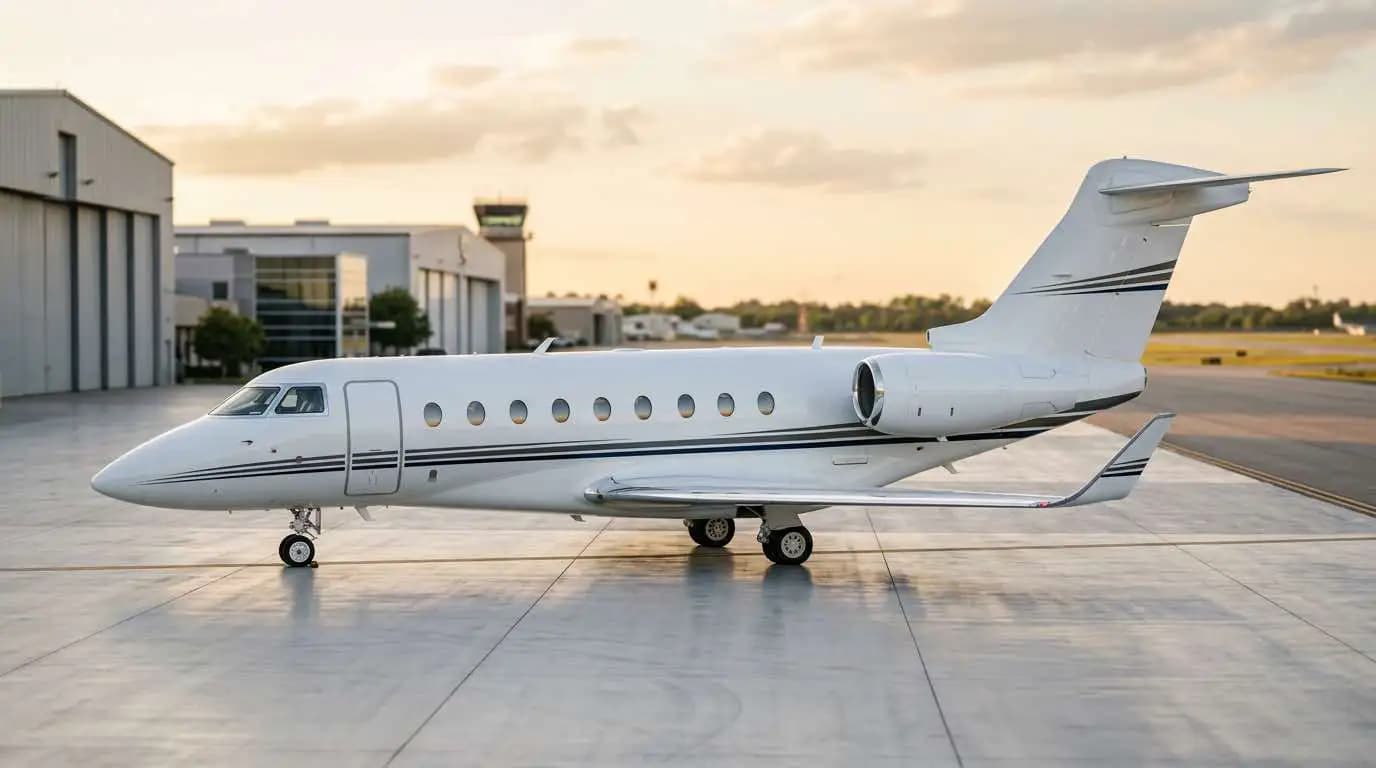
Gulfstream G280 Specifications: Aircraft Overview
The Gulfstream G280 is a super-midsize business jet manufactured by Israel Aerospace Industries (IAI) under license from Gulfstream Aerospace. First delivered in 2012 as the successor to the Gulfstream G200 (originally the IAI Galaxy), the G280 represented a generational leap in performance, efficiency, and cabin comfort. Production continued through 2024, with approximately 250 aircraft delivered worldwide.
The Gulfstream G280 specifications position it at the top of the super-midsize category, competing directly with the Cessna Citation Longitude, Bombardier Challenger 350, and Embraer Praetor 600. Among these competitors, the G280 offers the widest cabin, the lowest direct operating costs per nautical mile, and transatlantic capability that few super-midsize jets can match.
Type Certificate and Production
FAA Type Certificate A00012AT issued December 2012. Manufactured at IAI Lahav Division in Beer Sheva, Israel. Final completion and interior finishing at Gulfstream Dallas. Production ended in 2024 after approximately 250 deliveries. Supported by Gulfstream's global service network with authorized service centers on five continents.
Design Philosophy
Built on the proven Galaxy/G200 platform with a redesigned wing (increased span and area), new powerplant, modernized avionics, and improved cabin environment. The G280 retained the fuselage cross-section of the G200, the widest in the super-midsize category, while improving range by 200 NM and reducing fuel burn by 20%.
Market Position
The G280 occupies the top tier of the super-midsize segment. With a new list price of ~$25M and used pricing of $8–$18M, it competes with the Citation Longitude ($27M new), Challenger 350 ($27M new), and Praetor 600 ($21M new). The G280 trades at a slight discount to the Challenger 350 on the used market but offers comparable or superior range and cabin width.
Looking for a Gulfstream G280 for sale?
Browse verified aircraft listings on CollectAirs with transparent auction terms and full documentation review.
Performance Specifications: Engines, Range and Speed
The G280's performance envelope is defined by its Honeywell HTF7250G engines and aerodynamically optimized wing. These Gulfstream G280 specifications enable transatlantic range, FL450 cruise altitude, and short-field capability that distinguishes the G280 from most super-midsize competitors.

Honeywell HTF7250G Engines: 6,402 lbs Thrust Each
The HTF7250G is a high-bypass turbofan with Full Authority Digital Engine Control (FADEC). Each engine produces 6,402 lbs of takeoff thrust, delivering excellent hot-and-high performance. The engines feature a 20% fuel burn improvement over the Pratt & Whitney PW306A engines on the G200, translating directly to lower operating costs and extended range.
Range: 3,600 NM at Long-Range Cruise (Mach 0.80)
NBAA IFR range with four passengers is 3,600 NM at Mach 0.80, sufficient for non-stop U.S. coast-to-coast flights, Caribbean to any U.S. airport, and eastbound transatlantic crossings from Teterboro to London Luton. At high-speed cruise (Mach 0.84), range reduces to approximately 3,200 NM. The G280 holds over 40 NAA-certified city-pair speed records.
Ceiling: FL450 (45,000 ft)
Certified ceiling of 45,000 feet places the G280 above most commercial traffic and weather. Time to climb from sea level to FL430 is approximately 25 minutes at MTOW. Cabin altitude at FL450 is 7,000 ft, a meaningful improvement over the G200 (8,000 ft at FL450) that reduces passenger fatigue on longer missions.
Takeoff: 4,750 ft: Short-Field Capable
Balanced field length at MTOW (sea level, ISA) is 4,750 ft, shorter than the Challenger 350 (4,835 ft) and Longitude (5,170 ft). Landing distance of 2,660 ft enables access to shorter runways. The trailing-link main landing gear absorbs energy efficiently, providing consistently smooth landings even in gusty conditions.
Cabin Layout, Interior Dimensions and Comfort
The G280 cabin is the widest in the super-midsize category at 7 ft 2 in: wider than the Challenger 350 (7 ft 2 in equivalent), Citation Longitude (6 ft 4 in), and Praetor 600 (6 ft 10 in). Combined with a 6 ft 3 in standing height and 25 ft 10 in of cabin length, the G280 provides a genuinely comfortable workspace and rest environment for transcontinental and transatlantic missions.
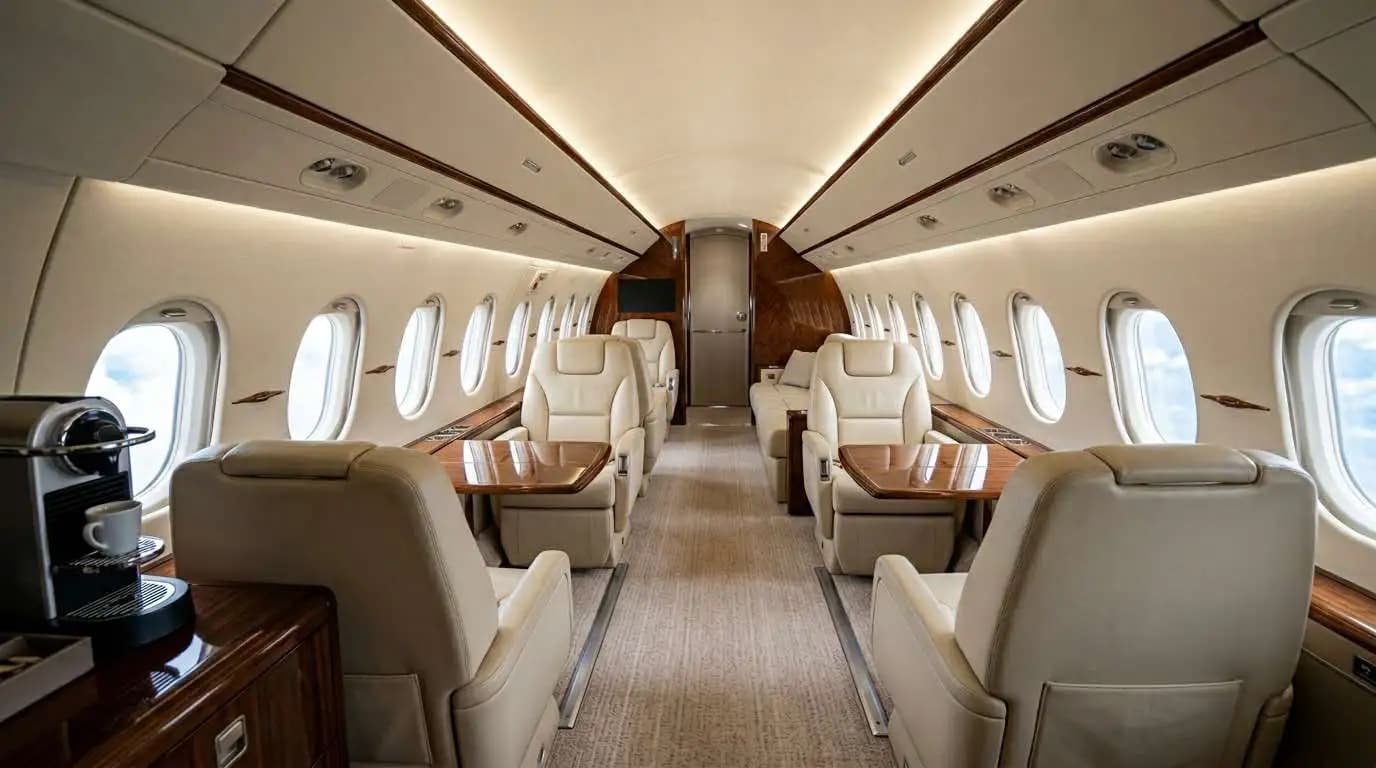
Cabin Dimensions: 25 ft 10 in × 7 ft 2 in × 6 ft 3 in
The flat-floor cabin accommodates a standard double-club seating arrangement (4 seats facing each other across work tables) plus an aft three-place divan. Total cabin volume of approximately 920 cu ft provides meaningful space for passenger movement and comfort. Fourteen large oval windows flood the cabin with natural light, a hallmark of Gulfstream design.
Seating: Up to 10 Passengers
Standard executive configurations seat 8–10 passengers. The four club seats are fully reclining with articulating leg rests. The aft divan converts to a flat berthing surface for sleeping on overnight missions. Some configurations include a credenza with fold-out seat in place of the divan for an alternative layout.
Galley and Lavatory
The forward galley includes an espresso machine, convection oven, chilled storage, and sufficient catering capacity for intercontinental flights. The enclosed aft lavatory features a flushing toilet, vanity with mirror, and changing space, a significant upgrade over curtain-divided lavatory configurations found in some competitors.
Baggage: 120 cu ft External + 15 cu ft Internal
The external baggage compartment holds 120 cu ft of luggage accessible in flight through a cabin-to-baggage passthrough. An additional 15 cu ft of internal cabin stowage accommodates briefcases and carry-on items. Total baggage capacity supports extended trips for the full passenger complement.
PlaneView 280 Avionics Suite
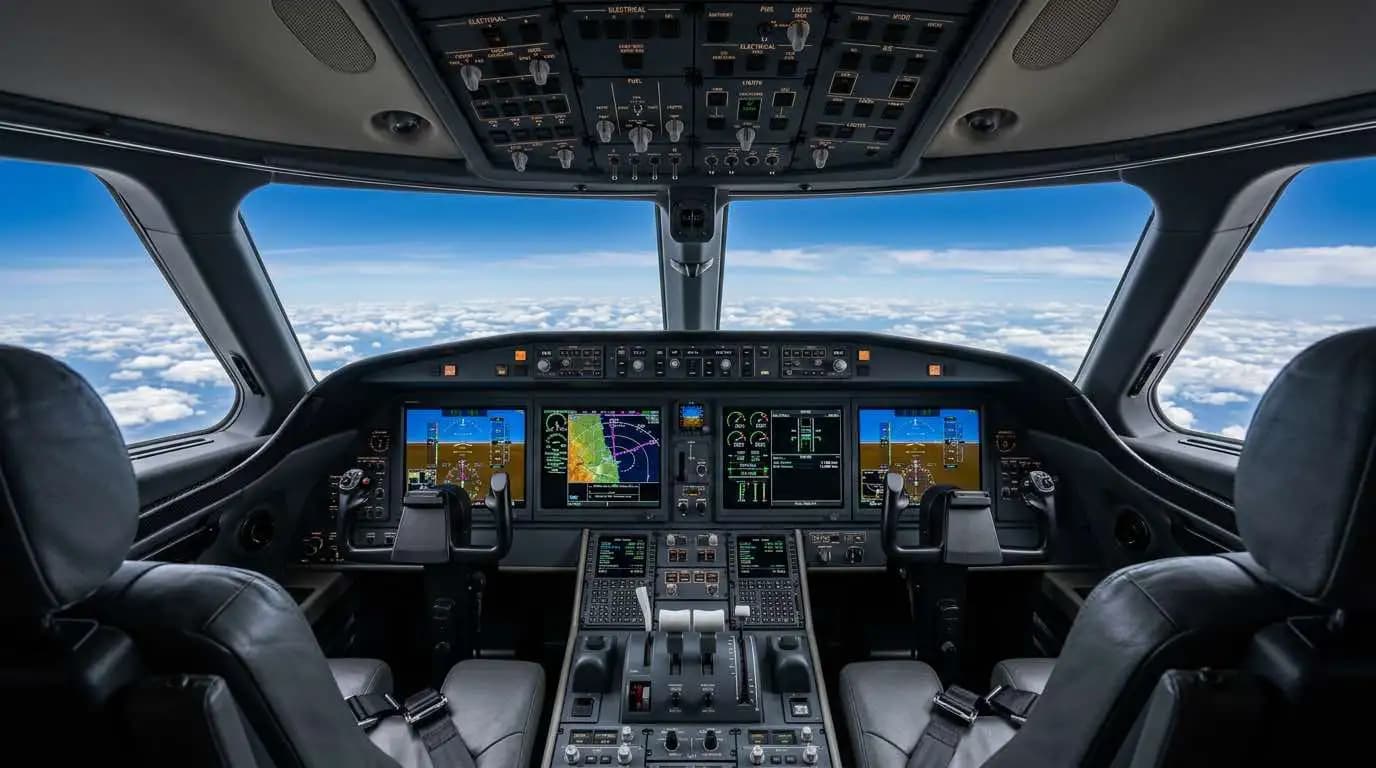
The PlaneView 280 cockpit represents a clean-sheet avionics design built on Honeywell Primus Epic architecture. It is the most advanced cockpit in the super-midsize class and a substantial upgrade over the G200's Honeywell Primus Elite system.
Four 14-Inch LCD Primary Flight Displays
The PlaneView 280 features four large-format Honeywell displays providing primary flight, navigation, engine, and systems information. The displays are configurable, pilots can customize layout for different phases of flight. Brightness and contrast auto-adjust for all lighting conditions.
Dual FMS with LPV Approach Capability
Dual Honeywell FMS units provide GPS/WAAS navigation with LPV approach capability to 200 ft decision height. This enables ILS-equivalent approaches at airports without ground-based ILS infrastructure, expanding the number of usable airports significantly, especially in remote areas and developing regions.
Integrated Safety Systems
Standard equipment includes TCAS II (Traffic Collision Avoidance System), TAWS (Terrain Awareness and Warning System), ADS-B Out, and dual radar altimeters. The integrated crew alerting system centralizes all warnings and cautions on a single dedicated display area with color-coded prioritization.
Optional Enhanced Vision System (EVS)
Gulfstream offers the Enhanced Vision System as an option, projecting infrared imagery onto the Head-Up Display (HUD) for improved situational awareness in low-visibility conditions. EVS-equipped G280s command a $200K–$400K premium on the used market versus non-EVS examples.
Gulfstream G200 vs. G280: What Changed
The G280 is a direct evolution of the Gulfstream G200, itself based on the IAI Galaxy platform. While the fuselage cross-section and basic structural layout were retained, the G280 introduced improvements across every major system. Buyers evaluating used aircraft frequently compare G200 and G280 examples, here are the key differences.
Gulfstream G200
- Engines: 2x Pratt & Whitney PW306A (5,700 lbs each)
- Range: 3,400 NM (NBAA IFR, 8 pax)
- Avionics: Honeywell Primus Elite (CRT displays)
- Cabin altitude at FL450: 8,000 ft
- Fuel burn: ~280 GPH at typical cruise
- Production: 2001–2011 (~250 delivered)
- Used pricing: $3M–$8M (2026 market)
Gulfstream G280
- Engines: 2x Honeywell HTF7250G (6,402 lbs each)
- Range: 3,600 NM (NBAA IFR, 4 pax): +200 NM
- Avionics: PlaneView 280 (four 14-inch LCDs)
- Cabin altitude at FL450: 7,000 ft: 1,000 ft lower
- Fuel burn: ~230–260 GPH: 20% reduction
- Production: 2012–2024 (~250 delivered)
- Used pricing: $8M–$18M (2026 market)
Buyer Consideration: G200 vs. G280 Value Gap
The G200 trades at a significant discount to the G280 ($3M– $8M vs. $8M–$18M) but carries higher operating costs, less range, older avionics, and increasing maintenance exposure as airframe hours accumulate. For buyers with budgets under $8M, a well-maintained late-model G200 with engine program enrollment and updated avionics databases can still be a capable aircraft. Above $8M, the G280 is almost always the better value proposition due to lower fuel burn, improved range, and stronger residual value retention.
Ownership Costs and Operating Economics
The Gulfstream G280 delivers some of the lowest direct operating costs in the super-midsize category: a direct result of the HTF7250G engine efficiency and relatively low airframe maintenance burden. Below is a realistic cost breakdown for a G280 operated 400 hours annually under a professional management program.

Gulfstream G280 Annual Cost Structure (400 hours)
- Fuel (400 hrs × 245 GPH × $6.25/gal): ~$612,500
- Engine program reserves (JSSI or Honeywell MSP, both engines): $180,000–$300,000
- Scheduled maintenance and airframe inspections: $120,000–$200,000
- Pilot salaries (2 pilots, rotating schedule): $300,000–$500,000
- Hangar (major metro dedicated space): $60,000–$120,000/yr
- Insurance (hull $12M + liability): $60,000–$120,000
- Avionics subscriptions, databases, recurrent training: $40,000–$80,000
- Management company fee (if applicable): $60,000–$150,000
- Total annual: ~$1,432,500–$2,082,500 at 400 hours
- Total loaded hourly cost: ~$3,580–$5,206/hr: versus charter at $6,000–$9,000/hr
Engine Program: The Most Critical Cost Variable
Engine program enrollment (JSSI, Honeywell MSP, or OEM CorporateCare) is the single most important cost variable for G280 owners and the dominant driver of resale value. A G280 enrolled on a comprehensive engine program commands a $500,000–$1,500,000 premium over an equivalent aircraft without program coverage. Unscheduled HTF7250G engine events can exceed $800,000– $1,200,000 per occurrence: making program coverage essential for predictable operating economics and buyer confidence at resale.
Buying a Gulfstream G280: Verification and Due Diligence
Acquiring a pre-owned Gulfstream G280 requires structured due diligence proportional to the $8–$18M acquisition cost. CollectAirs coordinates the following verification steps for G280 transactions.
Logbook Verification
Complete logbook continuity from delivery to present, every flight hour, maintenance event, and component replacement documented. G280 logbook sets typically span 6–12 volumes for aircraft with 2,000–4,000 total time. Gaps in documentation can reduce value by 5–15%.
AD Compliance Review
Verify compliance with all applicable Airworthiness Directives for the airframe (IAI), engines (Honeywell HTF7250G), and installed components. The G280 AD history includes recurring inspections of wing-to-fuselage attachments, engine mount hardware, and landing gear components.
Pre-Purchase Inspection
A G280 pre-purchase inspection at a Gulfstream-authorized service center costs $50,000–$100,000 and takes 10–15 business days. The inspection covers airframe structural condition, engine borescope, avionics functionality, flight control rigging, landing gear, and interior condition assessment.
Engine Program Transfer and Escrow
Confirm engine program enrollment is active and transferable. Verify escrow account balance, typically $300,000–$800,000 in accrued reserves for mid-life G280 engines. Program transfer requires buyer qualification and acceptance by the program provider (JSSI, Honeywell, or Rolls-Royce/Gulfstream).
Airframe Hours and Cycles Analysis
Average G280 utilization is 350–450 hours/year. A 2015 G280 with 3,500 total hours represents average utilization. Above 4,500 hours, maintenance exposure increases as major inspection intervals approach. Landing cycle count affects landing gear overhaul timing, a $300,000–$600,000 event.
Gulfstream G280 Specifications: Complete Data Table
| Specification | Value | Why It Matters |
|---|---|---|
| Engines | 2x Honeywell HTF7250G | 6,402 lbs thrust each; FADEC-controlled; 20% more fuel efficient than G200 PW306A engines |
| Maximum Range | 3,600 NM (NBAA IFR) | At Mach 0.80 with 4 passengers; transatlantic eastbound capable; 3,200 NM at Mach 0.84 |
| Max Cruise Speed | Mach 0.84 (482 KTAS) | Long-range cruise at Mach 0.80 (459 KTAS); holds 40+ city-pair speed records |
| Ceiling | FL450 (45,000 ft) | Above most commercial traffic and weather; cabin altitude 7,000 ft at FL450 |
| Takeoff Distance | 4,750 ft (SL, ISA, MTOW) | Access to shorter runways than many super-midsize competitors; steep approach capable |
| Landing Distance | 2,660 ft | Trailing-link landing gear for smooth arrivals; excellent short-field capability |
| Cabin Length | 25 ft 10 in (7.87 m) | Accommodates double-club seating plus aft divan; forward galley; enclosed rear lavatory |
| Cabin Width | 7 ft 2 in (2.18 m) | Widest cabin in the super-midsize category at time of certification |
| Cabin Height | 6 ft 3 in (1.91 m) | Full stand-up cabin for passengers up to 6 ft 3 in tall |
| Passengers | Up to 10 (typical 8–10) | Double-club plus three-place divan; berthing for 4 passengers on extended missions |
| Baggage Capacity | 120 cu ft (external) | Accessible in-flight through cabin; additional 15 cu ft internal stowage |
| MTOW | 39,600 lbs (17,962 kg) | Payload with full fuel: approximately 1,800 lbs (4 passengers + baggage) |
| Fuel Capacity | 13,085 lbs (1,956 USG) | Fuel burn approximately 230–260 GPH depending on cruise speed and altitude |
| Avionics | PlaneView 280 | Four 14-inch Honeywell LCD displays; dual FMS; integrated TCAS II; TAWS; ADS-B Out |
| Crew Requirement | 2 pilots (mandatory) | G280 type rating required; initial training ~18–21 days at FlightSafety International |
Looking for a Gulfstream G280 for Sale?
CollectAirs connects qualified buyers with verified super-midsize and large-cabin aircraft, with escrow protection, pre-purchase inspection coordination, engine program verification, and title confirmation on every transaction. Transparent pricing, real documentation.
Frequently Asked Questions: Gulfstream G280 Specifications
Can a Gulfstream G280 cross the Atlantic?
Yes. With a 3,600 NM range at Mach 0.80, the G280 can fly non-stop from the U.S. East Coast (Teterboro) to London Luton or Shannon under favorable wind conditions. Westbound crossings against the jet stream typically require a fuel stop in Iceland or the Azores. The G280 is one of the few super-midsize jets capable of transatlantic crossings without a fuel stop on eastbound routing.
How far can a Gulfstream G280 fly?
The Gulfstream G280 specifications list a maximum range of 3,600 NM at long-range cruise (Mach 0.80) with four passengers and NBAA IFR reserves. At high-speed cruise (Mach 0.84), range decreases to approximately 3,200 NM. This covers all continental U.S. city pairs non-stop and eastbound transatlantic crossings from the northeastern U.S. to Western Europe.
What is the difference between Gulfstream G200 and G280?
The G280 replaced the G200 with Honeywell HTF7250G engines (vs. PW306A), extending range from 3,400 to 3,600 NM. The PlaneView 280 avionics suite replaced Honeywell Primus Elite. Cabin improvements include larger windows, lower cabin altitude (7,000 ft vs. 8,000 ft), reduced noise, and 20% better fuel efficiency. The G280 also features a redesigned wing with improved aerodynamics.
How many people can fit on the Gulfstream G280?
The G280 is certified for up to 10 passengers. Typical executive layouts seat 8–10 in a double-club arrangement with an aft three-place divan. The cabin is 25 ft 10 in long, 7 ft 2 in wide, and 6 ft 3 in tall, a full stand-up cabin with enclosed rear lavatory, forward galley with espresso machine, and 120 cu ft of external baggage storage.
Does a Gulfstream G280 need two pilots?
Yes. The G280 type certificate mandates a two-pilot crew. Both pilots must hold a G280 type rating from an FAA-approved initial training course (18–21 days) at FlightSafety International. Recurrent training is required annually. The PlaneView 280 cockpit is designed to reduce crew workload through automation, but single-pilot operation is not certified.
What does a Gulfstream G280 cost to buy and operate?
Production ended in 2024 with a final list price of ~$25M. Pre-owned G280s trade at $8–$18M depending on year, total time, and engine program enrollment. Annual operating costs at 400 hours: fuel $600K–$900K, engine reserves $180K–$300K, maintenance $120K–$200K, crew $300K–$500K, fixed costs $150K–$350K, totaling approximately $1.35M–$2.25M/year or $3,375–$5,625/hr.
Sources
Used for: official G280 performance data, cabin dimensions, engine specifications, avionics details, and range/speed figures referenced throughout this guide.
Used for: engine thrust ratings, FADEC specifications, fuel burn figures, and maintenance interval data for the HTF7250G powerplant.
Used for: per-flight-hour engine program reserve rates, G280 maintenance cost benchmarks, and unscheduled event cost exposure data.
Used for: official type-certificated performance limitations, weight data, and crew requirements for the Gulfstream G280.
Used for: pilot training requirements, type rating course duration, and recurrent training schedule for the G280.
Related Resources
Cessna Citation Longitude Guide
Full specifications and buyer guide for the Citation Longitude: a direct G280 competitor in the super-midsize segment.
Read GuideCessna Citation CJ4 Guide
Complete buyer guide for the Citation CJ4 light jet, single-pilot certified, ideal for owners stepping down from super-midsize.
Read GuidePrivate Jet Cost Per Hour
Complete hourly rate breakdown across every jet category, see where the G280 fits in the cost spectrum.
Read GuideMost Expensive Private Jets
Rankings and pricing for the world's most expensive private jets: from the G700 to wide-body VIP conversions.
Read GuideAbout the Author

Phillip Müller
CEO, CollectAirs
Long-time pilot and CEO of multiple scenic flight and aircraft sales websites. Passionate about making aircraft transactions more transparent and accessible.
Connect on LinkedIn