

 Bad Vöslau
 Kirn
Kirn


 Florida

Technical review: October 2026. Fuel approvals, engine limits, maintenance requirements and support availability can change. Always verify the current approved documentation for the exact engine and aircraft being evaluated.
A diesel aircraft engine is a compression-ignition piston engine designed to operate on specifically approved fuels, commonly Jet-A or Jet A-1 in modern general-aviation installations. These engines can offer efficient cruise operation, broad fuel availability and simplified power management, but fuel burn alone does not determine whether a diesel-powered aircraft is a good purchase.
Buyers should evaluate the complete installation: engine and gearbox limits, FADEC and electrical architecture, fuel approvals, local maintenance capability, useful load, replacement exposure and the aircraft’s actual mission. A diesel installation can be highly attractive for regular touring or training, but a conventional avgas aircraft may remain easier and less expensive to own in another operating environment.
Diesel vs Avgas Aircraft: The Quick Decision
| Decision factor | Diesel / Jet-A may fit better when... | Avgas may fit better when... |
|---|---|---|
| Fuel access | Approved Jet-A or Jet A-1 is widely available and competitively priced on the normal route network | Avgas is easy to obtain locally and at normal destinations |
| Annual utilisation | High annual hours allow fuel-efficiency savings to accumulate | Low annual utilisation makes fixed and calendar costs more important than fuel burn |
| Typical mission | Regular touring, training or international operations | Local recreational flying with established avgas infrastructure |
| Maintenance | Engine-specific diagnostics, parts and trained maintenance support are nearby | Conventional piston-engine support is significantly easier to access |
| Power management | The operator values FADEC and simplified engine controls | The owner prefers a more traditional mechanically managed installation |
| Major-cost exposure | The buyer understands gearbox, engine and calendar/time replacement limits | The buyer prefers a familiar overhaul-oriented engine-support model |
| Payload | The aircraft retains adequate useful load with the installed diesel system | The diesel installation would compromise the intended passenger, baggage or fuel mission |
That table is only a screening tool. The final comparison should be made at aircraft level because two airframes with different engines can have very different useful load, fuel capacity, maintenance programmes and acquisition costs.
What Is a Diesel Aircraft Engine?
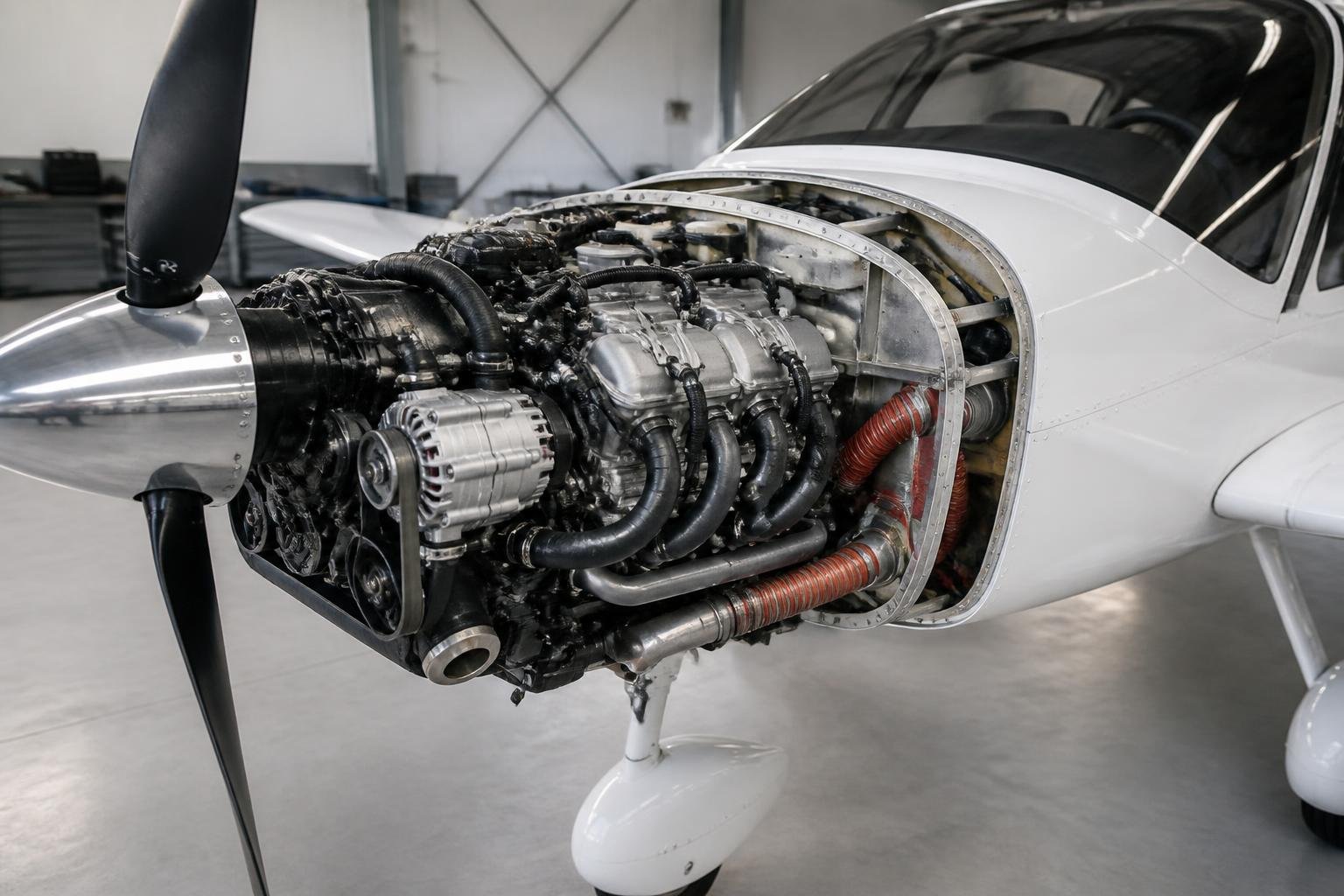
Unlike a spark-ignition avgas engine, a compression-ignition engine does not depend on spark plugs to initiate normal combustion. Air is compressed until its temperature is high enough for injected fuel to ignite.
Many modern certified aviation diesel installations use technology such as:
- Electronic high-pressure fuel injection.
- Full Authority Digital Engine Control, or FADEC.
- Turbocharging.
- Liquid cooling.
- A reduction gearbox between the engine and propeller.
- Electronic engine monitoring and fault diagnostics.
Continental’s current CD-135 and CD-155 families are examples of this architecture. Their manufacturer documentation describes liquid-cooled, turbocharged, geared compression-ignition engines with fuel injection and FADEC.
Other installations differ. The engine architecture, fuel approvals and operating procedures must therefore be established from the documentation for the exact engine and airframe rather than from the generic word “diesel.”
Why Jet-A Piston Aircraft Attract Buyers

The first attraction is fuel logistics. Jet-A and Jet A-1 are widely distributed through aviation fuel networks, particularly at airports serving turbine aircraft. For an owner travelling internationally or a flight school operating from an airport with limited avgas availability, that can simplify planning.
The second attraction is efficiency. Modern compression-ignition engines can provide favourable specific fuel consumption in appropriate operating conditions. That can reduce fuel cost over frequent cross-country or training use, especially when annual utilisation is high.
FADEC is another practical advantage. Instead of requiring separate mixture and, in many installations, detailed propeller-management inputs, the engine-control system schedules fuel and other operating parameters automatically. This can reduce routine pilot workload and simplify standardisation in a training fleet.
Jet-A and Jet A-1 also avoid the tetraethyl lead associated with traditional leaded avgas. That does not by itself make the entire aircraft environmentally preferable, but it removes one lead-related operational issue from the fuel system.
None of these advantages is universal. If Jet-A is expensive at the home base, annual utilisation is low or specialist maintenance is far away, the theoretical benefits can disappear quickly.
Jet-A, Jet A-1 and Road Diesel: What Is Actually Approved?

Fuel approval belongs to the specific engine-and-airframe combination. Do not assume that every aviation diesel can use every kerosene or road-diesel specification.
Jet-A and Jet A-1 are closely related aviation turbine fuels, but their low-temperature specifications differ. Jet A-1 has a lower maximum freeze point than Jet-A, making it particularly relevant to colder operating environments. The aircraft and engine documentation determines which grades are approved and what limitations apply.
Some certified aviation diesel engines also approve additional fuels. For example, current Continental CD-135 technical data includes Jet-A, Jet A-1 and EN590 diesel among its certified fuels.
That does not mean automotive diesel is automatically acceptable in every diesel-powered aircraft.
Before using any fuel, verify:
- The exact engine model and variant.
- The aircraft-level fuel approval.
- The applicable operating manual.
- Temperature or altitude limitations.
- Any required additives or handling procedures.
- Whether local regulations or the aircraft’s approval basis impose additional restrictions.
Fuel convenience should never override approved data.
Fuel Quality and Cold-Weather Operation
Kerosene fuel systems still require careful contamination control. Water can enter through supply equipment, condensation or aircraft fuel-system defects, and water contamination can contribute to filter problems or microbial growth in suitable conditions.
Routine sampling and drainage should follow the aircraft’s approved procedures. Repeated evidence of water, unusual debris or contamination should trigger investigation rather than simply being treated as normal.
Cold-weather operation also involves more than fuel freeze point. Battery capacity, oil viscosity, coolant condition and starting procedure can all affect a compression-ignition installation.
Use the cold-weather procedure published for the exact engine and aircraft. Do not improvise with automotive additives or practices that are not approved for the installation.
FADEC and the Electrical System
FADEC can make a diesel aircraft easier to operate, but it changes what the buyer should inspect.
The electronic engine-control system receives data from sensors and controls fuel scheduling and other engine functions. Depending on the installation, the aircraft may have redundant engine-control channels, alternators, batteries or emergency electrical arrangements designed to maintain engine operation after particular failures.
That architecture makes electrical condition especially important.
A pre-buy should establish:
- Battery age and test history.
- Alternator and charging-system status.
- Engine-control-unit configuration.
- Relevant FADEC fault history.
- Wiring and connector condition.
- Approved backup-power arrangements.
- Any recurring electrical or engine-control messages.
A stored FADEC message does not automatically indicate a major defect. Repeated or unexplained faults, however, deserve diagnosis by a facility familiar with the specific engine.
Gearboxes, TBR and Major Engine Costs
Many aviation diesel engines turn at a higher crankshaft speed than is suitable for direct propeller drive, so a reduction gearbox is used between the engine and propeller.
Depending on engine design, that system may also include a clutch, torsional-damping components or other items with inspection, replacement or life limits.
This creates an important difference from the ownership model familiar to buyers of many traditional avgas engines.
Some diesel engine families use a Time Between Replacement (TBR) model rather than assuming a conventional field overhaul at the end of the published interval. Continental currently publishes TBR figures up to 2,100 hours or 12 years for current CD-135/CD-155 configurations, although the exact limit depends on the applicable engine model, serial status and current technical documentation.
A buyer therefore needs more than “engine has 600 hours.” The useful questions are:
- Which exact engine is installed?
- What time and calendar limit applies?
- How much remaining life is documented?
- What gearbox or clutch limits apply?
- What will replacement or major scheduled work cost today?
- How quickly can the required parts or replacement engine be obtained?
Use current written quotations when building reserves. A diesel-engine reserve should not simply be copied from a Lycoming or Continental avgas overhaul estimate.
Fuel Burn and Real Operating Cost
A diesel aircraft can burn less fuel than a comparable avgas-powered aircraft and still cost more overall to own.
The useful comparison is total mission and annual cost.
| Cost area | What to model |
|---|---|
| Fuel | Approved fuel grade, local price, cruise consumption, taxi, climb and reserve fuel |
| Engine | Remaining time and calendar life, TBR/TBO model, replacement cost and downtime |
| Gearbox | Inspection intervals, component limits and replacement exposure |
| Maintenance | Specialist labour, filters, fluids, diagnostics and parts logistics |
| Electrical systems | Batteries, alternators, FADEC-related troubleshooting and backup-power components |
| Fixed costs | Insurance, hangarage, annual inspections, avionics subscriptions and finance |
| Downtime | Travel to specialist maintenance, parts lead times and lost utilisation |
Model at least two annual-utilisation scenarios. A flight school operating hundreds of hours per year can benefit much more from fuel efficiency than a private owner flying 40 or 50 hours annually.
For the low-utilisation owner, calendar-driven engine and component limits can dominate the economics long before fuel savings recover a higher acquisition price.
Do Not Ignore Useful Load and Aircraft-Level Performance
An efficient engine does not automatically produce a more useful aircraft.
Liquid cooling, turbocharging, gearbox hardware and associated systems affect installation weight. The resulting aircraft may have a different empty weight and centre-of-gravity position from an avgas version of the same or similar airframe.
Always compare the aircraft using its current weight-and-balance report.
Test a realistic mission with:
- Actual pilot and passenger weights.
- Trip fuel plus reserves.
- Baggage.
- Installed equipment.
- Expected runway and density altitude.
A lower hourly fuel burn is of limited value if the aircraft cannot legally carry the intended occupants and trip fuel.
Maintenance Requirements for Diesel Aircraft Engines

Maintenance should begin with the current engine manuals, aircraft Instructions for Continued Airworthiness and the approved maintenance programme applicable to the aircraft.
Diesel installations may combine flight-hour, cycle and calendar requirements. An aircraft flown very little can therefore still encounter significant scheduled work.
Typical areas requiring attention include:
- Fuel filters and contamination monitoring.
- High-pressure fuel-system condition.
- Cooling hoses, coolant and heat exchangers.
- Turbocharger and exhaust condition.
- Gearbox and clutch requirements where applicable.
- Electrical supply and battery condition.
- FADEC diagnostics, sensors, wiring and connectors.
- Approved oils, fluids and consumables.
Do not transfer maintenance practices from one diesel engine family to another. A Continental CD-series engine and an Austro E4-series engine may share broad technology concepts while having different maintenance instructions, limits and support requirements.
Airworthiness Directives and Manufacturer Service Information
Regulatory status needs careful wording.
Applicable Airworthiness Directives must be identified and complied with according to the aircraft’s governing regulatory framework.
Manufacturer Service Bulletins, Service Letters and other service information should also be reviewed, but their mandatory status is not automatically identical in every jurisdiction. A manufacturer instruction may become mandatory because it is incorporated into an Airworthiness Directive, required by an approved maintenance programme, included in applicable Instructions for Continued Airworthiness or otherwise required by the governing approval basis.
For a pre-buy, establish:
- Which Airworthiness Directives apply to the engine, propeller and airframe.
- Whether compliance is properly recorded.
- Which manufacturer service information affects the installed configuration.
- Whether recurring inspections remain outstanding.
- Whether any modification changes the applicable maintenance requirements.
Use the latest approved documentation rather than relying on an old compliance list prepared for a previous owner.
Common Jet-A Piston Engine Families
Two important modern certified engine families illustrate how different diesel-aircraft ownership can be.
Continental CD Series
Continental’s CD family developed from the earlier Thielert/Centurion lineage and is used in aircraft including variants of the Diamond DA40 and DA42, Cessna 172, Piper PA-28 and Robin DR400.
Current CD-135 technical documentation describes a liquid-cooled, turbocharged, fuel-injected, geared engine with FADEC. The exact certified fuels and TBR depend on the engine configuration and current technical data.
Austro Engine E4 / AE300
The Austro Engine E4 family, commonly known in aircraft applications as the AE300 series, is type-certified by EASA and is closely associated with current Diamond diesel aircraft such as the DA40 NG and DA42 NG/VI family.
Its maintenance and support model is not interchangeable with the Continental CD series. Buyers need access to the engine-specific manuals, current Airworthiness Directives and an appropriately capable service organisation.
Factory Installation vs Diesel Retrofit
Factory-built diesel aircraft and approved diesel conversions should be evaluated separately.
A factory installation benefits from an aircraft-engine integration package designed around that airframe. An approved retrofit can provide Jet-A capability to an existing aircraft but may introduce a different engine mount, electrical architecture, propeller, cooling system, weight-and-balance result and supplemental approval basis.
For a retrofit aircraft, request:
- The STC or other approved installation basis.
- Engine and propeller serial numbers.
- Installation and maintenance documentation.
- Current weight and balance.
- Electrical and cooling-system modifications.
- Evidence of continued support for the conversion.
The engine model alone does not tell the whole ownership story.
Pre-Buy Checklist for a Diesel-Powered Aircraft
A diesel-aircraft pre-buy should combine the normal airframe inspection with engine-specific technical review.
| Area | What to verify |
|---|---|
| Engine identity | Exact model, serial number, installation approval and current status |
| Fuel approval | Permitted fuel grades in current aircraft and engine documentation |
| Remaining engine life | Hours, calendar age and applicable TBR/TBO or replacement limit |
| Gearbox / clutch | Time, inspection history and remaining component life |
| FADEC | Fault history, diagnostics, software/configuration status and unresolved messages |
| Electrical system | Battery, alternator, wiring, connectors and backup architecture |
| Cooling system | Coolant, hoses, leaks, heat exchangers and maintenance history |
| Fuel system | Filters, pumps, injectors and contamination history |
| Turbo and exhaust | Leaks, cracking, heat effects and applicable inspections |
| Compliance | Applicable ADs and relevant manufacturer service information |
| Support | Nearest capable maintenance facility, diagnostics and parts availability |
Request diagnostic information before closing where the engine system supports it. Reconcile logbook entries with physical component identities and current engine data rather than relying only on seller summaries.
The inspection should be performed by a facility that understands both the aircraft type and the exact diesel installation.
Real-World Example: Diamond DA42 TDI
A useful example of the ownership questions discussed above is the Diamond DA42 TDI listed on CollectAirs.
The aircraft is a 2007 DA42 TDI equipped with two Continental CD-135 / TAE125-series Jet-A diesel engines and Garmin G1000 avionics. The listing also provides airframe time and remaining engine-time information, making it a useful example of why diesel buyers need to examine remaining engine life rather than simply noting that the aircraft has “diesel engines.”
A buyer evaluating that aircraft should compare the engine records, remaining time, gearbox and propeller status, current maintenance requirements and available local CD-series support against the purchase price and intended annual utilisation.
The same process applies to any Jet-A piston listing: identify the exact engine generation first, then calculate the aircraft’s real remaining-life and support position.
Diesel vs Avgas: Which Should You Buy?
A diesel-powered aircraft is more compelling when:
- Jet-A or Jet A-1 is easier or cheaper to obtain than avgas.
- The aircraft will fly enough hours for fuel efficiency to matter.
- Regular touring or cross-border operation is part of the mission.
- Qualified engine support is available within a practical distance.
- The buyer is comfortable budgeting for engine, gearbox and calendar limits.
- The aircraft retains adequate useful load for the intended mission.
An avgas aircraft may remain the more practical choice when:
- Annual utilisation is low.
- Avgas is readily available and competitively priced.
- Conventional piston-engine maintenance is much easier to obtain locally.
- The diesel aircraft carries a significant acquisition premium.
- Specialist diesel support would create unacceptable downtime.
- The owner prefers the maintenance model of the specific avgas engine under consideration.
The decision should be based on the whole aircraft rather than engine ideology. Fuel type is only one part of ownership.
Who Should Consider a Jet-A Piston Aircraft?
Jet-A piston aircraft can be particularly attractive to frequent touring pilots, flight schools and operators based in regions where avgas availability is limited or expensive.
They can also suit buyers who value FADEC-controlled power management and are willing to operate within an engine-specific maintenance ecosystem.
They are less compelling when the aircraft will fly relatively few hours or when qualified support is difficult to access. In that situation, calendar limits, fixed costs and downtime may outweigh the fuel advantage.
Before deciding, calculate the next major engine, gearbox and calendar-driven expenses and compare them with at least one credible avgas alternative.
Diesel Aircraft Engine FAQ
Do diesel aircraft engines use Jet-A?
Many modern certified compression-ignition aircraft engines are approved for Jet-A, Jet A-1 or related aviation kerosene grades. The exact fuel list is engine- and airframe-specific and must be checked in the approved documentation.
Can an aviation diesel engine use road diesel?
Only when the exact engine and aircraft approval permits it. Some current Continental CD-series configurations approve EN590 diesel, but that approval cannot be generalized to other aviation diesel engines.
What does FADEC do on a diesel aircraft engine?
FADEC electronically manages functions such as fuel delivery based on power demand and engine-sensor inputs. Depending on the installation, it can simplify power management considerably, but it also makes electrical-system condition, redundancy and fault diagnostics important ownership considerations.
Why do many diesel aircraft engines have reduction gearboxes?
The engine can operate efficiently at a crankshaft speed higher than the desired propeller speed. A reduction gearbox allows both the engine and propeller to operate within their intended rpm ranges.
What is the difference between TBR and TBO?
TBO normally refers to a recommended or approved interval between overhauls under the applicable engine and regulatory framework. TBR means Time Between Replacement and may require replacement of the engine or designated assembly at the applicable limit rather than assuming a conventional overhaul. Check the exact current limit for the installed engine.
Are diesel aircraft cheaper to operate?
They can have lower fuel costs in suitable missions, but that does not guarantee lower total ownership cost. Engine replacement exposure, gearbox maintenance, specialist labour, acquisition price, calendar limits and downtime must also be included.
What is most important in a diesel-aircraft pre-buy?
Confirm the exact engine and fuel approval, remaining engine and gearbox life, FADEC and electrical-system history, cooling and turbocharger condition, regulatory compliance and realistic access to type-specific maintenance support.
Authoritative Sources & Further Reading
- Continental Aerospace Technologies — CD-135 Jet-A Piston Engine technical data and current certified-fuel information.
- Continental Aerospace Technologies — CD-155 Jet-A Piston Engine technical data and TBR information.
- Continental Aerospace Technologies — Certified Jet-A Engine Series documentation.
- EASA Type Certificate Data Sheet E.055 — Continental / TAE125 series engines.
- EASA Type Certificate Data Sheet E.200 — Austro Engine E4 series engines.
- FAA aviation-fuel guidance — Jet-A and Jet A-1 properties and low-temperature considerations.
- Applicable aircraft AFM/POH, engine operating manual and Instructions for Continued Airworthiness for the individual aircraft.
- CollectAirs — Diamond DA42 TDI aircraft listing.
Engine specifications, fuel approvals, TBR/TBO limits, Airworthiness Directive applicability and manufacturer service requirements can change by engine variant, serial number, airframe installation and jurisdiction. Confirm the latest approved documentation before making a purchase or maintenance decision.
Considering a Jet-A piston aircraft? Review the Diamond DA42 TDI listing on CollectAirs and compare its engine remaining time, maintenance records, fuel requirements and support needs against the checklist above.

Comments
No comments yet
Be the first to share your thoughts!