

 Bad Vöslau
 Kirn
Kirn
 Florida
Technical review: October 2026. Performance, maintenance requirements, engine programmes, insurance conditions and operating limitations vary by aircraft, configuration and jurisdiction. Always verify the current approved documentation for the individual aircraft.
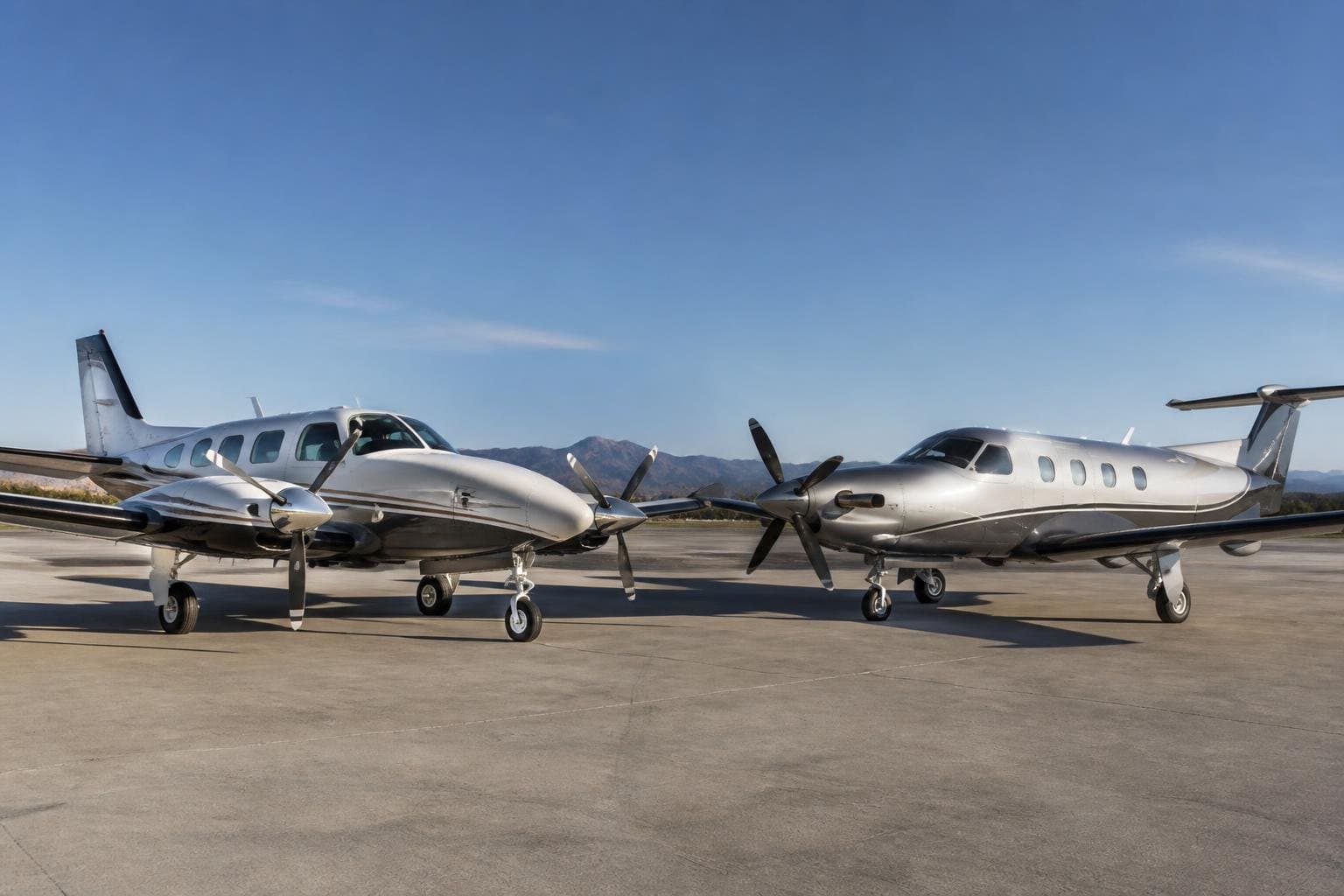
Moving from a pressurized piston to a single-engine turboprop can transform the way an owner travels, but it is not automatically the next logical step. The upgrade makes sense when the owner’s real missions repeatedly expose the piston aircraft’s limits in block time, payload, climb performance, schedule reliability or cabin utility—and when the added capability justifies the higher capital, training and maintenance commitment.
The decision should therefore begin with actual trips rather than aircraft prestige. Compare the routes you fly, passengers you carry, airports you use and schedule pressure you face, then model the financial and operational consequences over several years.
Pressurized Piston vs Turboprop Aircraft: The Core Differences
In a piston vs turboprop aircraft comparison, the most obvious difference is the powerplant. A piston engine uses reciprocating cylinders and a crankshaft, while a turboprop uses a gas-turbine core to drive a propeller through a reduction gearbox.
That distinction affects far more than fuel type. Engine reserves, maintenance planning, training, insurance, climb performance, altitude capability and the economics of downtime all change when moving into turbine ownership.
| Factor | Pressurized piston | Single-engine turboprop |
|---|---|---|
| Typical mission | Regional and personal cross-country travel | Frequent business, family, executive or utility transport |
| Engine planning | Condition monitoring, accessories and overhaul reserve | Trend monitoring, scheduled engine events and overhaul/replacement exposure |
| Fuel | Typically avgas | Typically Jet-A / Jet A-1 |
| Cabin | Usually compact, often four to six seats | Ranges from owner-flown executive cabins to large utility cabins |
| Training | High-performance piston and pressurization proficiency | Turbine transition, high-altitude systems and recurrent training |
| Financial commitment | Generally lower acquisition and major-event exposure | Higher capital and potentially much larger maintenance events |
These are category-level differences only. A fast pressurized piston can outperform a utility turboprop in some missions, while a large-cabin turboprop may prioritise payload and runway flexibility over maximum cruise speed.
When Does a Turboprop Upgrade Make Sense?
There is no universal annual-hour threshold at which turbine ownership suddenly becomes rational.
An owner flying 100 hours per year on repeated 500-nautical-mile business trips may extract more value from a turboprop than someone flying twice as many hours on short recreational sectors. What matters is how often the additional capability changes the outcome of a real trip.
A turboprop becomes increasingly relevant when several of these conditions occur regularly:
- Longer sectors make cruise and climb performance commercially meaningful.
- Payload restrictions frequently force fuel stops or baggage compromises.
- Same-day return capability has measurable value.
- Schedule reliability is important to business or family travel.
- High-altitude capability materially improves the normal route network.
- The owner needs more cabin or baggage flexibility.
- The operating budget can absorb training, insurance and major maintenance reserves.
A pressurized piston remains rational when trip lengths are moderate, passenger loads are manageable and cost discipline matters more than reducing every possible minute of travel.
Measure Block Time, Not Brochure Speed
Published cruise speed is useful for screening aircraft, but block time is a better measure of transportation value.
Compare representative trips from engine start to shutdown, including taxi, climb, descent, vectors, approaches and likely fuel stops. The faster aircraft does not save its full cruise-speed advantage on every mission.
On short sectors, terminal time and climb can consume a large part of the journey. On repeated longer sectors, stronger climb and higher cruise performance can create meaningful annual time savings.
For each candidate, test at least three real routes:
| Mission | What to compare |
|---|---|
| Short regional trip | Door-to-door time, handling and airport access |
| Typical business/family trip | Block time, payload, fuel and alternates |
| Longest recurring trip | Non-stop capability, winds, reserves and schedule impact |
Use seasonal wind assumptions rather than still-air brochure range.
Payload, Cabin and Passenger Mission
Useful load should be evaluated with realistic fuel rather than maximum payload and maximum range as separate brochure numbers.
Build representative loading cases for:
- Solo long-distance travel.
- Two-person business travel.
- Family travel with baggage.
- Full-seat short-sector operation.
Include actual passenger weights, baggage, onboard equipment and the fuel required for the route and reserve policy.
Cabin volume can matter as much as useful load. Door size, rear-seat access, baggage location, noise, temperature control and seating geometry influence whether passengers actually want to use the aircraft repeatedly.
Pressurization should also be evaluated by cabin altitude and pressure differential rather than by the simple presence of a pressurization system. Review the approved data for the specific aircraft and inspect the maintenance history of doors, windows, seals, valves, controllers and environmental systems.
Runway and Airport Access
Greater power does not automatically mean unrestricted airport access.
Compare take-off and landing performance using the AFM or POH at realistic:
- Aircraft weight.
- Pressure altitude.
- Temperature.
- Wind.
- Runway surface.
- Slope.
- Obstacle environment.
Some turboprops are designed around short-field or utility missions, while others are primarily fast executive aircraft. Grass, gravel or unimproved-field suitability must be confirmed for the specific aircraft, tyres, propeller clearance and operating limitations.
Also consider practical infrastructure: hangar dimensions, Jet-A or avgas availability, de-icing services, ground handling and nearby maintenance capability.
Five-Year Ownership Cost: Acquisition Is Only the Beginning
A similar asking price does not mean similar ownership economics.
An older turboprop near a major engine event can require much more capital than a higher-priced piston aircraft with strong maintenance status. Conversely, a premium piston aircraft with ageing avionics, pressurization problems or an engine approaching overhaul can carry substantial near-term cost.
Build a five-year ownership model rather than comparing hourly fuel burn alone.
| Cost area | Pressurized piston considerations | Turboprop considerations |
|---|---|---|
| Acquisition | Purchase, inspection, rectification and avionics | Purchase, inspection, engine position and programme status |
| Fuel | Avgas price and availability | Jet-A price, uplift and handling |
| Engine | Overhaul reserve, cylinders, turbo, exhaust and accessories | Engine trend, scheduled events, overhaul/replacement and life-limited components |
| Training | Transition and recurrent high-performance training | Initial turbine transition and recurrent training |
| Insurance | Pilot experience and aircraft value | Turbine experience, make/model time and training requirements |
| Fixed ownership | Hangar, inspection, subscriptions and finance | Hangar, inspection, programmes, subscriptions and finance |
| Downtime | Parts and specialist piston/pressurization support | Engine, avionics and turbine-support logistics |
Calculate both a conservative and an expected case. The conservative version should include meaningful unscheduled-maintenance contingency and realistic downtime.
Also compare cost per trip, not only cost per hour. A more expensive aircraft can still create value if it eliminates a fuel stop, saves a working day or carries a team that would otherwise require another transport solution.
Engine Maintenance and Support
Maintenance economics depend on the exact engine and aircraft rather than the piston or turbine label alone.
For a pressurized piston, investigate:
- Engine hours and calendar history.
- Cylinder and borescope trends.
- Oil and filter findings.
- Turbocharger and exhaust condition.
- Ignition and fuel-system history.
- Pressurization discrepancies.
- Accessories and upcoming scheduled work.
For a turboprop, investigate:
- Engine hours and cycles.
- Hot-section and overhaul status where applicable.
- Trend-monitoring history.
- Borescope and oil-analysis findings where available.
- Life-limited or calendar-controlled components.
- Propeller and governor status.
- Engine-program participation where applicable.
Local support matters in both cases. Before buying, identify who will actually maintain the airframe, engine, propeller and avionics, what work must be outsourced and how long common parts typically take to obtain.
Training, Insurance and the Owner-Pilot Transition
Moving from a pressurized piston into a turboprop is a meaningful operational transition even for an experienced instrument pilot.
Higher approach energy, turbine engine management, pressurization, automation and high-altitude operations require disciplined training. Initial and recurrent programmes may include aircraft, simulator or combined training depending on the model and provider.
Before committing to an aircraft, obtain preliminary insurance feedback. Underwriters may consider factors including:
- Total flight time.
- Instrument experience.
- Time in make and model.
- Turbine experience.
- Recent training.
- Claims history.
- Operating base and aircraft use.
Mentor-pilot or recurrent-training conditions can materially affect first-year ownership planning.
Representative Aircraft: From Pressurized Piston to Turboprop
Common pressurized-piston examples include aircraft from the Piper PA-46 family, Cessna P210 and other high-performance pressurized piston designs.
Single-engine turboprop candidates range from owner-flown executive aircraft such as the Piper Meridian/M500 and Daher TBM family to larger platforms such as the Pilatus PC-12 and utility-focused Cessna Caravan.
| Class | Typical mission emphasis | Main trade-off |
|---|---|---|
| Pressurized piston | Efficient personal and regional transportation | Lower speed, payload and climb capability than many turbine alternatives |
| Owner-flown executive turboprop | Fast business and family travel | Higher acquisition, training and engine exposure |
| Large-cabin turboprop | Passenger, baggage and multi-role flexibility | Greater operating scale and infrastructure needs |
| Utility turboprop | Payload, rugged access and operational flexibility | May sacrifice executive speed or cabin refinement |
Model name alone is not enough. Engine status, avionics, de-ice equipment, maintenance programmes, modifications and records can make two examples of the same aircraft economically very different.
Current CollectAirs Examples: PA-46 Piston vs Turboprop
The Piper PA-46 family provides an unusually useful real-world illustration because closely related airframes exist on both sides of this decision.
Buyers considering the piston route can review the Piper PA-46 Malibu Mirage currently shown on CollectAirs. It is a pressurized piston example and provides a practical reference for cabin, engine, loading and maintenance questions discussed above.
For the turbine step, the Piper Meridian (M500) currently shown on CollectAirs illustrates how the PA-46 concept changes when paired with a Pratt & Whitney PT6 turboprop engine.
Because both listings belong to the broader PA-46 lineage, comparing them is more useful than comparing two completely unrelated aircraft purely by category. Buyers can focus on what turbine power actually changes: engine economics, climb, cruise, fuel type, training and maintenance exposure.
Buyers requiring more cabin or utility capability can also consider current CollectAirs examples such as the Pilatus PC-12 NG or Cessna 208 Caravan, while faster executive missions may lead toward aircraft such as the Daher TBM family.
Inventory changes over time. Treat these listings as current examples rather than permanent market benchmarks, and never use an asking price or auction bid as a universal aircraft valuation.
Pre-Buy Inspection Priorities
An independent pre-buy inspection should be tailored to the specific model and intended mission. It is not the same as an annual inspection or an appraisal.
For both categories, begin with:
- Complete airframe, engine and propeller records.
- Damage and repair history.
- Applicable Airworthiness Directive status.
- Relevant manufacturer service information.
- Component times and calendar status.
- Modification and avionics documentation.
- Current weight and balance.
- Pressurization and environmental-system history.
For the piston aircraft, give additional attention to cylinder condition, turbocharging, exhaust, engine accessories and pressurization history.
For the turboprop, review engine trend and inspection data, major scheduled engine events, component-life status and programme documentation where applicable.
Use a model-experienced inspector who is independent of the seller and define in advance how significant findings affect the purchase agreement.
Piston vs Turboprop Mission Scorecard
A scorecard helps prevent one attractive feature—usually speed or purchase price—from controlling the decision.
| Criterion | Suggested weight | What to evaluate |
|---|---|---|
| Mission completion | 20% | How often the aircraft completes normal trips without payload, fuel or weather-related compromise |
| Five-year ownership cost | 20% | Capital, fuel, insurance, maintenance, training and major-event reserves |
| Typical trip distance / block time | 15% | Real time saved on recurring routes |
| Payload and cabin | 15% | Passengers, baggage, practical fuel and comfort |
| Schedule sensitivity | 10% | Financial or personal value of completing trips on time |
| Maintenance support | 10% | Local expertise, parts, engine support and likely downtime |
| Runway and airport access | 5% | Home base, destination runway and infrastructure fit |
| Training and insurance | 5% | Pilot qualification, recurrent training and underwriting requirements |
Score each candidate from 1 to 5 and multiply by the chosen weighting. Adjust the percentages to match the mission. For a business owner, schedule sensitivity may deserve more weight; for a recreational owner, total ownership cost may dominate.
Keep the Piston or Move to a Turboprop?
Keeping the pressurized piston may make more sense when:
- Annual utilisation is moderate.
- Most trips are regional rather than long-range.
- Two to four people represent the normal mission.
- Payload restrictions rarely cancel a trip.
- Schedule pressure is manageable.
- Lower fixed and major-maintenance exposure is important.
- Strong piston-engine maintenance support is available locally.
Moving to a turboprop becomes more compelling when:
- Longer routes occur frequently.
- Time saved has measurable business or personal value.
- Payload and baggage limitations regularly create compromises.
- Higher-altitude and climb capability improve normal missions.
- More cabin flexibility is genuinely required.
- The owner is prepared for turbine transition and recurrent training.
- The five-year budget supports engine, insurance and maintenance exposure without depending on optimistic assumptions.
For occasional missions that exceed the piston aircraft’s capability, charter or fractional access can also be compared with ownership before making the step into a turbine aircraft.
The Final Upgrade Decision
The strongest case for a turboprop is not that it is faster or more prestigious. It is that its additional capability repeatedly solves problems the current aircraft cannot solve efficiently.
Use real trips, realistic passenger loads and conservative cost assumptions. Then compare individual aircraft based on engine status, records, equipment, support and condition.
A well-matched pressurized piston can remain the more rational transportation tool for years. A turboprop becomes justified when its time, payload, altitude and schedule advantages are valuable often enough to support the larger financial and operational commitment.
Sources & Further Reading
- Applicable aircraft AFM or POH for each specific model evaluated.
- Aircraft manufacturer performance and maintenance documentation.
- Engine-manufacturer operating, inspection and lifecycle documentation.
- FAA or EASA airworthiness guidance applicable to the aircraft and registration.
- Individual aircraft maintenance records, engine records and approved modification documentation.
- CollectAirs current aircraft listings for real-world configuration and marketplace examples.
Performance, loading, engine limits, insurance requirements and maintenance schedules vary by model, serial number, configuration and jurisdiction. Confirm current approved documentation before making an acquisition decision.
Deciding whether to stay piston or move to turbine power? Compare the Piper PA-46 Malibu Mirage with the Piper Meridian (M500) on CollectAirs and apply the mission scorecard above to the aircraft that best match your travel requirements.

Comments
No comments yet
Be the first to share your thoughts!