

 Bad Vöslau
 Kirn
Kirn


 Florida

Why Aircraft Engine Times Matter to Buyers and Sellers

Aircraft engine-time abbreviations are concise, useful, and easy to misread. TT generally means total time, TSOH means time since major overhaul, SMOH usually means since major overhaul, STOH means since top overhaul, and TBO means time between overhaul. Together, these figures help describe an engine’s recorded history and anticipated maintenance planning position. They do not, on their own, establish mechanical condition, airworthiness, or value.
For a buyer, engine times shape the scope of a pre-buy inspection, the questions to ask about logbooks, and the reserve to set aside for future engine and accessory work. For a seller, clearly separating airframe total time from engine time and supporting every figure with records makes a listing easier to assess. A low SMOH figure may be attractive, but its meaning depends on who performed the work, what was included, when it occurred, how the aircraft has been operated, and how completely the work is documented.
Engine time is therefore best treated as a maintenance-history indicator. A well-documented engine with moderate time since overhaul, regular use, sound inspection evidence, and a credible maintenance trail may warrant closer consideration than an engine advertised with very low hours but unclear records or a long inactive period.
Before relying on an advertised number, reconcile it with complete engine and airframe logbooks, overhaul invoices or release paperwork, and subsequent maintenance entries. The buyer’s goal is not merely to find the smallest number. It is to understand exactly what that number measures and what maintenance exposure remains.
The Core Terms at a Glance: TT, TSOH, SMOH, STOH and TBO
| Abbreviation | Full term | What it normally measures |
|---|---|---|
| TT | Total time | Accumulated time in service; the record must identify whether this refers to the airframe, engine, propeller, or another component. |
| TSOH | Time since major overhaul | Operating time accumulated after a documented major engine overhaul. |
| SMOH | Since major overhaul | Common listing shorthand, usually intended to communicate the same post-major-overhaul operating time as TSOH. |
| STOH | Since top overhaul | Operating time accumulated after upper-engine work, commonly involving cylinders, valves, and related components. |
| TBO | Time between overhaul | A manufacturer-published overhaul interval or planning recommendation applicable to a particular engine model and operating context. |
TT requires the most care because it is often used without an object. “3,500 TT” may refer to an airframe’s total time, but an engine can also have total time since new or since installation. A careful listing labels these separately, such as airframe TT, engine total time, propeller time since overhaul, and hours SMOH. If the object is not stated, ask before drawing a conclusion.
TSOH is generally the clearer term because it expressly says that the recorded hours are since a major overhaul. SMOH is widespread marketplace language and normally carries the same intended meaning. Yet neither abbreviation substitutes for evidence that a major overhaul occurred, the date it was completed, the identity of the engine, and the basis on which the post-overhaul hours were tracked.
Terminology can differ between advertisements, maintenance entries, approved manuals, and jurisdictions. An owner may use familiar shorthand in a sales description while a certificated maintenance record uses more formal wording. Read the logbooks and supporting documents rather than assuming every seller, shop, or market uses the labels identically.
What Does SMOH Mean in an Aircraft Listing?

The SMOH meaning in aircraft listings is “since major overhaul.” In ordinary piston-aircraft market use, it describes the engine operating time accumulated after a major overhaul. For example, an aircraft represented as having 400 hours SMOH is usually being presented as having flown 400 hours since its engine was major-overhauled. The figure should be tied to a specific engine and a documented overhaul event.
That simple description leaves several material questions. An advertised SMOH number is a claim about recorded history, not proof by itself that the overhaul meets a buyer’s expectations. The purchaser should identify the overhaul date, the maintenance provider, the engine model and serial number, the stated scope of work, the release or return-to-service documentation, and the time-record basis used after installation or completion.
“Fresh overhaul” deserves particular care. It may accurately describe an engine with little or no recorded operating time after overhaul, but it does not tell the whole story. Calendar age matters. An overhaul completed years ago followed by minimal flying can create different questions from one completed recently and followed by regular operation. Storage environment, preservation measures, periodic maintenance, and evidence of recent use all influence the due-diligence picture.
- Ask for the overhaul invoice, work order, and signed maintenance record entry.
- Confirm that the serial number in the overhaul documentation corresponds to the installed engine.
- Establish the overhaul completion date and the number of hours run afterward.
- Determine what work was included and which accessories or components were treated separately.
- Review later logbook entries for repairs, cylinder work, oil changes, inspections, and periods of inactivity.
SMOH is useful shorthand when it is traceable. Without those records, it should be treated as unverified seller-reported information until a qualified review establishes the history.
TT Explained: Airframe Total Time and Engine Total Time
Total time means accumulated time in service, but the component being measured is essential. Airframe TT describes the aircraft structure’s recorded operating time. Engine total time describes the accumulated operating time of a particular engine from new, or from another documented starting point. These figures often diverge because engines can be overhauled, replaced, removed, or installed in another airframe while the airframe continues accumulating its own time.
An aircraft with 6,000 hours airframe TT and 800 hours SMOH is not unusual. It may have its original engine that was overhauled, a replacement engine, or an engine that has been removed and reinstalled. The logbooks should show enough continuity to explain the relationship. A buyer should be able to follow the engine’s identity, installation history, overhaul event, and subsequent hours without relying on assumptions.
High airframe TT is not automatically negative. It can reflect many years of regular use, often accompanied by a substantial maintenance trail. Its significance depends on the aircraft type, operating environment, corrosion exposure, repair history, utilization pattern, and quality of records. A high-time aircraft kept in a dry environment and maintained consistently presents a different research case from one with fragmented records or prolonged outdoor storage.
Time sources can also differ. Tachometer time is normally driven by engine operation and may accumulate at a rate related to engine speed. Hobbs time is often used as an operational meter and may be activated differently depending on installation. Maintenance records may use one source consistently, another source, or a properly documented conversion or reconciliation. Differences do not automatically indicate an error, but they need an explanation.
Vague statements such as “total time unknown” should not be dismissed as a minor listing detail. In some older aircraft, partial records or historical circumstances may make a precise figure unavailable. The practical question is what records exist, which periods are missing, how the seller arrived at the stated figure, and how the uncertainty affects inspection scope and price discussions.
TSOH and SMOH: Similar Terms, Important Documentation Questions

In many piston-aircraft advertisements, TSOH and SMOH are used interchangeably. Both normally refer to time accumulated after a major overhaul. TSOH can be more explicit because it names the measurement directly: time since major overhaul. SMOH is understood by most aviation buyers, but it is shorthand rather than a full maintenance-history explanation.
A major overhaul is not defined by marketplace language alone. The applicable maintenance rules, approved data, engine manufacturer guidance, and work actually performed matter. The scope may involve disassembly, inspection, repair or replacement of parts as necessary, reassembly, testing, and return-to-service documentation, but a buyer should not infer the exact content of one overhaul from another. Review the invoice and maintenance records rather than relying on the phrase “major overhaul.”
The source of the work also merits attention. An engine may have been overhauled by the manufacturer, a specialized engine shop, or a qualified maintenance provider in the field. These routes are not automatically equivalent or inferior to one another; the meaningful assessment concerns the provider’s documentation, the work scope, parts and approved data used where applicable, test information, warranty terms if any remain, and the quality of subsequent operation and maintenance.
“Zero-time” is a term that should be used precisely. An overhaul does not ordinarily erase an engine’s total history or make it a newly manufactured engine. Some factory programs may have their own defined terminology, but a seller should not describe an overhauled engine as zero-time unless the statement is accurate, properly supported, and understood in its specific technical and regulatory context.
Propellers and accessories follow their own maintenance clocks. A low-TSoH or SMOH engine does not establish the status of the propeller, governor, magnetos, alternator, starter, vacuum system, fuel components, or hoses. Request separate times, calendar dates, and supporting records for those items when relevant to the aircraft under review.
STOH Explained: What a Top Overhaul Does and Does Not Tell You
STOH means time since top overhaul. A top overhaul generally concerns the upper portion of a piston engine: commonly cylinders, pistons, valves, guides, and related hardware or work. It may be performed to address cylinder compression concerns, oil consumption, valve issues, cylinder condition, or wear identified during maintenance. The exact scope varies materially by engine, technician, findings, and maintenance provider.
A top overhaul is not a major overhaul. It does not necessarily mean that the lower-end components, crankshaft, camshaft, bearings, gears, case, or full engine assembly have received the inspection and work associated with a major overhaul. It therefore should not be read as an equivalent substitute for TSOH or SMOH.
The phrase can also cover very different events. One aircraft may have received a coordinated cylinder-focused overhaul across all cylinders. Another may have had a limited repair or individual cylinder replacement and later be described informally as having top-end work. That difference can be commercially significant, especially when a listing uses STOH as a prominent selling point.
Buyers should ask for the maintenance entries and invoices establishing what was replaced, repaired, inspected, or retained. Useful records identify the date, engine time at the event, cylinder positions where relevant, component part and serial information when recorded, and the reason for the work. A cylinder replacement is not automatically evidence of a comprehensive top overhaul, and a recent top overhaul does not reset the engine’s time since major overhaul.
TBO: The Maintenance Interval Behind the Number
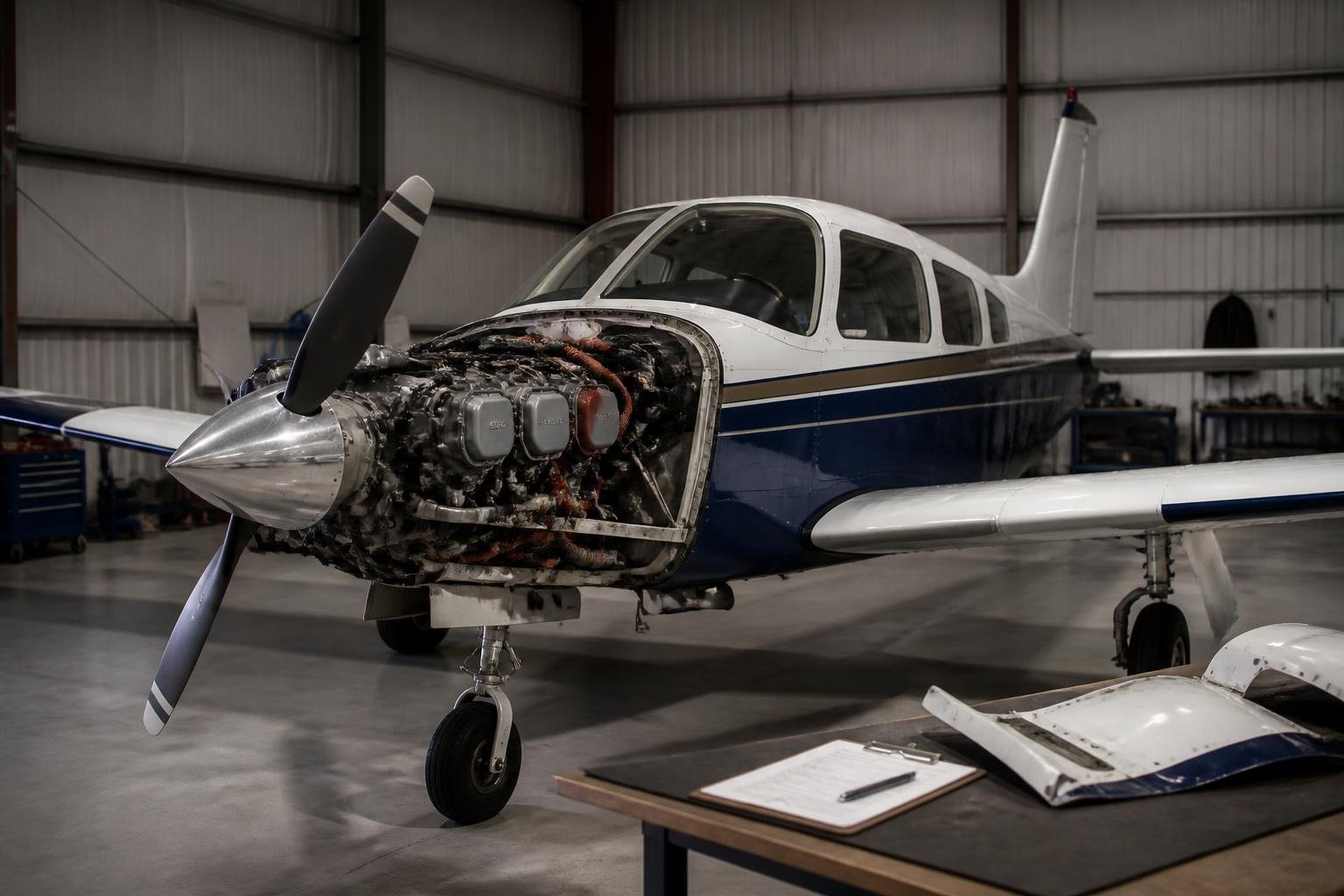
TBO means time between overhaul. It is a manufacturer-published overhaul interval or recommendation associated with a particular engine model, configuration, and operating context. TBO is commonly expressed as an hourly figure, and engine documentation may also include calendar recommendations or limitations. The applicable manual and engine model—not a generic number quoted in a listing—are the proper reference.
For ownership planning, TBO helps a buyer estimate where an engine sits in its expected overhaul cycle. An engine near its published TBO may deserve a larger maintenance reserve and closer review of operating evidence. It does not, by itself, diagnose the engine or determine that an immediate overhaul is required in every situation. Condition evidence, maintenance history, utilization, applicable regulations, and the nature of the operation all matter.
Operational rules differ. A privately operated aircraft may be subject to different maintenance and operational considerations than an aircraft used in commercial, training, public-use, or other regulated service. National aviation rules also vary. A buyer should consult the applicable engine manufacturer documentation and discuss the aircraft’s intended use, jurisdiction, and maintenance status with an appropriately qualified maintenance professional.
Calendar time deserves equal attention. An engine with relatively few hours since overhaul can still have substantial calendar age. Seals, hoses, accessories, and corrosion-sensitive internal surfaces do not become irrelevant merely because flight hours accumulated slowly. Conversely, a regularly operated engine closer to TBO may have a better-developed maintenance record than a low-hour engine stored for extended periods. TBO is a planning benchmark, not a standalone airworthiness finding.
How Engine Times Are Recorded and Why Figures Can Differ
Aircraft time records come from several sources, and they do not always match exactly. Tachometer time, Hobbs time, maintenance-record time, and operational records can reflect different methods of measuring use. A difference may be legitimate if the source and basis are understood. It becomes a concern when the listing provides a precise number that cannot be reconciled with the logbook trail.
Airframe and engine logbooks should show continuity across major events: installation, removal, overhaul, repair, annual or periodic inspection, and significant component work. An overhaul should normally be supported by documentation identifying the engine and recording the authorized return to service. The post-overhaul hours should then be traceable through later maintenance entries and credible time records.
Key distinctions include time since new, total time on the engine, time since installation, time since major overhaul, and time since top overhaul. These may all be correct figures for one aircraft, but they answer different questions. A replacement engine with 1,200 hours total time installed in an airframe three years ago may have a different time since installation, different SMOH, and a different relationship to TBO.
Simple errors occur. Listings may contain rounded numbers, transposed digits, stale figures copied from an older advertisement, or an unlabeled reference to airframe rather than engine time. Resolve material discrepancies before making an offer or treating the numbers as valuation inputs.
- Which meter or record source supports the stated hours?
- What was the engine time on the overhaul completion date?
- Do later annual or maintenance entries support the claimed post-overhaul accumulation?
- Does the engine serial number remain consistent through the records?
- Are there missing logbook periods, replacements, or unexplained jumps in time?
How to Read an Aircraft Listing Without Misinterpreting Engine Time

Read an aircraft listing as a set of separate, verifiable claims. First separate airframe TT, engine total time, SMOH or TSOH, STOH, and propeller time. Then identify the engine manufacturer, model, serial number, installation history, and the source documents available. A well-presented figure has limited value if it is attached to the wrong component or cannot be supported by records.
Review the overhaul date alongside the stated hours since overhaul. Two engines with 300 hours SMOH can have very different histories if one was overhauled recently and flown consistently while the other accumulated those hours over a decade with long inactive intervals. Ask about storage, preservation, hangar conditions, recent flight activity, and maintenance performed during low-use periods.
Calendar-sensitive items should be considered separately from engine time. Hoses, seals, flexible fuel components, magnetos, and some accessories may have recommended inspection, replacement, or overhaul intervals based partly on calendar time. Their status is not answered simply by a low engine-time figure.
Seller-reported figures are useful starting points, not final conclusions. A prudent buyer compares them against logbooks, work orders, component tags where applicable, inspection results, and a qualified pre-buy review. This approach also protects sellers: clear documentation and careful labels reduce avoidable misunderstandings once a serious buyer examines the file.
Engine Time Is Not Engine Condition
Engine time describes recorded use. Condition requires evidence. A pre-buy evaluation may include compression testing, borescope examination, inspection of the oil filter or screen, and review of maintenance history. The appropriate scope depends on the aircraft, engine type, records, intended mission, and findings during the inspection. No single test should be presented as conclusive in isolation.
Oil-analysis trends can add useful context when samples have been taken consistently over time, but one report is only a snapshot. Engine-monitor data may help reveal operating temperatures, cylinder-temperature patterns, and recent operational behavior when available and competently interpreted. Recent flight activity, cold-start behavior, oil consumption history, and pilot reports can also contribute to the overall picture.
Corrosion risk is particularly relevant after inactivity. Climate, coastal exposure, storage quality, preservation practices, and the duration of non-operation can affect an engine differently from ordinary hour accumulation. An aircraft that flies regularly may have a more informative recent operational record than one with very low hours but uncertain storage history.
Do not overlook accessories. Magnetos, alternators, starters, vacuum systems where fitted, fuel pumps, fuel-control components, and propeller systems can generate significant maintenance expense independent of the engine’s SMOH. Their time and calendar status should be reviewed separately.
An independent pre-buy inspection is the decision-grade assessment. It is distinct from an appraisal, a listing review, and an annual inspection. The buyer should agree the scope with an appropriately qualified independent maintenance professional, particularly where the records are incomplete, the engine is near TBO, or there are indications of storage-related risk.
A Buyer’s Due-Diligence Checklist for SMOH and TBO Claims
Use an engine-time claim to organize due diligence rather than to end it. The following checklist helps establish whether an advertised SMOH or TBO position is supported and meaningful for the intended purchase.
- Obtain complete available airframe and engine logbooks, including records before and after the claimed overhaul.
- Verify the overhaul invoice, work order, release paperwork, and engine serial number against the installed engine.
- Confirm the hours accumulated after the overhaul date through later maintenance entries and credible time records.
- Review the stated work scope, including cylinders, accessories, test documentation, and any exclusions.
- Check compliance status for applicable airworthiness directives and determine what records support that status.
- Ask about inactive periods, storage conditions, preservation actions, and recent operating history.
- Obtain separate information on the propeller, governor, magnetos, hoses, and other major accessories.
- Commission an appropriately scoped independent pre-buy inspection before treating the aircraft as technically acceptable.
- Build a realistic reserve for foreseeable engine, accessory, propeller, airframe, and avionics work.
When records are missing, document what is known, what is inferred, and what cannot be verified. Missing records do not automatically end a transaction, but they should affect inspection planning, risk assessment, and the confidence placed in a time figure. A qualified maintenance professional can help determine what additional inspection or research is sensible for the specific aircraft and jurisdiction.
Using Engine Times in Price Discussions and Ownership Planning
Lower SMOH alone does not establish market value. Buyers and sellers should weigh overhaul quality, documentation, calendar age, utilization after the work, inspection evidence, accessory condition, and the aircraft’s broader airframe and avionics status. An engine described as low-time after overhaul can still require substantial attention if the records are unclear or the aircraft has sat unused.
An engine approaching TBO should be included in ownership planning, but it should not be treated as an automatic instruction to discount the aircraft by the full cost of an overhaul. The relevant question is broader: what does the engine’s documented condition, operating environment, regulatory context, and intended mission indicate about foreseeable maintenance exposure? A qualified inspection can inform that judgment more effectively than an hours-only calculation.
Keep financial reserves separate. Engine reserves are not substitutes for propeller, airframe, paint, interior, avionics, compliance, or accessory reserves. This distinction helps buyers compare aircraft fairly and helps sellers present an honest technical picture without implying that one favorable engine number resolves every maintenance question.
Sellers can improve confidence by stating airframe TT, engine total time, SMOH or TSOH, STOH if applicable, propeller status, overhaul date, and available documentation separately. Qualifying the figures as seller-reported until records are reviewed is appropriate where the listing process has not independently audited them. Buyers should compare documentation quality across the aircraft under consideration, not merely compare the smallest SMOH number.
Key Takeaways for Reading Aircraft Engine Times
SMOH and TSOH normally describe operating time after a major overhaul, but both figures require record verification. STOH describes time after upper-engine work and should not be mistaken for a full overhaul measure. TT means total accumulated time, but only has meaning when clearly identified as airframe, engine, propeller, or another component time.
TBO is a manufacturer maintenance-planning benchmark applicable to a particular engine model and operating context. It is not a standalone condition verdict or universal airworthiness finding. The most useful buying decision combines engine-time figures with complete logbooks, overhaul work scope, calendar age, usage and storage history, accessory records, and independent inspection evidence.
For a serious buyer, the practical next step is straightforward: reconcile every advertised engine-time figure with the documentation, then use a qualified pre-buy inspection to determine what the records and the aircraft itself actually support.

Comments
No comments yet
Be the first to share your thoughts!