

 Bad Vöslau
 Kirn
Kirn


 Florida

Turbocharged aircraft ownership can deliver a meaningful advantage when a mission regularly involves mountains, hot-and-high airports, weather layers or long cross-country legs. The benefit is not simply more speed: it is the ability to retain useful engine power as altitude rises. In return, buyers accept a more heat-sensitive engine installation, additional components, closer operating discipline and a pre-buy inspection that must go beyond an ordinary piston-aircraft review. The right decision depends on the altitude you will genuinely use, the support available for the aircraft, and evidence of how the individual aircraft has been maintained and operated.
What Turbocharging Changes for a Piston-Aircraft Buyer

A naturally aspirated piston engine relies on ambient air pressure to fill its cylinders. As an aircraft climbs, air density and available manifold pressure fall, reducing the power the engine can produce. A turbocharger uses energy from the exhaust stream to compress induction air, helping the engine retain manifold pressure at altitudes where a normally aspirated installation has already lost a substantial share of its available power.
In everyday buying discussions, turbocharged and turbo-normalized are sometimes used loosely, but the distinction matters. A turbocharged system may permit manifold pressure above sea-level ambient pressure, subject to the approved limits of that engine and installation. A turbo-normalized system is generally intended to maintain sea-level-equivalent manifold pressure as altitude increases rather than provide additional boost at low altitude. Installation design, controller configuration and approved operating limitations determine the practical result; buyers should consult the applicable flight manual and engine documentation, not rely on the label alone.
The mission benefit can be substantial, but turbocharged aircraft ownership adds responsibility. The owner must understand power-setting procedures, mixture management, temperature trends and the condition of exhaust and boost-control hardware. Heat, pressure and vibration place demands on parts that a comparable naturally aspirated installation may not carry.
| Potential benefit | Buyer consideration |
|---|---|
| Power retained to a higher altitude | More systems, heat exposure and inspection points |
| Better high-density-altitude performance | Requires disciplined engine operation |
| Access to higher cruise altitudes | May require oxygen, weather planning and IFR capability |
| Potentially stronger cruise performance aloft | Fuel flow, payload and actual route altitude still govern economics |
It is a good fit for an owner who will repeatedly use those capabilities, rather than one who simply prefers the idea of a higher service ceiling.
Who Benefits Most From Turbocharged Aircraft Ownership
Turbocharging is easiest to justify when it solves a recurring operational problem. An owner based at a high-elevation airport in warm weather may value the additional margin in climb and takeoff performance, while still observing all published performance data and weight limits. Pilots crossing mountainous areas can use higher-altitude capability to plan more sensible terrain clearance and route options, although turbocharging never removes the need for conservative terrain, wind and escape-route planning.
It also suits frequent cross-country missions where higher altitudes can place the aircraft above some turbulence, haze and weather, or where tailwinds make a higher flight level worthwhile. The operative word is “can.” Convective weather, icing forecasts, winds, oxygen limits, passenger comfort and air traffic restrictions may make the theoretically ideal altitude impractical on a given trip.
- Owners routinely operating from hot, high-elevation fields.
- Pilots making long, repeatable cross-country trips across high terrain.
- Operators whose routes often reward higher-altitude winds and smoother air.
- Buyers with access to maintenance support experienced in the exact engine and turbo installation.
- Pilots prepared to maintain currency in instrument procedures and high-altitude decision-making.
A normally aspirated alternative is often the rational choice for local flying, short regional trips, low-altitude sightseeing, training use or missions where payload matters more than altitude. Simplicity has economic and operational value. If most flights remain at moderate altitudes, the turbo system may provide little return while adding acquisition complexity and maintenance exposure.
Turbocharged Piston Aircraft Performance: The Practical Trade-Off

Critical altitude is the altitude at which a turbocharged engine can no longer maintain its rated manifold pressure. Above it, available power begins to decline, just as it does in a naturally aspirated engine, although from a higher starting point. Critical altitude is installation-specific and should not be confused with the aircraft’s service ceiling, which reflects climb capability and other certified limitations.
Below critical altitude, a turbocharged aircraft may climb more strongly and sustain cruise power at levels where a comparable normally aspirated aircraft cannot. That can improve true airspeed because true airspeed rises with altitude for a given indicated airspeed. Yet indicated airspeed remains central to handling, stall margins and structural limits. Higher true airspeed is not a free performance gain: fuel flow, engine temperatures, winds and the time required to climb all belong in the trip calculation.
Intercoolers, fitted to some installations, cool compressed induction air before it enters the engine. Cooler charge air is denser and can improve detonation margin, but it does not eliminate the need to follow approved mixture and power procedures. Buyers should identify whether the aircraft has an intercooler, whether it is original or modified equipment, and what documentation supports the installation.
The turbocharger, associated plumbing and possible intercooler add weight. In some aircraft that effect is modest; in others, useful load and center-of-gravity flexibility deserve close review. A buyer should calculate payload using the individual aircraft’s current weight-and-balance data, realistic fuel quantity, occupants and baggage—not brochure figures.
High-Altitude Operations Require More Than Extra Power
Higher capability brings physiological and operational obligations. Supplemental oxygen requirements vary by jurisdiction, aircraft registration and operating rules. The applicable regulations should be reviewed before a planned flight, along with the approved operating documentation for the oxygen system if installed. For buyers, the practical issue is broader than legal minimums: duration at altitude, night operations, fatigue, smoking history, illness and individual susceptibility can all affect hypoxia risk.
A pulse oximeter can support conservative personal decision-making, but it is not a substitute for oxygen planning or training. Symptoms may be subtle and judgment itself can degrade. A sensible owner establishes conservative altitude and duration limits, understands the equipment, and ensures passengers know how to use masks or cannulas before departure.
Weather demands more respect at higher altitude. Icing can be encountered in cloud, freezing precipitation and visible moisture, and the availability of higher altitudes does not create a safe path through known icing. Oxygen endurance, diversion options, terrain clearance, forecast tops and a viable descent route must be considered together. For many owners, the real value of a turbo aircraft is paired with competent instrument-flight planning, not simply a higher number on the altimeter.
Some high-performance piston aircraft are pressurized, but pressurization is a separate system and capability. A turbocharged but unpressurized aircraft still requires oxygen planning; a pressurized aircraft adds its own inspection, maintenance and emergency-descent considerations.
How Turbocharged Engines Need to Be Operated

Turbocharged piston engines reward repeatable, informed operation. Manifold pressure, RPM, mixture, cylinder-head temperature, exhaust-gas temperature, oil temperature and—where applicable—turbine temperature or turbine-inlet limits must be managed as an integrated system. The aircraft flight manual, engine manufacturer guidance and any approved supplemental instructions are the primary references. There is no universal “safe setting” that can replace them.
Rich-of-peak and lean-of-peak operation can both be appropriate on particular engines and installations when conducted within approved guidance and supported by accurate engine-monitor information. Neither label is a shortcut. The buyer should understand what operating technique has been used, whether the installed monitor is capable of showing all cylinders, and whether recorded data indicates consistent temperature management.
- Confirm takeoff and climb power limits, including time limits where applicable.
- Avoid overboost through correct use of throttle and boost-control procedures.
- Respect published temperature limits and investigate abnormal trends promptly.
- Make power and mixture changes smoothly unless approved procedures state otherwise.
- Use warm-up, cool-down and shutdown practices specified for the engine and installation.
Abrupt thermal changes, prolonged high temperatures and improper boost control can create expensive consequences. That does not make the aircraft fragile; it means the operating manual is part of the asset’s preservation plan.
The Turbo System: Components, Failure Modes and Maintenance Exposure
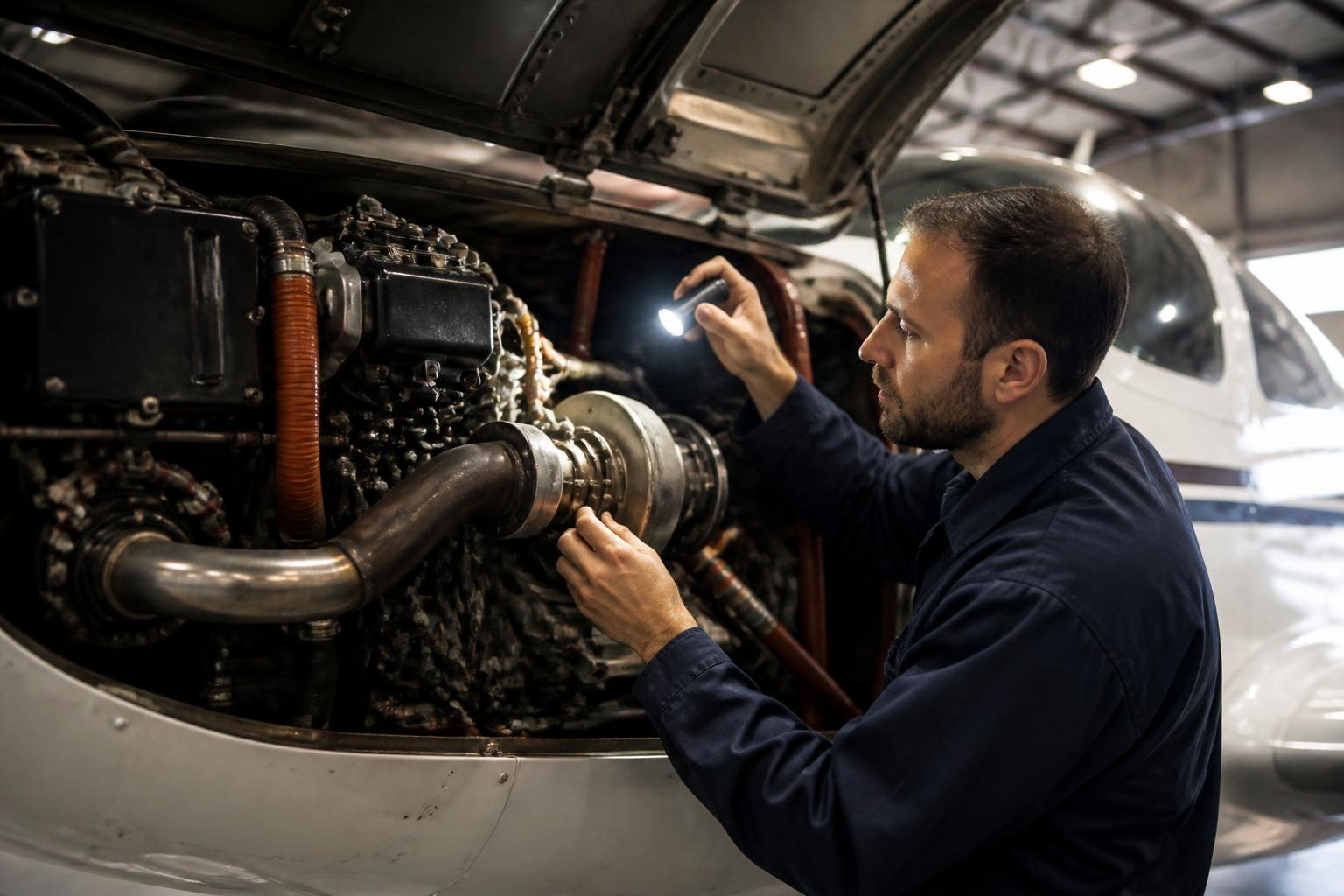
A typical system includes the turbocharger itself, a wastegate that regulates exhaust energy to the turbine, a controller or related boost-control hardware, induction plumbing and exhaust components. Some installations also include an intercooler. The turbocharger operates in an environment of high heat and speed, while the exhaust system must tolerate vibration and repeated thermal cycling.
Inspection concerns can include exhaust cracking, distorted or deteriorated components, oil leakage, worn turbocharger bearings, sticking wastegates, control faults, degraded hoses, loose clamps and heat damage to nearby parts. Symptoms such as abnormal boost behavior, unexpected temperature changes, exhaust odor or oil evidence require competent assessment; they should not be dismissed as normal traits of a turbo installation.
Component intervals, overhaul guidance and available parts vary significantly by engine, airframe and modification status. A generic component-life assumption is not a substitute for the maintenance manual, airworthiness directives, service information and the aircraft’s records. A well-documented system with recent, properly recorded work may be more attractive than one with low apparent time but weak history, long inactivity or recurring discrepancies.
Engine Health, Temperature Management and Trend Monitoring
A modern multi-cylinder engine monitor with downloadable data is particularly valuable in a turbocharged aircraft. It does not certify engine health, but it can reveal patterns that cockpit gauges or a short demonstration flight miss. Review cylinder-head temperature, exhaust-gas temperature, oil temperature, fuel flow and any recorded turbo-related parameter against approved limits and the aircraft’s own baseline.
One apparently normal flight proves little. Buyers should look for gradual divergence among cylinders, recurring high-temperature events, unstable indications, unusual lean-test behavior and changes following maintenance. Data interpretation needs context: sensor faults, outside air temperature, phase of flight and pilot technique all affect traces. An experienced technician familiar with the engine family can provide more useful interpretation than a simple pass-or-fail reading.
Compression tests, borescope inspection and oil analysis are also contextual tools. Compression numbers alone do not reveal valve condition, cylinder-wall condition or exhaust-valve appearance. A borescope can add important evidence, while oil reports may identify trends when multiple samples exist. None should be treated as a warranty. Together with logbooks, monitor downloads and an operational evaluation, they help estimate maintenance risk.
Operating Costs: Where Turbocharged Ownership Can Cost More
Fuel cost begins with the mission. A turbocharged aircraft may consume more fuel in climb and at high-power settings, while an efficient high-altitude cruise setting may improve trip time or exploit favorable winds. The relevant comparison is door-to-door mission cost at realistic altitudes, not a single brochure cruise figure. Fuel reserves, climb time and descent planning belong in the calculation.
Maintenance reserves should recognize the additional turbocharger, wastegate, exhaust and induction-system exposure. Budget for normal scheduled maintenance, engine reserve, propeller reserve where applicable, and a separate contingency for turbo-system or exhaust work. Oxygen equipment may require servicing or periodic attention, and high-altitude training, instrument proficiency and insurance terms can affect the total ownership picture.
There is no responsible universal annual ownership-cost figure for this category. Airframe age, utilization, location, corrosion environment, parts availability, hangar costs, engine history and insurance profile can change the result materially. Build an aircraft-specific budget from the records, local maintenance labor rates, known upcoming work and a contingency that acknowledges the complexity of the installation.
Pre-Buy Inspection Checklist for a Turbocharged Piston Aircraft
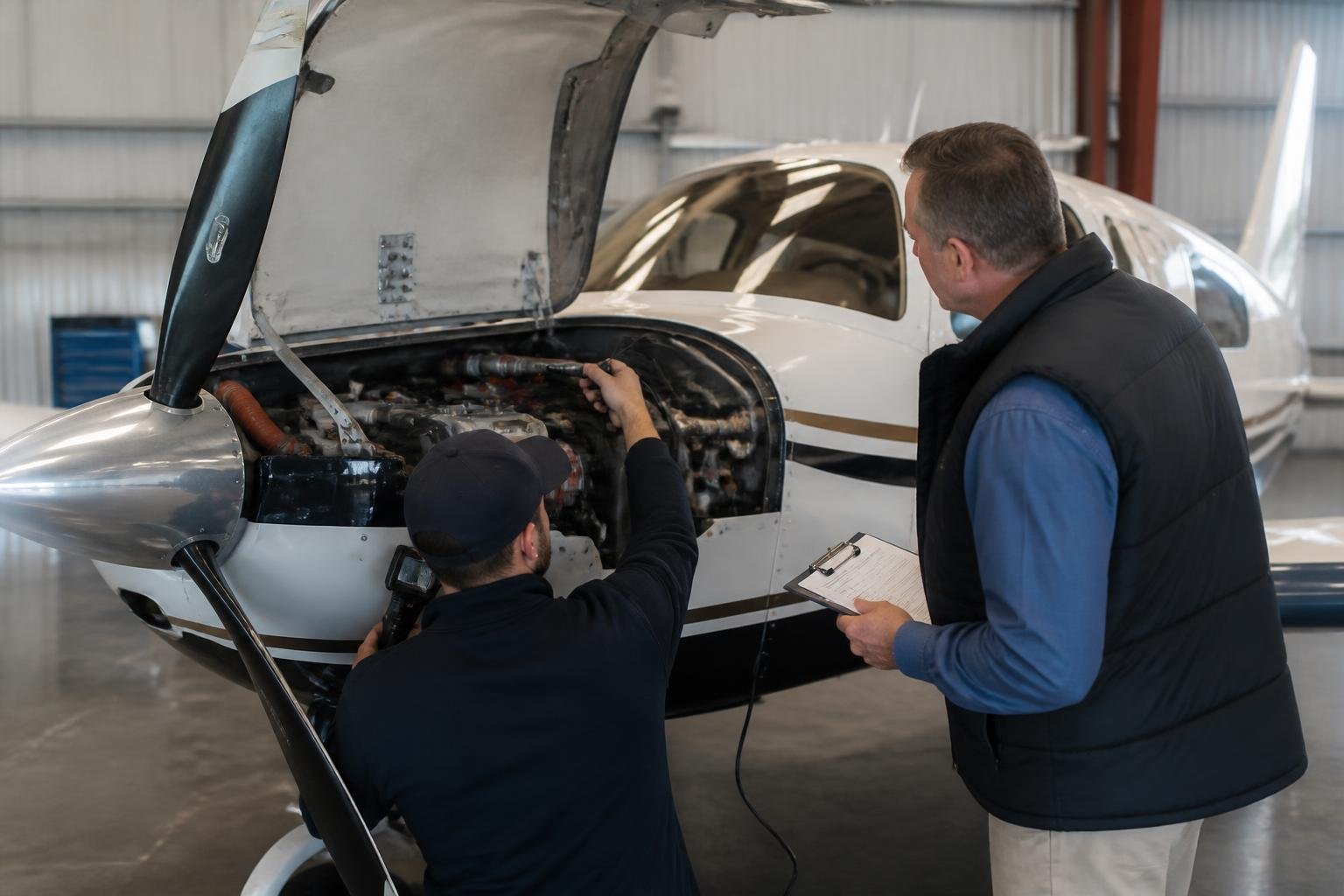
The pre-buy inspection should be performed for the buyer by an independent shop or technician with experience in the exact airframe, engine and turbo system. It is not an annual inspection, an appraisal or a substitute for the buyer’s broader legal and financial due diligence. Its scope should be agreed in writing before money changes hands.
- Establish continuity of airframe, engine, propeller, turbocharger and wastegate records.
- Review recurring discrepancies, unscheduled removals, repairs and periods of inactivity.
- Inspect exhaust components, induction plumbing, baffling, hoses, clamps and heat shielding.
- Check for evidence of leakage, chafing, heat distress, cracking and unsuitable repairs.
- Conduct borescope and compression assessments appropriate to the engine condition.
- Review downloadable engine-monitor data where available.
- Perform an operational evaluation to assess boost control, engine indications and installed equipment.
- Verify the condition, servicing status and completeness of supplemental-oxygen equipment when installed.
The buyer should ask for findings to be categorized by safety, airworthiness, operating limitation, near-term cost and cosmetic or convenience item. That makes negotiation and ownership planning more rational than relying on a single overall verdict.
Documentation Buyers Should Review Before Making an Offer
Documentation tells the story that appearance cannot. Review airframe, engine, propeller and appliance logbooks for continuity, legibility and consistency with the aircraft’s stated times. Examine records for major repairs, alterations, supplemental type certificates and compliance documentation. An installed item should not be assumed to be approved merely because it appears on an equipment list.
For the turbo system, request invoices and work orders for turbocharger, wastegate, controller and exhaust work where available. These records can establish part numbers, dates, reasons for removal and the organization that performed the work. Engine-monitor downloads and oil-analysis reports may add value, especially when they show a consistent multi-year pattern rather than an isolated report.
Ask directly about damage history, corrosion exposure, storage periods and geographic operating history. Coastal operation, outdoor storage and long dormant periods are not automatic disqualifiers, but they shape the inspection scope. Distinguish seller-provided equipment descriptions from the configuration independently verified during pre-buy. Missing records are not proof of a defect, but they increase uncertainty and should be reflected in the buyer’s decision.
Comparing Turbocharged and Naturally Aspirated Alternatives
Compare missions before comparing specifications. Write down the routes, field elevations, passenger load, baggage, expected fuel stops and seasonal weather that actually define your flying. Then compare candidate aircraft at the altitudes you can realistically use, not only at their best published altitude. A turbocharged aircraft may win decisively on a mountain route yet offer no material advantage for short low-level flights.
For Cessna, Piper, Mooney, Beechcraft, Cirrus and other relevant model families, useful buyer questions include:
- At what altitude will I normally cruise, and can I use oxygen comfortably there?
- What payload remains with the fuel required for my typical trip?
- Is the available maintenance support familiar with this engine and installation?
- What does the flight manual say about turbo operation, mixture and temperature limits?
- Would a normally aspirated version meet the same mission with less expense and workload?
- Does the aircraft’s avionics and de-icing equipment support the way I actually plan to fly?
Turbocharging adds capability, but it also adds decisions. The better choice is the aircraft that meets the mission with acceptable training demands, dispatch resilience and financial margin.
Evaluating a Used Turbocharged Aircraft in the Current Market
Model reputation is only a starting point. Two aircraft of the same type can have very different prospects because of maintenance quality, utilization, storage, engine operation and recent component work. A carefully documented aircraft with a transparent history can be easier to evaluate than a lower-time example with gaps, vague explanations or deferred discrepancies.
Listing and auction documentation should be treated as the beginning of due diligence, not its conclusion. Ask sellers how the engine has been operated, what power-setting practices were used, whether monitor data is available, how long the aircraft has been inactive, and why significant components were removed or replaced. Request clarity on the source of every important claim.
When reviewing suitably documented turbocharged aircraft listings, prioritize records, configuration and inspection access over a headline specification. Then arrange a qualified independent pre-buy inspection sized to the particular aircraft. That process protects both the buyer and the aircraft’s long-term ownership outcome.
Is a Turbocharged Piston Aircraft the Right Ownership Choice?
A turbocharged piston aircraft is most compelling for owners with repeatable high-altitude, high-terrain, hot-and-high or long-distance missions. It can offer valuable performance flexibility and a more comfortable strategic margin when operated within its approved limitations. That value is strongest when the pilot is equipped for oxygen use, weather decisions and the workload of a high-performance piston aircraft.
Prioritize simplicity when your mission rarely needs turbo capability, when payload is the decisive constraint, or when experienced maintenance support is limited. A naturally aspirated aircraft that is well maintained, comfortably funded and regularly flown may be the stronger ownership choice than a more complex aircraft whose capability goes unused.
Make the decision through five filters: mission, training, budget, maintenance support and inspection evidence. Start with the routes you will fly, then validate the individual aircraft’s condition through complete records, engine data and a specialist pre-buy inspection. Turbocharged aircraft ownership works best when its extra capability is purposeful and its additional responsibilities are accepted before the offer is made.

Comments
No comments yet
Be the first to share your thoughts!