

 Bad Vöslau
 Kirn
Kirn


 Florida

A trustworthy aircraft auction listing makes it easier to understand what is known, what is seller-reported, and what still requires independent verification. It does not eliminate risk or replace a pre-buy inspection. Instead, it gives a serious buyer enough clear, consistent evidence to assess the aircraft, estimate total acquisition exposure, ask informed questions, and decide whether bidding is justified.
Why Trust Matters in an Aircraft Auction Listing

An aircraft is a high-value technical asset whose condition cannot be judged from a headline description or a small group of photographs. Its value and suitability depend on airframe history, engine and propeller status, maintenance quality, installed equipment, corrosion exposure, modifications, records continuity, legal ownership, and the buyer’s intended mission. A credible aircraft auction listing helps a buyer begin evaluating those factors before committing funds.
Auctions can be efficient because they organize information, bidding and transaction timing in one process. That convenience must not be mistaken for reduced due diligence. The seller usually knows more about the aircraft’s history than a prospective bidder, while the bidder may be reviewing the aircraft remotely or under a limited timetable. This information asymmetry is normal, but it makes transparent records and specific disclosures especially important.
Listing credibility and aircraft condition are related but not identical. A well-organized listing may describe an aircraft with defects, incomplete records or deferred work honestly. Conversely, an attractive aircraft may be presented with vague claims that do not stand up to document review. The more a listing distinguishes documented facts from seller statements and unknown items, the more useful it is to a buyer.
Trust signals are therefore a starting point, not a guarantee of airworthiness, title quality, regulatory compliance or future maintenance cost. A disciplined bidder treats a detailed listing as an invitation to verify, rather than a substitute for verification.
The Core Elements of a Trustworthy Listing

A reliable listing begins with a clear aircraft identity. The manufacturer, model, year of manufacture, serial number, registration where applicable, and configuration should be stated accurately enough for a buyer to connect the listing to the aircraft, records and inspection findings. Variant names matter: differences within a model family can affect engine installation, useful load, fuel system, equipment approvals and maintenance considerations.
Location should be defined clearly, along with realistic arrangements for viewing the aircraft and reviewing documentation. A buyer needs to know whether the aircraft is in a hangar, on a ramp, in maintenance, in storage, or in a location where access is limited. If an inspection is possible, the listing or auction process should make clear how it may be arranged and whether access requires advance notice.
Structured specifications make comparison easier. A useful presentation identifies installed engine and propeller types, reported times, avionics, interior and exterior condition descriptions, equipment, modifications and known operational limitations. The listing should not bury material facts inside broad promotional language. A specific statement such as “seller reports one inoperative instrument” is more valuable than an unsupported assurance that the aircraft is “excellent.”
- Verified documents should be identified as documents, not converted into broad conclusions.
- Seller-provided statements should be attributed clearly.
- Unknown, unavailable or unverified information should be disclosed rather than implied.
- Listing fields, photos and supplied documents should not contradict one another.
Consistency is one of the strongest practical trust signals. A discrepancy may have an innocent explanation, but it deserves a question before bidding. Buyers should compare serial numbers, equipment lists, reported times and maintenance dates across the listing, logbooks, invoices and photographs.
Aircraft Documentation That Buyers Should Expect
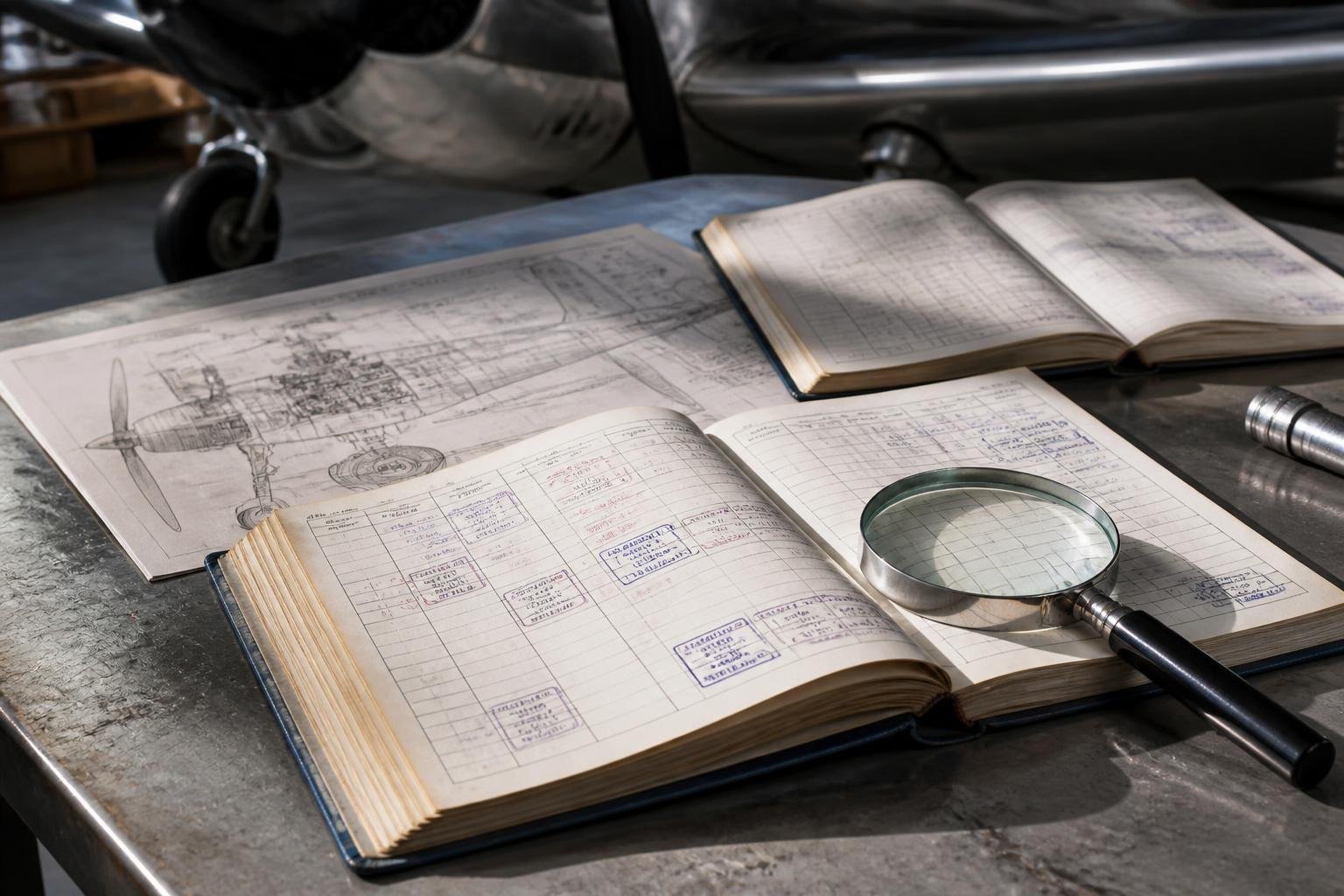
Documentation is often the foundation of an aircraft auction listing. The precise records expected vary by jurisdiction, certification basis and aircraft type, but buyers should normally seek airframe, engine and propeller logbooks or equivalent maintenance records. These should allow a qualified reviewer to understand the recorded history, significant maintenance events, component times, inspection pattern and any apparent gaps in the timeline.
Ownership and registration records are also important. The buyer should understand who has authority to sell the aircraft and what process will be used to transfer title. Registration records alone may not establish title in every jurisdiction, so the appropriate title, lien and ownership checks remain part of buyer due diligence.
Maintenance status should be described carefully. Records may show annual, periodic, calendar-based or other inspections, depending on the aircraft and regulatory framework. A listing should avoid suggesting that an aircraft is current, airworthy or ready for operation unless that conclusion is directly supported and within the proper authority to make it. Buyers should ask what maintenance has been completed, what work is due, and what work may have been deferred.
| Record area | What a buyer should look for |
|---|---|
| Logbooks | Continuity, legibility, component identification and recorded maintenance events |
| Alterations | Major repair records, supplemental type certificate paperwork and supporting entries |
| Weight and balance | Current documentation reflecting installed equipment and configuration |
| Damage history | Specific disclosure plus repair documentation when available |
| Ownership records | Authority to sell, title-transfer process and relevant registration information |
Gaps, illegible entries and unexplained changes in recorded time do not automatically make an aircraft unacceptable. They do, however, affect confidence and may affect insurability, resale appeal, maintenance planning and valuation. A trustworthy listing brings those limitations into view rather than allowing the buyer to discover them after the auction.
Photos, Video and Visual Evidence: What Good Coverage Looks Like

Good visual evidence gives the buyer a current, candid view of the aircraft. Recent high-resolution exterior photographs should show multiple angles, not only the most flattering side. Useful coverage includes wings, empennage, windshield, control surfaces, tires, brakes and areas where corrosion, paint deterioration, repairs or hangar rash may be visible.
The cockpit deserves equally careful treatment. Images of the panel, avionics, seats, belts, cabin trim, controls and baggage area allow a buyer to compare the visual configuration with the equipment list. For an aircraft marketed partly on its avionics or interior, vague photographs are not enough. Images should make it possible to identify what is physically installed without implying that every item is operational, approved or current.
Engine compartment, propeller and landing gear photographs can reveal general presentation and help frame inspection questions. Close-ups of known cosmetic defects, repairs, corrosion, chipped paint, worn upholstery or damaged trim are particularly useful. Candid disclosure through images often improves confidence because it shows that the listing is not trying to conceal ordinary imperfections.
- Look for photographs that appear to be of the same aircraft and broadly the same period.
- Compare visible avionics, antennas, propeller type and cabin details against the written description.
- Ask when images and video were captured if the aircraft has been stored, repaired or modified recently.
- Treat video of an engine run as limited evidence, not a mechanical evaluation.
Photographs cannot establish airworthiness, compression condition, internal corrosion status, structural integrity, regulatory conformity or the quality of an earlier repair. Lighting can hide paint defects, and a closed inspection panel can conceal important areas. Visual material supports a decision to investigate; it cannot replace a suitable inspection.
Seller Disclosure and the Value of Specific Answers

The strongest seller disclosures are factual and bounded. They describe known defects, deferred maintenance, inoperative equipment, periods of inactivity, storage environment and repair history without attempting to predict the outcome of a future inspection. Specificity matters because it lets the buyer assess practical consequences and decide which issues require specialist attention.
A seller who knows of an accident, incident, hail exposure, corrosion finding, significant repair or recurring defect should disclose the known information and, where available, provide supporting records. The same principle applies to a long period of storage. Inactivity does not determine condition by itself, but it raises legitimate questions about preservation, engine inactivity, seals, fuel-system condition, tires, brakes, battery condition and inspection requirements.
A reason for sale may be useful when voluntarily supplied, but it is not proof of condition. Buyers should place more weight on records, consistency and answers to technical questions than on a general narrative. The most useful question-and-answer exchange is one in which the seller or representative responds directly, identifies uncertainty and avoids overstating what can be known.
Warning signs include evasive replies, conflicting statements, repeated reliance on unsupported assurances, and reluctance to clarify a material discrepancy. A seller does not need to be an engineer to give a credible answer. It is reasonable, however, to expect them to distinguish personal knowledge from information received from a maintenance provider, prior owner or other party.
How Auction Platform Practices Support Confidence
A professional auction platform can improve the quality and accessibility of information without becoming the guarantor of the aircraft. Identity and listing-submission processes help establish who is presenting the aircraft. Standardized fields encourage sellers to provide key details in comparable categories, while organized document areas make it easier for bidders to conduct a structured review.
Trust improves when the platform clearly distinguishes seller-supplied statements from platform-provided information. Buyers should be able to understand which condition details originate with the seller, which documents have been made available, and which auction rules govern the transaction. A platform should not imply that its review amounts to an airworthiness inspection, title opinion or independent valuation unless it explicitly provides such a service and defines its scope.
Question-and-answer mechanisms are valuable when they give registered or prospective bidders a practical way to ask material questions before the bidding deadline. Public answers can also reduce information imbalance by making clarifications available to all interested parties. The process should not prevent a buyer from seeking independent professional advice.
Clear timing, bid rules, reserve treatment, deposits, payment requirements, collection arrangements and dispute procedures are fundamental. These policies allow buyers to assess their contractual exposure before placing a bid. Platform safeguards support confidence by making the process more transparent; they do not alter the buyer’s responsibility to verify condition, title, compliance and suitability for the intended mission.
Auction Terms That Deserve Careful Reading
A bidder should read the auction terms before becoming emotionally invested in an aircraft. Reserve, no-reserve and subject-to-approval structures have different practical effects. A reserve auction may not result in a sale at the highest visible bid. A no-reserve format may determine a winner under stated rules, while a subject-to-approval arrangement can involve a subsequent seller decision. The terms should explain the applicable structure rather than leave the buyer to infer it.
The apparent bid is not necessarily the full acquisition cost. Buyers should calculate any buyer’s premium, transaction fees, applicable taxes, inspection expense, insurance, storage, transport, import or export cost, and likely remedial work. Taxes and transfer obligations vary by jurisdiction, transaction structure and intended use, so specialist advice may be appropriate.
Deposit rules require particular attention. Confirm the amount, due time, payment method, whether it is credited to the purchase price, and the circumstances in which it may or may not be refundable. Payment deadlines and accepted payment methods should be workable for the buyer’s bank, currency arrangements and internal approval process.
- Establish who is responsible for collection, storage and transport after the sale.
- Review title-transfer procedures and any export documentation requirements.
- Understand whether a collection deadline may lead to storage charges.
- Read “as-is, where-is” language in full before bidding.
As-is, where-is terms generally allocate substantial condition risk to the buyer, subject to the governing terms and applicable law. They are not a reason to ignore a material misdescription, but neither do they create an implied inspection or warranty. The practical response is to investigate more thoroughly before bidding, not less.
Independent Verification Before You Bid
An independent pre-buy inspection is often the most important step a buyer can take before bidding. The mechanic or maintenance organization should be suitably qualified for the aircraft type, engine and scope of work. Independence matters: the inspector should be engaged by the buyer and asked to provide findings directly to the buyer, not simply to repeat the seller’s maintenance history.
The inspection scope should be agreed in writing. It may include a records review, visual inspection, operational checks where appropriate, corrosion assessment, borescope work, compression testing, avionics verification, damage-repair review or other tasks suited to the aircraft. No inspection can eliminate all risk, but a defined scope makes its limitations understandable.
A type-experienced professional can also review logbooks for continuity, recorded compliance items, time calculations and alteration history. Buyers should independently check title, liens and registration through the relevant jurisdictional processes. Installed avionics, modifications and serial numbers should be compared with the listing and documentation, particularly when equipment materially affects the buyer’s mission or aircraft value.
A test flight may be useful only where permitted by the seller, safe and appropriate under the applicable operating rules, insurance requirements and aircraft status. It is not a substitute for maintenance inspection. Before bidding, buyers should also investigate insurability, hangarage availability, training requirements, realistic operating costs and the practical path to registration or importation. Keep written findings, photos and scope documents in the transaction file.
Common Red Flags in Aircraft Auction Listings
Red flags do not always mean a listing is fraudulent or an aircraft is unsuitable. They mean the buyer should slow down, ask more questions and adjust the bid strategy to reflect uncertainty. Missing or materially incomplete logbooks are among the most significant concerns because they can limit a reviewer’s ability to establish maintenance history, component times, repair evidence and compliance records.
Stock imagery, photographs with unclear dates, or images that do not appear to match the written configuration undermine confidence. So do mismatches between equipment lists, panel photographs, serial-number records and maintenance documents. A discrepancy may be caused by an upgrade, clerical error or old photograph, but it must be resolved rather than ignored.
Unexplained low time, long-term storage, recent major repair or an unusually broad condition claim requires evidence. Buyers should be cautious when a seller relies on phrases such as “needs nothing” or “ready to fly” without records, inspection support or appropriately qualified confirmation. Pressure to bypass formal auction procedures, pay outside the stated process, or avoid a documented title transfer is a serious warning sign.
- Restrictions on viewing or reasonable independent inspection without a clear operational reason.
- Refusal to answer direct questions about known history or documentation gaps.
- Unclear ownership authority or inconsistent title paperwork.
- Claims of upgrades or overhaul without invoices, logbook entries or identifying details.
- Contradictory statements about damage, storage or operational status.
When evidence remains insufficient, the right decision may be not to bid. A disciplined withdrawal is often less costly than discovering after purchase that a seemingly minor uncertainty has wider consequences.
How to Compare Listings and Bid With Discipline
Compare aircraft auction listings by evidence quality and condition-adjusted relevance, not by headline price alone. Two aircraft of the same model can differ substantially in records continuity, engine status, avionics capability, paint and interior condition, corrosion exposure, modification history and near-term maintenance needs. A lower bid on a less documented aircraft may not represent lower ownership cost.
Create a total acquisition estimate for each candidate. Include the expected winning bid, buyer’s premium, taxes and fees where applicable, inspection travel, professional review, ferry or transport, insurance, hangarage, registration work and an allowance for identified remedial items. Do not treat a current auction bid as market value, appraisal value or final transaction price.
Set a maximum bid before auction activity becomes intense. That figure should reflect only verified information, a conservative view of unknowns and the buyer’s financial capacity after transaction costs. It should not rise merely because another bidder is active. If an inspection, title check or document review reveals a material uncertainty, revise the limit or stop bidding.
Submit essential questions early enough to receive and evaluate answers before the auction closes. Save listing copies, photographs, records made available, correspondence, auction terms and inspection findings. This archive helps the buyer compare candidates, document the basis for the bid and prepare for post-auction transfer. A trustworthy listing supports disciplined bidding; it should never encourage a buyer to abandon a pre-set decision process.
A Practical Trust Checklist Before Placing a Bid
Before placing a bid, confirm the aircraft’s identity, stated location and seller authority as far as the available process permits. Review records for completeness, consistency and unexplained gaps. Match the visible aircraft, equipment and configuration to the listing, while remembering that photographs do not establish condition or airworthiness.
- Confirm the manufacturer, model, serial information, configuration and location.
- Review airframe, engine, propeller and alteration records with appropriate professional help.
- Document known defects, damage disclosures, storage history and unanswered questions.
- Check that visual evidence matches the stated avionics and equipment.
- Calculate premiums, taxes, deposits, deadlines, transport and likely remedial costs.
- Decide whether an independent pre-buy inspection and records review are required.
- Plan insurance, collection, registration, hangarage and any cross-border transfer steps.
- Set a maximum bid before bidding begins and stop if material evidence remains unavailable.
The most trustworthy aircraft auction listing is not necessarily the one with the most flattering presentation. It is the one that helps a buyer see the aircraft clearly: its identity, records, configuration, known limitations, transaction terms and remaining uncertainties. When that information is paired with independent verification and a disciplined bid limit, an auction can be an efficient way to pursue the right aircraft without treating confidence as certainty.

Comments
No comments yet
Be the first to share your thoughts!