
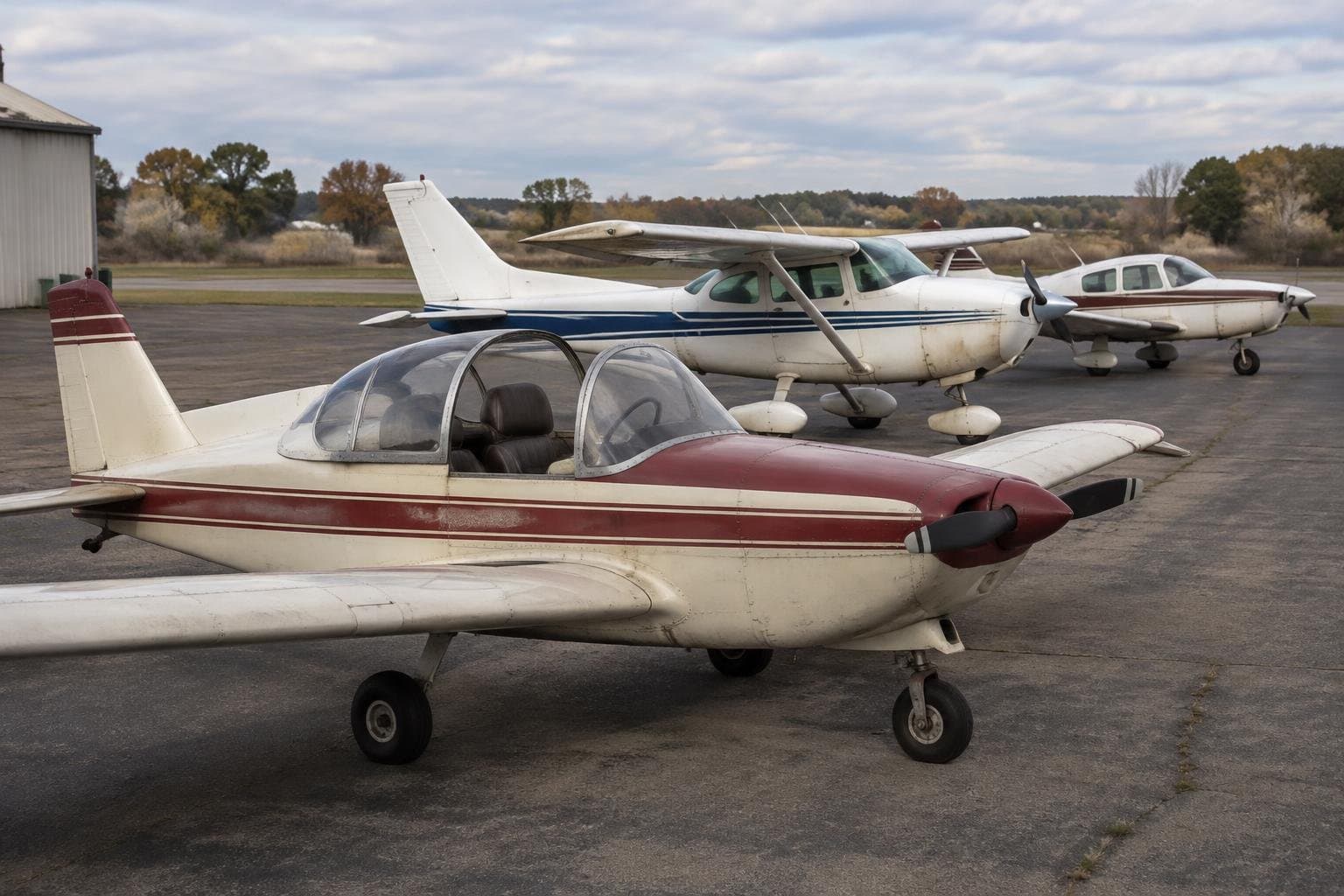
At a Glance: Which Aircraft Fits Your Flying?
In a Grumman AA-5 Traveler vs Cessna 172 comparison, the Traveler belongs on the shortlist for two-person touring from paved runways, while the 172M is the natural starting point for buyers who value a familiar training platform. The Piper Cherokee 140 offers a conventional low-wing alternative for solo or two-person flying; its equipment, approved seating and actual loading limits determine how well it handles anything more.
Shortlist the Traveler if low-wing sightlines, a sliding canopy and easy access to the front seats appeal to you. Its steering and boarding arrangements are different enough from a Skyhawk’s that a ground demonstration and a checkout are worth arranging before you settle on the type. Shortlist the 172M if you prefer a high wing, a door on each side and a panel and cockpit layout familiar to many instructors. Check that your local shop actually supports older 172s; familiarity with newer Skyhawks does not answer every maintenance question on an M model.
Shortlist the Cherokee 140 if most trips involve one or two people and you like its cabin and handling. Don’t assign much value to rear seats until you’ve checked the installed configuration and run the numbers. For all three, the better buy may be the aircraft with the clearer repair history and more usable payload, not the model with the more attractive brochure figures.
Which Model Years and Variants Belong in the Comparison?
The Grumman baseline is the original AA-5 Traveler. The later AA-5A Cheetah and AA-5B Tiger are separate variants; don’t use their weights, tank capacities or performance to fill gaps in a Traveler listing. The Cessna baseline is a period-appropriate 172M, not an average across decades of Skyhawks. For the Piper, the comparison uses a 1974 PA-28-140 Cherokee Cruiser with a 150 hp engine and treats rear seating as configuration-dependent. The “140” model designation alone does not tell you the engine rating or how many seats an individual aircraft is approved to carry.
| Item | 1974 Grumman AA-5 Traveler | 1975 Cessna 172M | 1974 Piper PA-28-140 Cherokee Cruiser |
|---|---|---|---|
| Baseline engine | Lycoming O-320-E2G, 150 hp | Lycoming O-320-E2D, 150 hp | Lycoming O-320-E3D, 150 hp baseline; verify approved installation |
| Maximum takeoff weight | 2,200 lb | 2,300 lb | 2,150 lb |
| Usable fuel | 37 US gal | 38 US gal with standard tanks | 48 US gal with standard tanks |
| Seating | Four positions in standard configuration | Four positions in standard configuration | Two front seats; count rear positions only if approved and installed |
| Illustrative cruise | 115 KTAS | 110 KTAS | 105 KTAS |
| Takeoff ground roll / over 50 ft | Use the applicable AA-5 performance chart | 865 ft / 1,525 ft as published reference figures; use the chart for actual conditions | Use the applicable PA-28-140 performance chart |
Start with the FAA type certificate data sheets for the AA-5, 172M and PA-28-140 to identify the certified model, approved engines and applicable limitations. Use the flight manual, operating handbook or approved operating material applicable to the serial number for loading and performance. The 172M runway figures above are reference figures, not a matched-condition test against the other two; substituting unrelated figures from a sales listing would make the comparison less useful.
Keep modifications in a separate column on your own comparison sheet. An engine conversion, replacement propeller, different tanks or changes to seating can affect both the numbers and the paperwork you need. Ask for the approval basis, applicable flight manual supplements and updated weight-and-balance records. A seller’s description of a modification is not enough to establish a higher weight limit or authorize a seating change.
Grumman AA-5 Traveler vs Cessna 172: Training and Touring
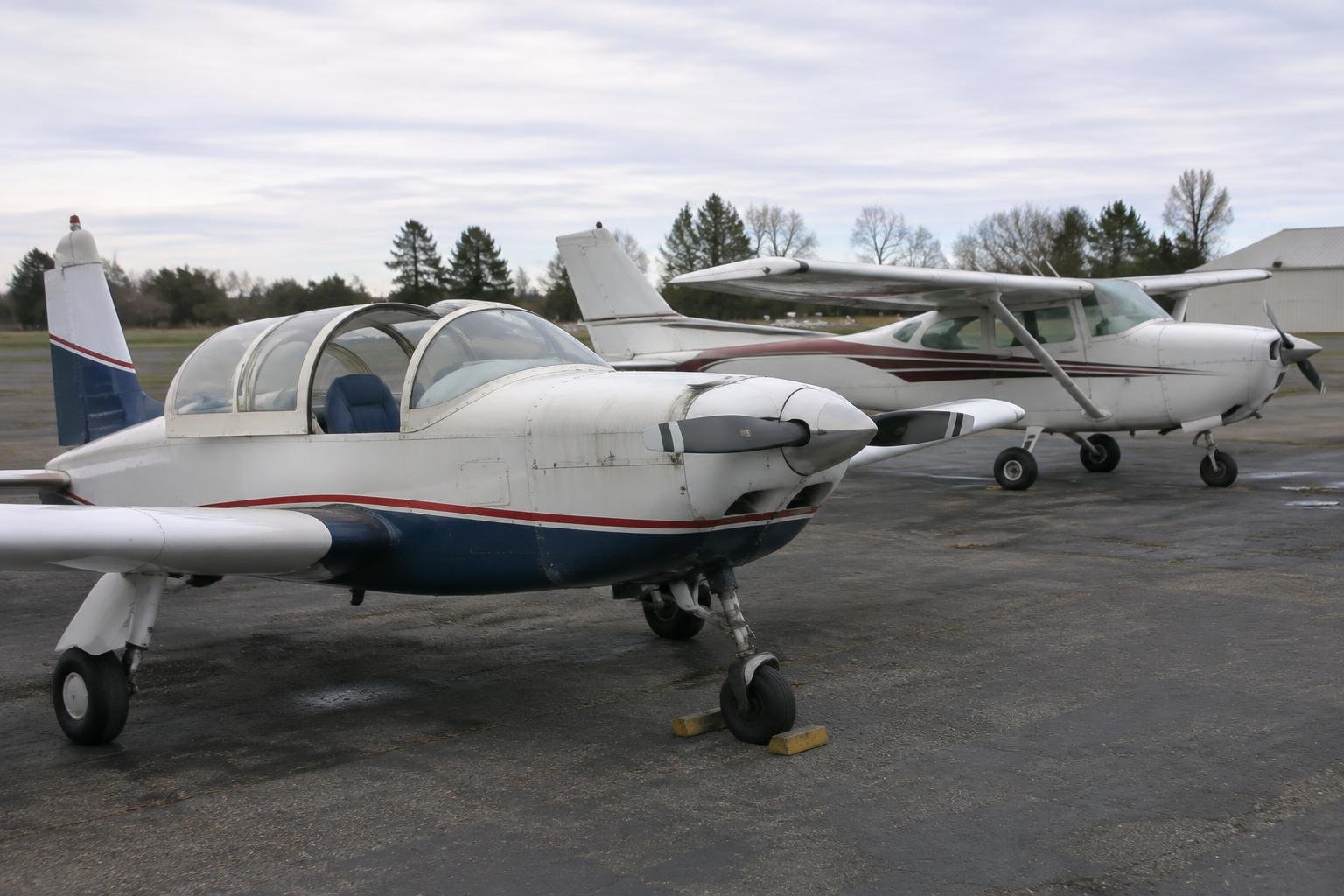
The high-wing 172M generally provides a better view down toward the ramp and ground references, while the Traveler’s low wing leaves more of the upper side view open. Neither layout eliminates blind spots. On the ramp, compare what you can see from the seated position near the wing tips and at taxiway intersections. In the pattern, have an instructor show you where the wing hides traffic during turns and how that changes between the two aircraft. A view that feels good in level cruise may be less useful when you’re banked and looking for another aircraft.
The larger adjustment for many Skyhawk pilots comes before takeoff. The Traveler’s nosewheel casters, and differential braking provides steering at low speeds when rudder authority is limited. The 172M uses pedal-linked nosewheel steering, with differential braking also available. A checkout should include tight turns, braking feel and crosswind taxi in suitable conditions. If the Traveler takes noticeably more brake on one side or is hard to keep straight, don’t write it off as a type characteristic; ask the mechanic to evaluate it.
The Traveler’s sliding canopy opens up the cockpit for boarding and ground ventilation. It also asks passengers to step onto the wing and lower themselves into the cabin. The 172M’s side doors let front occupants enter from either side without climbing onto a wing, an advantage if you regularly carry someone with limited mobility. Try both arrangements with the passengers and bags you actually expect to carry. Check that the canopy moves and latches correctly, and follow the applicable operating limitations rather than assuming that ground ventilation options are permitted in flight.
For a pilot moving out of a 172, budget for instruction in the Traveler that covers sight picture, configuration changes, speed control, crosswind handling and go-arounds. Discuss landing technique and nosewheel handling with an instructor who knows the AA-5. For recurrent training, verify that the same instructor will be available after purchase, not just for a delivery checkout.
Grumman AA-5 Traveler vs Piper Cherokee 140: Two Low-Wing Choices
The Traveler and Cherokee share a low-wing layout, but they don’t board the same way. The Traveler’s canopy opens above the cabin. On the Cherokee 140, occupants use the right-side wing step and cabin door. That single entrance affects the order in which people get in and out; with a rear passenger, test the process with the front seat adjusted as it would be in flight. Check whether worn seat hardware or stiff door or canopy operation makes access harder than it should be.
Inspect baggage access on the exact aircraft rather than assuming that every example has the same arrangement. Try loading a representative soft bag, note what has to move out of the way and check where the bag can be restrained. Rear-seat space that works for a short local flight may not work for a long trip, and a space that physically accepts a bag is not necessarily an approved baggage station. Verify the placards, limits and seat installation against the aircraft documents.
On the ground, the Cherokee’s steerable nosewheel will feel more familiar to many pilots than the Traveler’s castering arrangement. In the air, don’t transfer approach numbers or the flare sight picture from one low-wing aircraft to the other. Have an instructor cover the model-specific landing behavior, including speed control, crosswinds and what to do after an unstable approach or a bounce. A checkout also gives you a chance to see whether the seat adjustment offers a consistent view and comfortable pedal reach.
For solo flying, the decision may come down to canopy or door preference, ground handling and local support. For weekend trips with two people, compare the time and fuel needed for the route, then load the bags before deciding which cabin works better. For occasional rear-seat use, place more weight on approved seating, access and center-of-gravity calculations than on the number of cushions visible in a listing.
Grumman AA-5 Traveler Useful Load: What Can You Actually Carry?
Calculate useful load by subtracting documented empty weight from the applicable maximum takeoff weight, using the empty-weight definition in the aircraft’s records. Then deduct the weight of usable fuel to find what remains for occupants and baggage. The examples below use 6 lb per US gallon of avgas across all three aircraft. The empty weights are hypothetical, not fleet averages; installed avionics, interior changes and past modifications can make two aircraft of the same model materially different.
| Calculation | Traveler | 172M | Cherokee 140 |
|---|---|---|---|
| Assumed empty weight | 1,350 | 1,410 | 1,300 |
| Calculated useful load | 850 | 890 | 850 |
| Full usable fuel weight | 222 | 228 | 288 |
| Payload at full usable fuel | 628 | 662 | 562 |
| Payload at 32 US gal usable | 658 | 698 | 658 |
Two adults weighing 190 and 175 lb with 60 lb of baggage total 425 lb. All three examples can carry that payload on weight alone at full fuel. Add a 165 lb rear passenger and the payload rises to 590 lb. At full fuel, the Traveler example has 38 lb remaining, the 172M has 72 lb and the Cherokee is 28 lb over. At 32 US gallons, all three pass the total-weight check for 590 lb. That doesn’t make 32 gallons sufficient for the trip, or make the rear seat legal to occupy.
Run the moment and center-of-gravity calculations at takeoff and at expected landing fuel, and check any intermediate condition that could be limiting. Verify the approved seats, individual station limits and baggage compartment limits separately. Putting a light passenger and a heavy bag behind the front seats is not equivalent to moving the same combined weight forward. Ask for the current weight-and-balance report and equipment list, and have the mechanic reconcile them with the installed equipment if the records are unclear. A listing’s useful-load number is only as dependable as the paperwork behind it.
Cruise, Fuel Burn, and Runway Performance
Compare cruise in knots true airspeed and fuel flow in US gallons per hour. Use the applicable handbook tables at the same pressure altitude and a comparable documented percentage of power, temperature and mixture setting wherever the tables permit it. For example, look for entries close to 65 percent power at 5,000 ft pressure altitude in standard conditions. Don’t substitute indicated airspeed for true airspeed, or compare one aircraft’s economy setting with another’s faster cruise setting. Where the handbook data do not line up, keep the conditions beside the numbers rather than claiming a measured speed advantage.
For a trip-budget illustration, assume 115 KTAS and 8.0 US gal/hr for the Traveler, 110 KTAS and 8.5 US gal/hr for the 172M, and 105 KTAS and 8.5 US gal/hr for the Cherokee. These are worksheet inputs, not verified outputs at the comparison power and altitude. On a 360 NM still-air leg, cruise-equivalent times are about 3 hours 8 minutes, 3 hours 16 minutes and 3 hours 26 minutes, respectively. Add a common 45-minute reserve at the assumed cruise burn and a simplified 2 US gal allowance for taxi and non-cruise fuel. The worksheet then calls for about 33.0, 36.2 and 37.5 usable gallons, respectively.
On those assumptions, all three examples have enough usable tank capacity in still air, but none can complete that leg on the 32-gallon loading scenario while retaining the stated reserve. With a 20-knot headwind at cruise, the estimates rise to about 38.3, 42.4 and 44.4 gallons. That puts the Traveler and standard-tank 172M over capacity. The Cherokee can hold that much fuel, but the sample three-person load cannot depart with it within maximum takeoff weight. For a real dispatch decision, use route winds and actual climb and cruise fuel, follow applicable reserve rules and plan a fuel stop when the required fuel or operating margin won’t fit.
For runway comparisons, ground roll ends at liftoff on takeoff or measures the ground portion on landing. Distance over a 50-foot obstacle includes the airborne portion as defined in the handbook. Pull both figures for the same runway surface, wind, weight, pressure altitude, temperature and configuration when the manuals support a direct comparison. Do that for departure and arrival, including the return leg on a warmer day. More weight and higher density altitude can reduce the margin substantially; a soft, wet or uneven surface changes the question again. Apply only the corrections supported by the applicable data, don’t extrapolate beyond the charts, and don’t treat an unsupported surface as equivalent to dry pavement.
Grumman AA-5 Traveler Operating Costs
Separate bills you pay regardless of flight time from those driven by use. Fixed expenses include a hangar or tie-down, insurance, base annual inspection labor and applicable recurring fees. The inspection labor line is not an allowance for whatever the inspection finds. Hourly expenses include fuel and oil, engine and propeller reserves, and wear items such as tires and brake parts. Check whether your fuel bill and flight-hour denominator use the same basis; a cruise burn assumption multiplied by billed or logged hours is only a budgeting shortcut.
The sample below is a hypothetical U.S. owner budget in USD, not a quote from a particular airport or shop. It assumes $7 per US gallon of avgas and the fuel burns used in the trip example. Each aircraft carries $26 per flight hour for engine reserve, $3 for propeller reserve, $2 for oil and $9 for routine wear. The engine allowance, for instance, corresponds to setting aside $39,000 over 1,500 budget hours; it does not predict overhaul cost or remaining engine life. All three examples use $3,000 for storage and $200 for recurring fees. Insurance and base annual labor are $1,200 and $1,600 for the Traveler, $1,300 and $1,700 for the 172M, and $1,200 and $1,500 for the Cherokee.
| Budget item | Traveler | 172M | Cherokee 140 |
|---|---|---|---|
| Fixed per year | $6,000 | $6,200 | $5,900 |
| Variable per flight hour | $96.00 | $99.50 | $99.50 |
| 50 hours: annual total / per hour | $10,800 / $216.00 | $11,175 / $223.50 | $10,875 / $217.50 |
| 100 hours: annual total / per hour | $15,600 / $156.00 | $16,150 / $161.50 | $15,850 / $158.50 |
Flying more lowers the average hourly cost in this example because the fixed bills are spread over more hours; total spending still rises. The small modeled differences between types don’t justify choosing one over an aircraft with a better engine history or easier local support. Replace the assumptions with airport, insurer and shop quotes. Keep a separate first-year allowance for deferred maintenance, transition training and planned upgrades, using written estimates where possible. A reserve funded after purchase won’t cover an engine expense that is already due.
Maintenance Support and Model-Specific Pre-Buy Checks
For the Traveler, hire someone familiar with bonded Grumman construction. Ask them to assess the bonded airframe for deterioration, separation or evidence of prior repairs and to verify that any repair is supported by appropriate data and records. Include canopy tracks, rollers and latches, and have the mechanic examine the castering nosegear and brakes for wear and correct function. Ask how a significant structural finding would be evaluated and who could perform a repair locally.
On the 172M, ask about corrosion in areas relevant to the model, its exposure history and any known leaks or previous repairs. The inspection should include the seat rails and locking hardware and a review of applicable airworthiness directives, including recurring actions. On the Cherokee 140, don’t assume that a wing-spar directive applies, or doesn’t apply, because a listing says “Cherokee.” Have the mechanic determine applicability under the current rules using the aircraft and component identification and relevant service history, document any required inspections or actions, and examine corrosion and prior repair history.
Before paying for travel, call shops near the intended home airport. Ask who works on the exact type, whether they’re taking new customers and how they source common and model-specific parts. The answer matters if an aircraft is grounded waiting for a part or if the nearest mechanic comfortable with a bonded-airframe repair is several hours away. A type-experienced mechanic at the seller’s airport can still be useful for the pre-buy even if a different shop will maintain the aircraft afterward.
Agree on an independent pre-buy scope in writing: records review, physical access the seller will permit, inspection priorities and how findings will be reported. Ask the mechanic to distinguish regulatory or airworthiness concerns from foreseeable maintenance and optional improvements. A pre-buy is not an annual inspection or a return-to-service approval. An appraisal addresses value; it doesn’t replace either the physical inspection or a review of the supporting records.
Comparing Asking Prices and Setting a Bid Ceiling
Build a comparable set around the actual variant, then filter by region, avionics and other installed equipment, engine and propeller history, documentation and airframe condition. Time since overhaul is only one part of the engine comparison: examine overhaul scope, calendar age, use and supporting records. Make adjustments for concrete differences, such as an avionics installation you need or corrosion work identified in an inspection, rather than treating the cheapest advertised aircraft as the baseline.
Keep asking prices, verified completed sales, current auction bids and appraisals in separate columns. An asking price is a seller’s position. A current bid is not a sale, and even a published auction result may not show whether fees were included or the transaction closed. An appraisal has its own date, purpose and assumptions. If the closest evidence is sparse, narrow what you are willing to conclude rather than publishing or relying on a price range the evidence can’t support.
Work backward from your all-in acquisition budget. If you can spend $80,000, and allow $5,000 for fees and transport plus $8,000 for documented first-year work, the maximum aircraft price is $67,000 before any additional contingency. If the buyer’s fee or tax is a percentage of the sale price, calculate the ceiling with that percentage rather than assuming the deduction is fixed. Revise the ceiling when new inspection findings can be priced. If a records gap prevents you from establishing the configuration, compliance status or scope of a repair, passing may make more sense than making a lower bid.
Your Shortlist: What to Verify Before Making an Offer
| Mission | Where to start | What can change the decision |
|---|---|---|
| Local training | 172M if local instructors and shops know the model | A well-supported Traveler or Cherokee may be the better purchase if instruction and insurance are available. |
| Two-person touring | Traveler for canopy access and paved-runway touring; compare all three on the same route | Required fuel, baggage space and actual payload can outweigh a modest cruise advantage. |
| Frequent passenger flights | 172M if doors on both sides make boarding easier | Check actual access, seat approvals, baggage limits and loaded center of gravity with your regular passengers. |
| Short, high, hot or unpaved runway | No model choice without checking the specific aircraft and runway | Eliminate any aircraft that lacks applicable performance data or adequate margin under expected conditions. |
Eliminate aircraft that cannot carry your normal payload with the fuel and runway margin you need. Also rule out examples you cannot reasonably maintain locally or whose critical records cannot be reconciled. Those constraints matter more than a panel upgrade or a slightly lower purchase price.
For the aircraft still on the list, request the current weight-and-balance report, equipment list and relevant operating documents. Obtain an insurance quote for the aircraft and named pilots, including any checkout requirements, and arrange an independent pre-buy before making an unconditional commitment. If a matching Traveler, 172M or Cherokee 140 is available on CollectAirs, apply the same records, loading and inspection criteria to that aircraft before deciding whether to bid.

Comments
No comments yet
Be the first to share your thoughts!