

 Bad Vöslau
 Kirn
Kirn

 Florida

Piper Mirage vs Meridian: the decision in brief
The Piper Mirage vs Meridian decision is fundamentally a choice between a pressurized piston single and a single-engine turboprop sharing much of the same PA-46 family concept. A Mirage can be a sensible aircraft for an owner-pilot who values a comfortable, capable cross-country cabin but wants piston-engine acquisition and operating exposure. A Meridian suits a buyer whose travel pattern places a clear value on stronger climb, higher cruise performance and turbine capability—and who has the budget, training commitment and maintenance reserve to support it.
For many buyers, the Mirage is the rational answer for regional trips, moderate annual utilisation and missions where saving an hour is useful but not decisive. The Meridian becomes more compelling when schedules are time-sensitive, weather-routing flexibility matters, the typical trip is longer, or the aircraft will regularly carry several occupants and meaningful baggage. The core trade-off is not simply fuel burn: it is capital at risk, maintenance planning, insurance, training and the operational discipline required for each type.
It is also vital to separate a model-family comparison from an individual-aircraft decision. A well-documented Mirage with a healthy engine, sensible avionics and complete records may be a stronger purchase than a neglected Meridian. Equally, a Meridian with a current engine programme, coherent maintenance history and appropriate equipment may justify its higher ownership exposure. The exact year, serial number, engine status, equipment fit, modifications, location and records determine the aircraft a buyer is actually considering.
- Choose the Mirage direction when piston ownership economics and a pressurized personal-travel aircraft are the priorities.
- Choose the Meridian direction when mission speed, climb performance and turbine capability materially improve how the aircraft will be used.
- Pause the decision when annual utilisation, training capacity, support access or capital reserves do not yet support either ownership path.
How the PA-46 Mirage and Meridian fit within the Malibu family

The PA-46 lineage was built around a distinctive owner-flown proposition: a relatively narrow, six-seat-class pressurized cabin in a single-engine aircraft intended for serious personal and business travel. Pressurization is central to the family identity. It can make high-altitude operations more comfortable and can reduce the fatigue associated with long trips, but it also adds systems, inspections and failure modes that deserve attention during ownership and a pre-buy review.
The Malibu Mirage designation generally identifies the piston-powered version of this concept. It uses a turbocharged, six-cylinder piston engine and retains the PA-46 cabin and pressurization architecture. Its appeal rests in combining piston-engine familiarity with the altitude capability, weather practicality and cabin environment that many buyers associate with more expensive aircraft.
The Meridian designation identifies the turboprop-powered PA-46 branch. In broad terms, it substitutes turbine power for the Mirage’s piston installation while retaining a related cabin and airframe philosophy. The result is not merely a different engine: the powerplant, operating procedures, engine-monitoring approach, fuel burn, maintenance planning, training expectations and insurance profile all change.
Terminology can be confusing because Piper has used evolving product names across model years and has developed later PA-46 variants. A listing title alone is not enough. Confirm the exact model designation on the airworthiness and registration records, identify the production year, review the engine and propeller installed, and establish whether major avionics or airframe modifications have altered the aircraft’s practical capability.
Serial number, equipment and modification status often matter more than a familiar name. Two aircraft described as Mirage or Meridian may differ substantially in panel generation, autopilot support, de-ice equipment, air-conditioning, engine time, maintenance programme and record quality. A buyer should therefore begin with the individual aircraft’s documentation rather than assume uniformity across the nameplate.
Mission comparison: which aircraft suits your flying?

Both aircraft can serve owner-flown business travel and regional cross-country missions well, but the right choice depends on how often the aircraft will fly at its limits rather than how attractive a published specification appears. Start with actual trips: origin and destination pairs, passenger count, baggage volume, runway lengths, seasonal weather, departure flexibility and the financial cost of delays.
A Mirage commonly makes sense for an owner who flies one to three passengers on trips where a pressurized cabin is valuable and where schedule pressure is moderate. It can offer a meaningful step up from unpressurized piston singles without making turbine operating costs part of every annual budget decision. It remains especially credible when annual flying hours are modest, destinations have straightforward fuel access, and a slightly longer trip does not undermine the purpose of travel.
The Meridian has greater relevance when the aircraft is expected to cover longer stage lengths frequently, climb efficiently above lower-level weather, or protect a tight business itinerary. The performance difference can change the mission by making higher flight levels more practical and by reducing time en route. That benefit is most real when the pilot has the qualifications, proficiency and weather-planning discipline to use it responsibly; it should not be treated as a guarantee of dispatch or weather avoidance.
Passenger and baggage planning deserve sober treatment. A PA-46 cabin may accommodate several occupants, but usable seating on a specific trip depends on weight and balance, fuel load, baggage, density altitude and the exact aircraft’s approved limitations. Buyers should model their normal load rather than their occasional light-load trip. A family, golf bags, work equipment or winter clothing can turn an apparently generous useful load into a careful fuel-and-payload calculation.
Airport infrastructure also shapes the answer. Consider runway condition and length, terrain, density altitude, hangar access, maintenance support, turbine-fuel availability and realistic alternates. A Meridian’s capability may be valuable at high-elevation airports or across demanding terrain, yet it does not eliminate runway-performance planning or destination constraints. Conversely, a Mirage can be entirely sufficient for an owner whose routes are mostly between well-served airports and whose time value does not justify a turbine premium.
Performance and cabin utility: speed, altitude, range and payload
Published cruise figures are useful for broad comparison, but they are not a trip plan. The Meridian is generally expected to deliver a substantially higher cruise speed and stronger climb than the Mirage. That can shorten multi-hour sectors and help the aircraft reach efficient or smoother altitudes sooner. The Mirage’s turbocharged piston installation still supports high-altitude operation, but its climb profile and cruise performance should be assessed with realistic loading, temperature and operational technique in mind.
Altitude capability matters most when it supports a real outcome: clearing terrain with suitable margins, finding a better wind, avoiding some weather layers, improving ride quality or reducing fuel burn. It does not mean a pilot can count on a particular flight level on every departure. Air traffic control constraints, icing, oxygen or pressurization considerations, turbulence, winds, aircraft weight and pilot judgment govern the practical altitude selected.
Range comparisons require the same discipline. A brochure figure may assume a particular power setting, fuel condition, reserve convention and weight. Real dispatch planning must account for forecast winds, alternate requirements, taxi and climb fuel, reserve policy, payload and the possibility that the desired cruise altitude is unavailable. A Meridian may cover a route faster, but higher fuel flow and its usable-fuel profile still need to be evaluated against the mission. A Mirage may offer attractive range at an economical setting, but only if payload and reserves remain appropriate.
| Planning area | Mirage focus | Meridian focus |
|---|---|---|
| Cruise planning | Power setting, mixture and cylinder-temperature management | Power setting, turbine operating limits and fuel flow |
| Climb planning | Weight, temperatures and engine-management technique | Weight, temperature, runway performance and turbine procedures |
| Payload decision | Full-fuel payload versus desired endurance | Passenger and baggage load versus fuel and mission reserves |
| Cabin utility | Seat, baggage and weight-and-balance limits for the individual aircraft | Same basic discipline, often with higher mission expectations to validate |
Cabin dimensions and seating layouts are related across the family, but individual interiors and equipment installations vary. Baggage limitations include both volume and loading restrictions; they should never be inferred from empty space in the cabin. The approved airplane flight manual, pilot’s operating handbook, current weight-and-balance records and applicable supplements are the final authority for a specific aircraft’s performance and loading limits.
Powerplants and systems: piston Mirage versus turbine Meridian
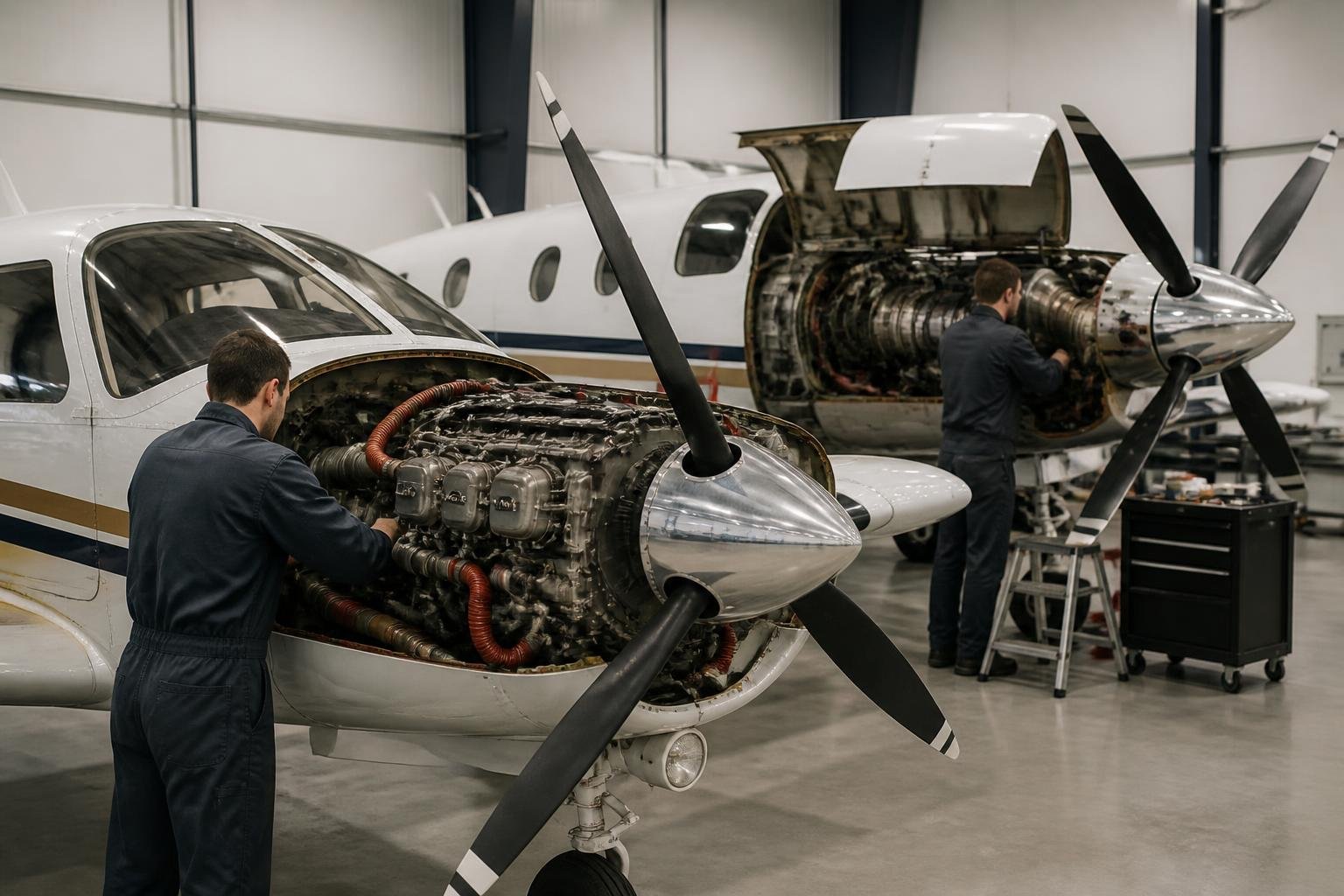
The Mirage’s piston engine rewards informed engine management. Buyers should understand the aircraft’s approved operating procedures, the significance of engine-monitor data and the owner’s maintenance philosophy. Turbocharged piston engines can provide impressive altitude performance, but they add heat, induction and turbo-system considerations that make disciplined operation and complete records particularly important. Oil analysis and engine-monitor data can be useful context, but neither replaces a qualified technical evaluation.
The Meridian’s turboprop installation changes the architecture and operating culture. Turbine engines are often valued for smooth power delivery and strong climb capability, but they have their own limits, scheduled events, accessory requirements and high-cost exposure. Correct start procedures, temperature and speed limits, fuel-system management and trend monitoring are part of normal ownership. A turbine is not automatically simpler or less expensive simply because it does not have cylinders and spark plugs.
Both types require attention to systems beyond propulsion. Pressurization depends on the integrity of the pressure vessel, seals, outflow control and associated components. Environmental systems, heating, ventilation and air-conditioning installations can be significant maintenance items. Supplemental oxygen arrangements, where installed or applicable to the aircraft’s operations, must be understood independently from cabin pressurization.
The propeller, landing gear, electrical system, environmental equipment and de-ice configuration can all influence downtime and cost. On the Meridian, the engine, gearbox-related arrangements and accessories require review in the context of the applicable maintenance documentation. On the Mirage, engine condition, turbocharging components and cylinder health warrant close attention. In both cases, uninterrupted logbooks, documented inspections and a credible plan for overhaul or life-limited components are more valuable than broad assumptions about the type.
Fuel availability is a practical distinction. A Mirage uses aviation gasoline, while a Meridian uses turbine fuel. Availability, quality-control practices and price vary substantially by region and destination. An owner who regularly flies to smaller airports should verify fuel access on the actual network of destinations rather than rely on a general statement about either fuel type.
Ownership economics: comparing the real cost categories
Purchase price is only the opening line of PA-46 ownership exposure. A buyer should build a mission-based annual budget that separates fixed commitments from variable costs and includes a realistic contingency reserve. The Mirage will often have lower fuel consumption and lower initial capital exposure than a Meridian, but an individual piston engine approaching a major event can alter the economics quickly. The Meridian’s turbine engine and related systems generally demand a larger reserve, even when the aircraft’s speed creates genuine business value.
Variable costs include fuel, oil where applicable, engine reserves, propeller reserves, routine consumables and unscheduled maintenance. Fixed or semi-fixed categories include hangarage, insurance, training, subscriptions, inspections, taxes, financing and administrative costs. Pressurization, de-ice systems and avionics can produce expensive repair events on either type. Geography matters as well: local labour rates, parts access, climate, corrosion environment, insurance market and tax treatment may change the annual result considerably.
Scheduled and calendar-driven maintenance should be treated separately from surprise repairs. An aircraft flown lightly is not exempt from calendar limits, age-related hose and seal work, corrosion inspection, avionics support concerns or required inspections. The buyer of a low-time aircraft should ask why its time is low and whether inactivity has created its own risks.
Do not equate an advertised asking price, an auction bid, a completed sale or an independent valuation. Each describes a different point in the market process. A bid may not be a final sale price; an asking price is not proof of transaction value; and a valuation does not remove the need to inspect condition and documentation. Compare like with like only after adjusting for engine status, maintenance history, equipment, location and deferred work.
- Build separate budgets for low, expected and high annual utilisation.
- Include a reserve for engine, propeller, avionics and pressurization-related work.
- Model travel time saved by the Meridian only on routes likely to use its performance.
- Ask an insurance specialist and maintenance provider for aircraft-specific estimates before committing.
Training, proficiency and insurance considerations

Both aircraft demand more than a generic complex-aircraft checkout. A transition should address high-performance piston or turbine procedures, pressurization, high-altitude operations, weather decision-making, automation management, abnormal procedures and the specific aircraft’s avionics. Formal initial training is a prudent baseline; an owner should then plan recurrent training and real-world mentoring appropriate to experience.
A Meridian transition typically brings more rigorous turbine-focused training expectations. Insurers may consider total flight time, time in retractable and high-performance aircraft, PA-46 time, instrument experience, prior turbine time, recency and the quality of initial training. Requirements are individual underwriting decisions, not a universal published threshold. A buyer should obtain insurance indications early, particularly when moving from a piston single to a turboprop.
Normal workload differs between the types, but neither should be described as effortless. The Mirage asks for careful piston engine management alongside pressurization and complex-aircraft tasks. The Meridian calls for precise turbine procedures, stronger performance awareness and a deliberate understanding of its systems. In either aircraft, autopilot competence matters. A pilot should be able to use coupled approaches and navigation equipment correctly while retaining the ability to recognise automation errors and fly manually when necessary.
Proficiency is more than meeting an insurance minimum. An owner should consider how frequently the aircraft will be flown, how often high-altitude or instrument conditions are likely, whether a qualified mentor can accompany initial trips, and how emergency planning will be maintained. If annual use will be sparse or the step-up is unusually large, postponing purchase or arranging structured mentoring can be the safer and financially wiser path.
Pre-buy inspection priorities for each PA-46 type

Select an independent pre-buy facility with meaningful PA-46 experience and no incentive to minimise findings. Agree the scope in writing before travel or deposit commitments make objective decisions harder. A pre-buy inspection is buyer due diligence; it is not the same as an appraisal, an annual inspection, an airworthiness determination or a review of seller documentation.
Begin with records. Review complete airframe, engine, propeller and avionics logbooks for continuity, inspection history, recurring discrepancies, damage repairs, corrosion findings, major alterations and supporting approvals. Check title, registration, serial-number consistency, modification records and the operational history available. A maintenance entry alone may not explain the scope or quality of a repair, so supporting invoices, photographs and release documentation can be valuable.
For both types, examine pressurization condition, seals, cabin-system operation, environmental equipment, landing gear, brakes, de-ice equipment and avionics. De-ice equipment deserves special care: confirm the installed configuration, approval basis, system condition and any operational limitations rather than assuming that an equipped aircraft is approved or suitable for every icing scenario.
Mirage-specific work should include a detailed engine-health review. That can involve cylinder-condition information, borescope findings where appropriate, engine-monitor records, oil and filter history, turbocharger-related maintenance, compression data interpreted by a qualified technician, and assessment of how the engine has been operated. A single reading should not be used in isolation to declare an engine sound or unsound.
Meridian-specific review should establish engine records, trend data, compliance with required inspections, hot-section status where applicable, remaining life or scheduled-event exposure, and documentation of maintenance performed by appropriately qualified personnel. The engine’s maintenance programme and records should be read against the exact engine installation rather than against a generic turboprop checklist.
- Confirm maintenance-record continuity and identify gaps before the physical inspection.
- Inspect for corrosion, repairs and signs of long inactivity.
- Test systems within an agreed scope, including pressurization and environmental functions.
- Obtain a written findings report, cost estimates where feasible and a clear list of unresolved items.
Avionics, equipment and upgrades that affect value
Avionics can change the usability and value of an individual PA-46, but only when the installation is legal, documented, supportable and appropriate to the buyer’s operation. Autopilot capability is especially important in these aircraft. Assess whether it supports the navigation and approach functions the buyer intends to use, whether it is reliable, and whether the pilot can operate it confidently.
A modern panel may improve situational awareness through weather, traffic, terrain and connectivity functions, yet it can also introduce interoperability and support questions. Review installation records, approved data, software status, antenna and sensor condition, backup instruments, electrical loading and the availability of service for the installed equipment. A visually impressive panel is not automatically a complete or well-integrated solution.
Known-ice equipment, air-conditioning and electrical upgrades can also affect value, comfort and dispatch planning. Confirm the approval status, actual installed components, maintenance condition and limitations. For modifications, review supplemental type certificates or other approval documentation as applicable, as well as clear maintenance entries. Avoid extrapolating broad market value from one highly upgraded listing: value depends on the quality, age, supportability and relevance of the specific equipment.
Market evaluation: comparing individual Mirage and Meridian listings
Compare aircraft through a structured worksheet rather than headline price. Filter by exact model, year, engine status, propeller status, total time, avionics, de-ice configuration, air-conditioning, damage history and location. Then read the maintenance records before deciding which examples are genuinely comparable. A less expensive aircraft with near-term engine, avionics or corrosion work may carry greater total exposure than a higher-priced, thoroughly documented example.
Time since overhaul is only one part of the picture. Calendar limits, life-limited components, hot-section or other scheduled turbine events, propeller status, inspections and deferred discrepancies may all be material. Ask what work has been completed recently, what is due next, and what items the seller considers deferred. A buyer should independently verify these answers through records and a pre-buy inspection.
Location affects more than ferry cost. Import status, registration pathway, tax treatment, delivery logistics, regional maintenance support and the ability to inspect the aircraft properly can influence the transaction. Auction documentation and seller disclosures are valuable starting evidence, not a substitute for independent technical and legal review. Current Piper marketplace inventory can help a buyer identify individual examples and equipment patterns, but it should not be used alone to establish market value.
Before making a commitment, combine a records review, a PA-46-experienced inspection, an insurance discussion and, when appropriate, independent valuation support. That sequence turns a broad Piper Mirage vs Meridian comparison into a grounded decision about the aircraft actually available.
Making the choice: Mirage, Meridian or a different PA-46 path
The Mirage fits the buyer seeking capable pressurized travel while retaining piston ownership priorities. It is not a low-complexity trainer, but it can be a logical bridge between conventional piston singles and more demanding turbine aircraft when the owner’s routes, budget and proficiency align. Its strongest case is usually made by a mission where comfort and altitude capability matter, but turbine speed is not essential.
The Meridian fits a buyer whose higher-performance missions justify turbine costs and responsibilities. Its advantage is most credible when annual utilisation, passenger expectations, route length and time value all support it. It should not be purchased merely for the appeal of turbine ownership; the owner must be ready for formal training, recurrent proficiency work, appropriate insurance and a reserve that can absorb major maintenance events.
There are good reasons to defer either choice. A buyer may need more instrument experience, a stronger capital reserve, a more dependable maintenance network or a clearer picture of annual travel demand. Other PA-46 variants and competing aircraft may also fit better once the mission is written down precisely. The right comparison is not piston versus turbine in isolation, but mission versus total ownership commitment.
Make the final decision using five tests: the trips the aircraft must complete, expected annual utilisation, available capital reserve, access to experienced support and the pilot’s realistic proficiency plan. Then compare documented individual aircraft, verify their status through independent due diligence and select the example whose condition and records support the intended mission.

Comments
No comments yet
Be the first to share your thoughts!