
 Bad Vöslau
 Kirn
Kirn

 Florida

An aircraft propeller strike is not automatically a reason to reject an otherwise suitable aircraft, but it is a reason to slow the purchase process and verify the technical record carefully. The central question is not simply whether a blade was damaged. A buyer needs to understand what contacted what, whether the engine was operating, what loads may have travelled through the propeller system and airframe, and whether the corrective work followed the applicable manufacturer and regulatory requirements.
A properly documented event with appropriate inspections and repairs can be assessed rationally. An aircraft supported only by verbal assurances, replacement parts and incomplete records leaves much more uncertainty for the next owner.
Five Things to Verify After an Aircraft Propeller Strike
Before deciding how significant a historical propeller strike is, verify these five areas:
Airframe, engine and propeller logbooks covering the event, corrective work and subsequent operation.
Work orders, invoices and inspection reports showing exactly what was inspected, repaired, overhauled or replaced.
Applicable engine and propeller manufacturer instructions used to determine the required corrective action.
Related airframe and landing-gear records if the event involved a gear collapse, runway excursion, hard landing or nose-over.
An independent pre-buy assessment by a facility familiar with the specific aircraft, engine and propeller combination.
The objective is not merely to establish that maintenance occurred. It is to establish whether the maintenance performed was appropriate for the event.
Why Aircraft Propeller Strike History Matters to Buyers

Visible propeller damage may represent only one part of an occurrence. A rotating propeller that contacts pavement, terrain, an obstacle or loose debris can transmit abnormal loads through the hub and into the engine. Depending on the event, the same occurrence may also involve the nose gear, engine mounts, firewall, forward fuselage or other structure.
A small mark on a blade does not by itself establish that an event was minor. Likewise, ordinary erosion, paint damage or handling damage is not automatically equivalent to a propeller strike. The event sequence and the applicable technical instructions matter more than appearance alone.
For a purchaser, the consequences can extend to maintenance planning, insurance discussions, future marketability and resale disclosure. A well-documented historical event may have little practical effect on ownership, while incomplete or contradictory records can create considerably more uncertainty.
Verbal statements such as “it was only a prop change” or “the shop checked everything” are useful starting points, not proof. A buyer should obtain supporting maintenance records and compare them with the physical condition of the aircraft. For a broader guide to reviewing maintenance documentation, see our aircraft logbook inspection guide.
What Counts as an Aircraft Propeller Strike?
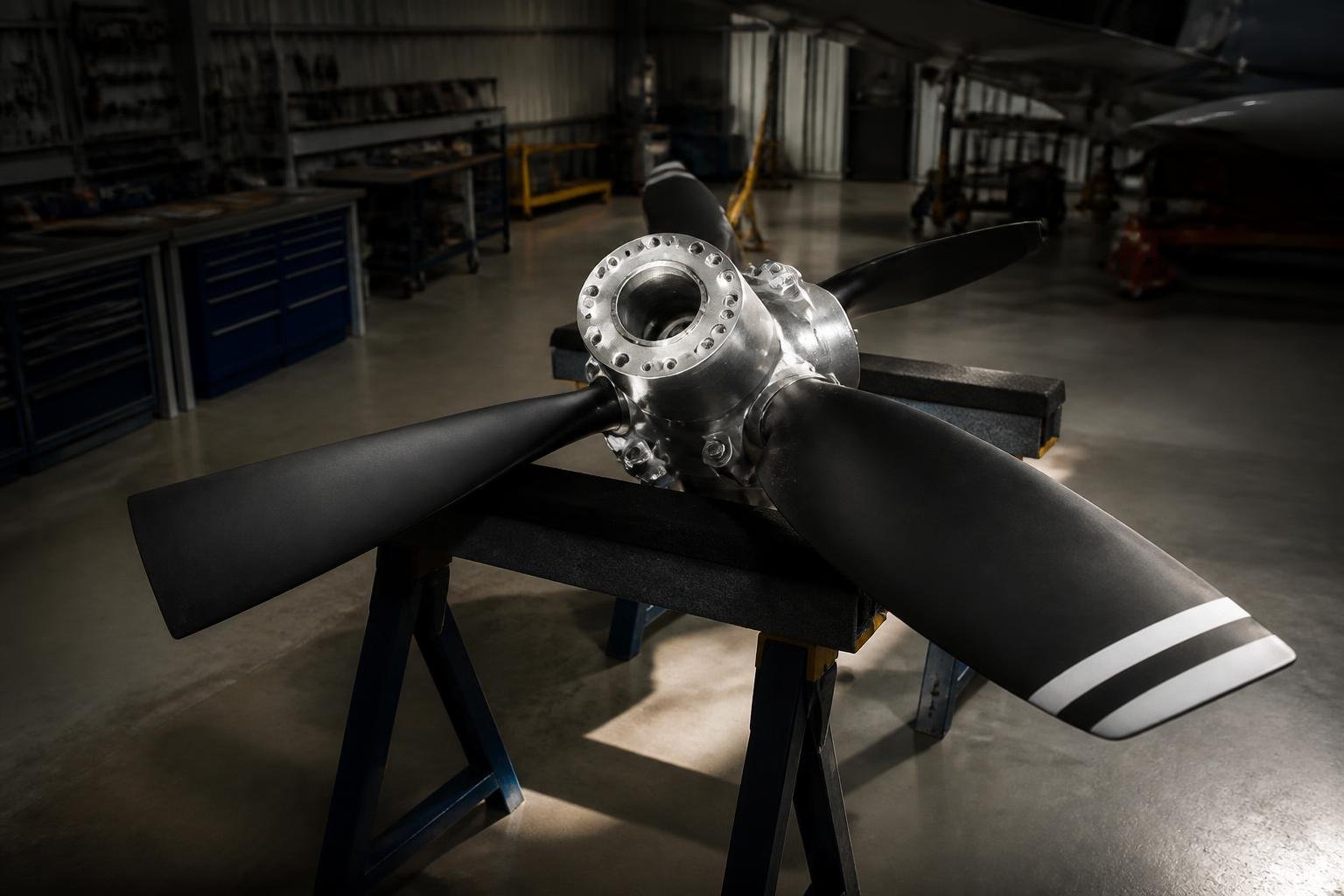
There is no useful one-sentence definition that safely replaces the applicable instructions for a specific engine and propeller installation.
Events that may require investigation include:
Ground contact while taxiing or landing.
Propeller contact following a landing-gear collapse.
Contact with a tow bar, chock, debris or other equipment.
A runway excursion involving propeller contact.
Sudden deceleration or stoppage of the rotating assembly.
Loss or significant damage of a propeller blade or blade tip.
A nose-over or other event involving the propeller and forward structure.
The applicable engine and propeller manufacturer documentation ultimately determines what inspection or corrective action is required.
For example, Lycoming Service Bulletin No. 533D addresses sudden engine stoppage, propeller or rotor strikes and loss of a blade or blade tip for Lycoming reciprocating engines. It specifies corrective action for engines within its applicability.
That does not mean the same procedure automatically applies to every engine. Continental, Rotax, turbine-engine and other installations must be evaluated under the instructions applicable to the particular engine, propeller and aircraft.
The same principle applies to the propeller. Manufacturers publish their own model-specific technical information. For example, the Hartzell Propeller service-document library provides service bulletins, service letters and service instructions that can apply to specific propeller installations.
Why a Strike Can Affect More Than the Propeller

On many piston aircraft, a propeller strike can transmit torsional, bending or impact loads into components connected to the propeller and engine. Depending on the engine design, event circumstances and manufacturer instructions, the technical review may extend to the crankshaft, bearings, gears, accessory drives and related components.
The propeller assembly itself also requires an appropriate documented response. Depending on the installation and event, the review may involve the blades, hub, spinner, attachment hardware, governor and associated components.
An invoice for a replacement propeller does not demonstrate that the engine was evaluated correctly. Likewise, evidence of engine inspection does not automatically establish that the propeller, governor and associated hardware were addressed.
The FAA's maintenance guidance also directs technicians dealing with sudden stoppage to follow the applicable manufacturer's maintenance instructions. The exact inspection remains installation-specific rather than a universal checklist.
Start With the Aircraft Logbooks and Maintenance Records

Start by reconstructing the event chronologically. Obtain the available airframe, engine and propeller records and identify the date of occurrence, aircraft total time, engine time and propeller time. Then follow the aircraft through inspection, corrective work, return to service and subsequent operation.
The records should make it possible to understand what happened, what damage was identified, which maintenance instructions were used and what work was completed.
| Record to request | Why it matters |
|---|---|
| Airframe, engine and propeller logbooks | Establish component times, continuity and signed maintenance history. |
| Work orders and invoices | Show the actual scope of labour, parts and specialist work. |
| Inspection reports | May contain measurements, findings and component disposition. |
| Parts and component records | Help establish traceability of replacement or overhauled components. |
| Photographs and occurrence material | Can clarify the event sequence and extent of visible damage. |
| Insurance correspondence, where available | May help confirm repair facilities and documented claim scope. |
Missing documents do not automatically make an aircraft unacceptable, particularly on an older aircraft. However, unexplained downtime, inconsistent component times or an undocumented propeller or engine replacement should trigger further investigation.
For more detail on reconciling times, identifying missing records and spotting documentation inconsistencies, read Aircraft Logbooks Explained: Red Flags Every Buyer Should Look For.
Verify the Required Engine and Propeller Actions

Do not begin with the question, “Was the engine overhauled?” A more useful question is: What did the applicable manufacturer instructions require for this specific event, and was that work completed?
The answer may depend on factors including:
Engine model and serial number.
Propeller model and serial number.
Whether the engine was operating.
The nature and severity of the contact.
Whether sudden stoppage or significant deceleration occurred.
Blade damage or loss.
Installation-specific manufacturer requirements.
Useful evidence can include repair-station work scopes, engine inspection or teardown records, propeller-shop reports, technician findings, component tags, parts invoices and overhaul documentation.
If a component was replaced, establish its origin, status and traceability. If it was overhauled, determine when, by whom and how the work affects its recorded time and future maintenance requirements.
A maintenance release is important, but it does not answer every technical or commercial question a buyer may have. The supporting records should show enough detail for an independent inspector to understand the scope of the work.
Assess Related Airframe, Landing-Gear and Firewall Damage
The physical and records review should follow the event sequence. A tow-bar contact at low speed creates a different investigation path from a nose-gear collapse during landing or a runway excursion through uneven terrain.
Depending on the occurrence, records and inspection may need to cover:
Engine mounts and attachment points.
Firewall and forward fuselage structure.
Cowling and related systems.
Nose-gear structure and steering linkage.
Wheels and brakes.
Alignment and rigging.
Tail and empennage following a nose-over.
Repair techniques also differ between metal and composite aircraft. A neat external finish does not establish that a structural repair was correctly performed. Buyers should determine what approved or accepted repair data was used and whether the required records and inspection sign-offs are available.
For a broader discussion of structural repairs, accident history and their impact on buyer confidence, see Aircraft Damage History: Which Repairs Affect Value and Buyer Confidence?.
Match the Repair History to Approved Data and Regulatory Requirements
Maintenance records, occurrence reports and insurance documentation can describe different parts of the same event. Compare them without assuming that one source answers every regulatory and technical question.
Repairs should be supported by the applicable maintenance manuals, structural repair manuals, manufacturer instructions or other approved or acceptable data required for the aircraft and jurisdiction.
Requirements differ between regulatory systems. Buyers should not assume that an FAA process applies unchanged to an EASA-registered aircraft, or vice versa. The aircraft's registration, certification status and the classification of the repair determine the relevant requirements.
Experimental and amateur-built aircraft require separate consideration because their maintenance authority, operating limitations, component choices and repair documentation can differ substantially from type-certificated aircraft.
Use a Pre-Buy Inspection That Is Sized to the Event
A generic walk-around is not necessarily an adequate response to a known or suspected propeller strike. The buyer should choose an independent inspector or facility with relevant experience in the aircraft, engine and propeller types.
Review the records before finalising the physical inspection scope. The records determine which questions need to be answered and which areas deserve additional attention.
Depending on the event and available evidence, an assessment may include:
Oil-filter or screen history.
Oil-analysis history, where available.
Compression testing where appropriate.
Borescope examination.
Propeller blade, hub and spinner inspection.
Propeller tracking and vibration history.
Engine-mount and firewall inspection.
Landing-gear and alignment checks.
Review of structural repairs.
None of these checks, by itself, proves the absence of internal or historical damage. They are tools within a broader technical assessment.
A pre-buy inspection is buyer-directed due diligence. An annual or other regulatory inspection addresses continued-airworthiness requirements. An appraisal addresses value, and an insurance survey serves underwriting needs. They should not automatically be treated as substitutes for one another.
Our Aircraft Pre-Buy Inspection Checklist covers the broader records, condition, compliance and acquisition-cost review that should accompany the technical investigation.
Questions to Ask the Seller, Broker and Maintenance Provider
Ask for a factual account first and then compare the answers with the documentation.
What exactly happened during the event?
Was the engine operating at the time?
What did the propeller contact?
Is there an occurrence report, photograph or insurance record?
Which engine, propeller and airframe instructions were applied?
Was the engine inspected, disassembled, repaired or overhauled?
Was the propeller inspected, repaired, overhauled or replaced?
Was the governor inspected?
Was landing-gear or structural damage involved?
Which organisations performed the work?
Are the original work orders and inspection reports available?
How many hours has the aircraft flown since the event?
Have there been subsequent vibration, alignment or maintenance issues?
Can the buyer's inspector contact the facility that performed the repair?
An inability to remember an older event is not automatically evidence of concealment. However, vague answers combined with missing documentation increase uncertainty and should influence the scope of further investigation.
For a complete transaction-focused question list, see Questions to Ask an Aircraft Seller Before You Place a Bid.
Value, Insurance and Future Resale Considerations
There is no universal percentage discount that should automatically be applied to an aircraft because of a historical propeller strike.
Value depends on factors including:
Aircraft type.
Event severity.
Repair scope.
Quality and completeness of documentation.
Current technical condition.
Time flown since repair.
Market conditions.
Buyer perception.
A properly repaired aircraft supported by a transparent and coherent file may remain fully marketable. An aircraft with unsupported claims, missing records or unresolved technical questions may require additional inspection or corrective work before its risk can be priced sensibly.
Insurance should also be discussed before closing when the history is material. Underwriters may request maintenance documentation or details of previous repairs, and requirements vary by aircraft, operator, insurer and jurisdiction.
Avoid negotiating from an assumed discount. First establish the verified condition, identify the limits of the available records and estimate the cost of work that is actually recommended. Only then assess whether the evidence supports a price adjustment.
Red Flags That Should Pause a Purchase Decision
The historical event itself is often less concerning than an inability to determine what happened afterward.
No logbook entry despite known propeller damage or replacement.
An unexplained engine overhaul or propeller change close to the occurrence date.
Missing work orders, invoices or inspection findings.
Airframe, engine or propeller times that cannot be reconciled.
Structural repair without supporting technical documentation.
Seller statements that conflict with maintenance records.
Physical evidence inconsistent with the documented event.
Seller reluctance to permit independent records review or inspection.
No clear evidence that the applicable engine or propeller instructions were considered.
When these issues appear, pause the transaction until they are clarified. Expand the inspection when technically justified, recover missing documentation where possible, or reconsider the purchase if the remaining engine or structural risk cannot be reasonably understood.
A Practical Buyer Decision Framework
| Finding | Risk implication | Recommended next step |
|---|---|---|
| Event and repairs are fully documented and current condition is satisfactory | The historical event appears technically understood | Proceed with normal transaction due diligence |
| Records are mostly complete but the technical scope is unclear | Uncertainty remains about whether prior work matched the event | Obtain type-specific specialist review |
| Inspection identifies defined corrective work | The technical exposure can potentially be quantified | Obtain repair estimates and renegotiate if appropriate |
| Important records are missing but may be recoverable | The technical history remains incomplete | Pause negotiations while documentation is obtained |
| Records conflict with physical evidence or seller statements | The original event or repair scope may be uncertain | Expand inspection and independently verify the history |
| Engine or structural risk cannot reasonably be determined | The buyer cannot quantify the exposure with confidence | Consider walking away |
A lower acquisition price cannot remove technical uncertainty that has not been defined.
Final Takeaway
A previous propeller strike should trigger investigation, not automatic rejection.
The strongest purchase candidate is not necessarily an aircraft with no historical damage. It is an aircraft whose history can be understood through a coherent chain of evidence:
event → applicable maintenance requirements → inspection → corrective work → return to service → subsequent operation
Manufacturer documentation should control the technical response. The applicable engine, propeller and airframe instructions, their relevant revisions and the aircraft's jurisdiction take precedence over generic advice.
Once the technical record is understood, an independent pre-buy inspection can help determine whether the aircraft's present condition supports the purchase decision.
Ready to apply that due-diligence process to a real aircraft? Browse current aircraft listings and compare their documented maintenance histories before you bid.

Comments
No comments yet
Be the first to share your thoughts!