
 Aschaffenburg
The Short Answer: What Matters Most Before You Buy
Buy the Sakota on the strength of its build quality, records, installed engine, and operating limitations—not its paint or panel. A tidy cockpit tells you little about how the main gear loads are carried into the fuselage, whether the engine is overdue for calendar-driven work, or whether the aircraft can legally do what you want it to do. Establish those facts before paying for travel or making a non-refundable commitment.
This RANS S-10 Sakota buyer’s guide covers three decisions: which candidates are worth seeing, what to put in an independent pre-buy inspection scope, and how much to offer once you understand the work and costs ahead. Treat a missing document differently from an adverse finding. A seller may be able to produce a misplaced equipment list. A serial number that cannot be reconciled or a structural repair that cannot be evaluated is not just a missing piece of paper.
Pause early if the records do not match the aircraft, an unresolved structural finding prevents a meaningful assessment, or the operating limitations rule out a non-negotiable part of your mission. Do not let a favorable price turn any of those problems into an assumption. If a discrepancy can be resolved, establish who will resolve it, what evidence you need, and whether that evidence will be available before money changes hands.
Who the Sakota Suits—and What to Verify About Its Specs
The Sakota is a two-seat kit design with conventional landing gear. That gives you a starting point, not a description of how every completed aircraft fits, loads, or flies. Sit in the actual cockpit with the pilot and, if practical, the passenger you expect to carry. Check headroom under the closed canopy, pedal reach and travel, visibility over the nose, and how easily each person can enter and exit. A second seat is of limited use if your typical passenger and trip fuel cannot be carried together within limits.
For local flying, consider your home runway, surface, obstacles, winds, and access to a suitable instructor. For cross-country use, plan a representative leg with reserves, baggage, and realistic fuel stops. Review the departure as well as the destination: a long paved runway at a demonstration does not establish suitability for a short grass strip on a hot day. A pilot new to tailwheel flying should confirm the training path and insurance requirements before purchase, including whether suitable training can be conducted in the candidate aircraft.
Use this RANS S-10 Sakota specs table as a side-by-side worksheet. Ask for the RANS reference material applicable to the kit and revision, then fill in the candidate column from its records. Where no verified manufacturer number is given here, retrieve it from the applicable documents rather than substituting a figure from another Sakota’s listing.
| Specification | Manufacturer reference or figure to obtain | Candidate aircraft’s documented configuration |
|---|---|---|
| Seating and gear | Two-seat design with conventional landing gear. | Confirm installed seats, restraints, usable controls, and any passenger restriction. |
| Dimensions | Obtain wingspan, overall length, and height from the applicable RANS drawing or kit literature. | Check the as-built dimensions and verify clearance for hangar doors or transport, including any nonstandard equipment. |
| Engine options | Check the engine and installation options documented for that kit revision. A Rotax 912 UL is an 80 hp-class engine; that rating alone says nothing about aircraft performance. | Record the installed engine model and serial number, propeller model, and any documented conversion. |
| Weight and loading limits | Obtain the design gross weight, center-of-gravity envelope, and any applicable loading limits. | Use the latest applicable empty weight, empty moment, station arms, and documented limits for the aircraft and intended operation. |
| Fuel capacity | Obtain the tank arrangement and reference total and usable capacities for the relevant configuration. | Verify the installed tanks, documented usable fuel, and fuel stations. Do not assume tank volume equals usable fuel. |
| Documented performance | Record published takeoff, climb, cruise, and landing figures only with their stated test configuration and conditions. | Ask for flight-test records or operating data for the installed engine and propeller. Mark unsupported numbers as unverified. |
Use the candidate’s latest weight-and-balance report to calculate both departure and expected landing loading. For illustration only, suppose a report showed an empty weight of 620 lb at a 30-inch arm. Add 330 lb of occupants at 40 inches, 60 lb of fuel at 50 inches, and 15 lb of baggage at 60 inches. Weight multiplied by arm gives each item’s moment. The total is 1,025 lb and 35,700 lb-in, putting the center of gravity at about 34.83 inches aft of the example datum. After burning 48 lb from that fuel station, the result is 977 lb at about 34.08 inches. Those are teaching figures, not Sakota specifications or permissible loads. Use the real report’s stations and limits, check baggage and seat limits separately, and account for fuel burn from each tank if the aircraft has more than one.
Read performance claims with the same care. Ask whether the quoted speed is indicated or true airspeed, whether a runway figure is ground roll or distance over an obstacle, and at what weight and density altitude it was recorded. Engine and propeller choice, pitch setting where applicable, surface, wind, and technique can all affect the comparison. If the underlying conditions are unknown, do not use the number to plan a tight runway departure or a marginal fuel leg.
What to Ask for Before You Travel to See the Aircraft
Request readable copies of the airframe, engine, and propeller logs; the builder’s records and photos; the latest inspection entries; the current equipment list; and the latest weight-and-balance report. Ask for the certificate and its associated operating limitations at the same time. Full entries are more useful than a screenshot showing only a date or time total: the description, component identity, and signer can determine whether an entry answers your question.
Start with identity. Compare the airframe serial number across the identification plate, registration documents, certificate, and logs. Compare engine and propeller identifiers in the logs with the installed equipment, using data-plate photos for the remote review and physical checks at inspection. A different propeller or an engine replacement may be entirely legitimate. What you want is a record of when it was installed, its prior time or service status, and any associated changes to weight and balance, limitations, or flight-test status.
Build a timeline with dates and hours in separate columns. Mark the original completion, ownership changes, long periods of inactivity, repairs, modifications, and the last documented flight or inspection where available. Distinguish total time from time since overhaul and from the reading on a cockpit hour meter. If a log starts midway through the engine’s life, ask what supports the carried-forward time. A low hour count does not establish good storage, and a gap does not prove damage; it tells the inspector what remains unverified.
Ask for well-lit photos of the engine bay, landing gear attachments, cockpit, fabric surfaces, and accessible areas around known repairs. Close-ups show details; wider views establish where those details are. Request builder photographs of normally hidden areas if they exist, but do not assume a construction photo proves that area’s present condition. Keep seller statements, documentary support, and independent findings separate in your notes. That distinction makes it easier to decide whether to book an inspection, request more evidence, or stop before spending on travel.
Airworthiness Paperwork, Operating Limits, and Transfer
Identify the exact airworthiness certificate or permit under which the individual aircraft operates. Read its associated operating limitations and confirm the required inspection status; a registration entry or an inspection sticker does not substitute for those documents. In the United States, if the aircraft is certificated as experimental amateur-built, the FAA-issued operating limitations are part of its airworthiness certificate. Review the actual version issued to that aircraft rather than assuming it has the same wording as another homebuilt.
For a US experimental amateur-built Sakota, distinguish who may perform maintenance from who may sign the required condition inspection. Maintenance is generally not restricted to a certificated mechanic on these aircraft, but owning or maintaining one does not give a buyer condition-inspection sign-off authority. Typically, an appropriately rated FAA mechanic with airframe and powerplant ratings or the holder of the experimental aircraft builder repairman certificate for that specific aircraft can sign in accordance with its limitations. An inspection authorization is not normally required for the A&P to perform that condition inspection, and the original builder’s repairman privilege does not transfer with the sale.
Check the exact inspection entry, its date, and the signer’s qualifications. If the records show an engine conversion, propeller change, or other significant modification, have the inspector review whether it constituted a major change under the applicable limitations. Look for the resulting records, any required coordination with the authority, and evidence that any required return to flight testing was completed before normal operation resumed. A recent condition inspection entry does not by itself close an outstanding flight-test requirement.
Review aerobatics, passenger carriage, and any other intended operation against the actual limitations and applicable rules. A reputation for aerobatic capability is not authorization for a specific airframe or maneuver. Check whether the relevant maneuvers were demonstrated and recorded as required, and whether the loading and configuration you intend to use are covered. Separately, verify registration eligibility, seller authority and title or lien status as applicable. Outside the United States, ask the local authority or a qualified local specialist about permit recognition, inspection privileges, and operational restrictions. For an import, confirm the path to registration and permission to fly in the destination country before committing; a transferable sale does not guarantee a transferable operating status.
RANS S-10 Pre-Buy Inspection: Airframe, Fabric, and Controls
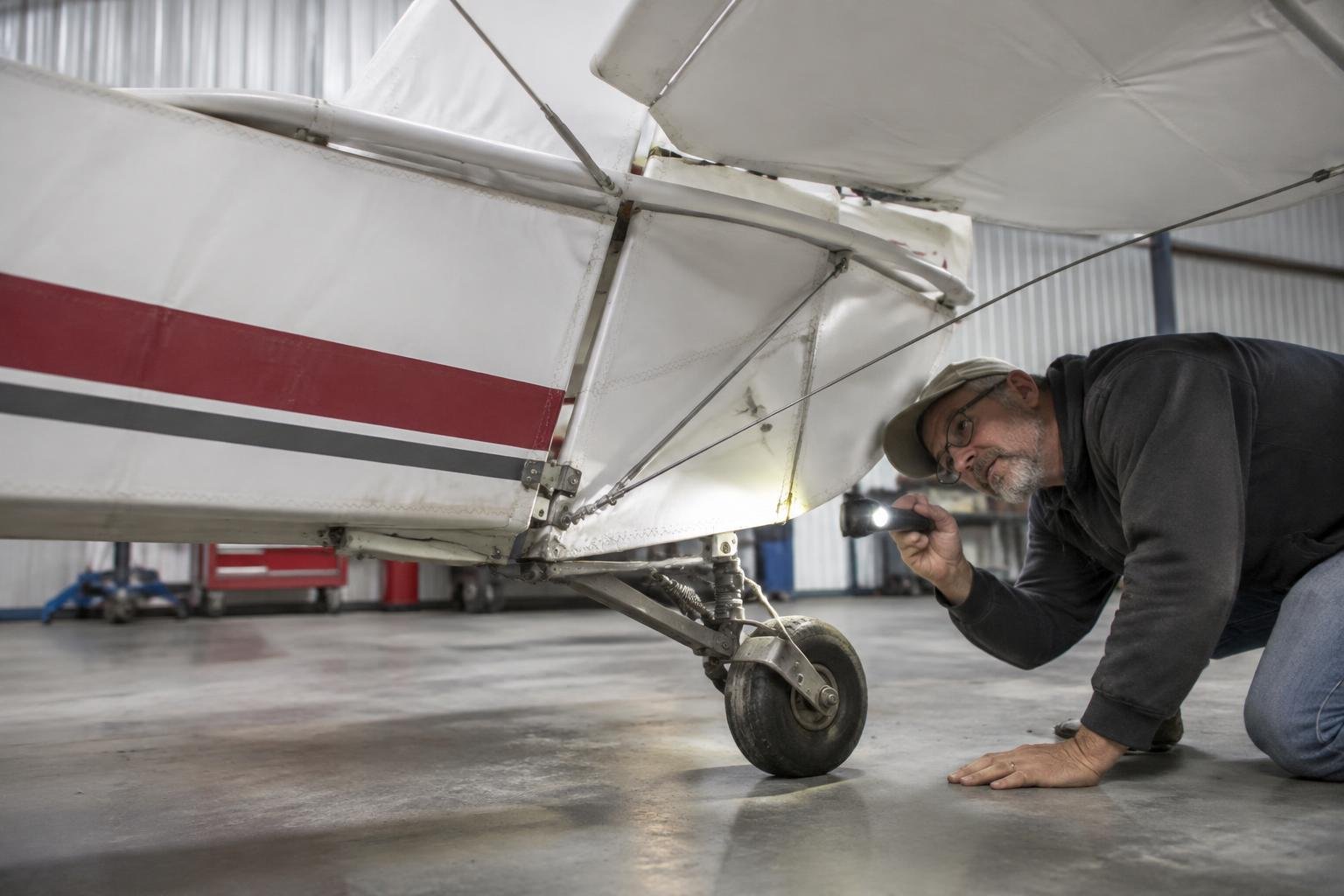
Hire an independent inspector with comparable homebuilt, fabric-airframe, and tailwheel experience. Agree in writing on access, who may remove cowlings or inspection panels, what cannot be examined, and how findings will be reported. Request photographs, applicable reference documents, and a distinction between findings that must be resolved before flight, items to budget for, and areas not inspected. A RANS S-10 pre-buy inspection is a buyer’s assessment. It is not an appraisal, a required condition inspection, or a certification that the aircraft is airworthy.
Have the inspector compare accessible workmanship and construction details with the applicable build documentation. Deviations are not automatically defects, but a deviation in a load path or control installation needs more evidence than a neat finish. Look for corrosion, deformation, and signs of previous work, and reconcile those observations with the repair and builder records. Assess the fabric covering and finish for deterioration, loose areas, cracking, and questionable repairs; any testing should suit the covering system and be agreed with the owner in advance. Fresh paint does not establish the condition of fabric or the structure beneath it.
Give particular attention to the wing and tail attachments, firewall and engine mount, main gear fittings, and tailwheel assembly. Look for damage, movement, corrosion, and repairs that do not match the records. A distorted gear fitting, for example, raises questions about the structure that takes the load, not just the replaceable part bolted to it. If a consequential area is hidden, ask what additional access or specialist review would resolve the finding. Have the report state plainly where access was insufficient.
Ask for a review of control routing, hardware security, free play, clearance through full travel, and actual travel against the applicable build documentation. Where controls are provided at both seats, confirm their operation and freedom from interference with occupants or cockpit equipment. Assess restraint condition and attachment, canopy latch engagement and security, and electrical and avionics workmanship. Unsupported wiring near controls, poorly protected penetrations, and an undocumented equipment change are more useful buying information than whether the panel looks modern.
RANS S-10 Rotax 912 UL: Engine, Installation, and Propeller Checks
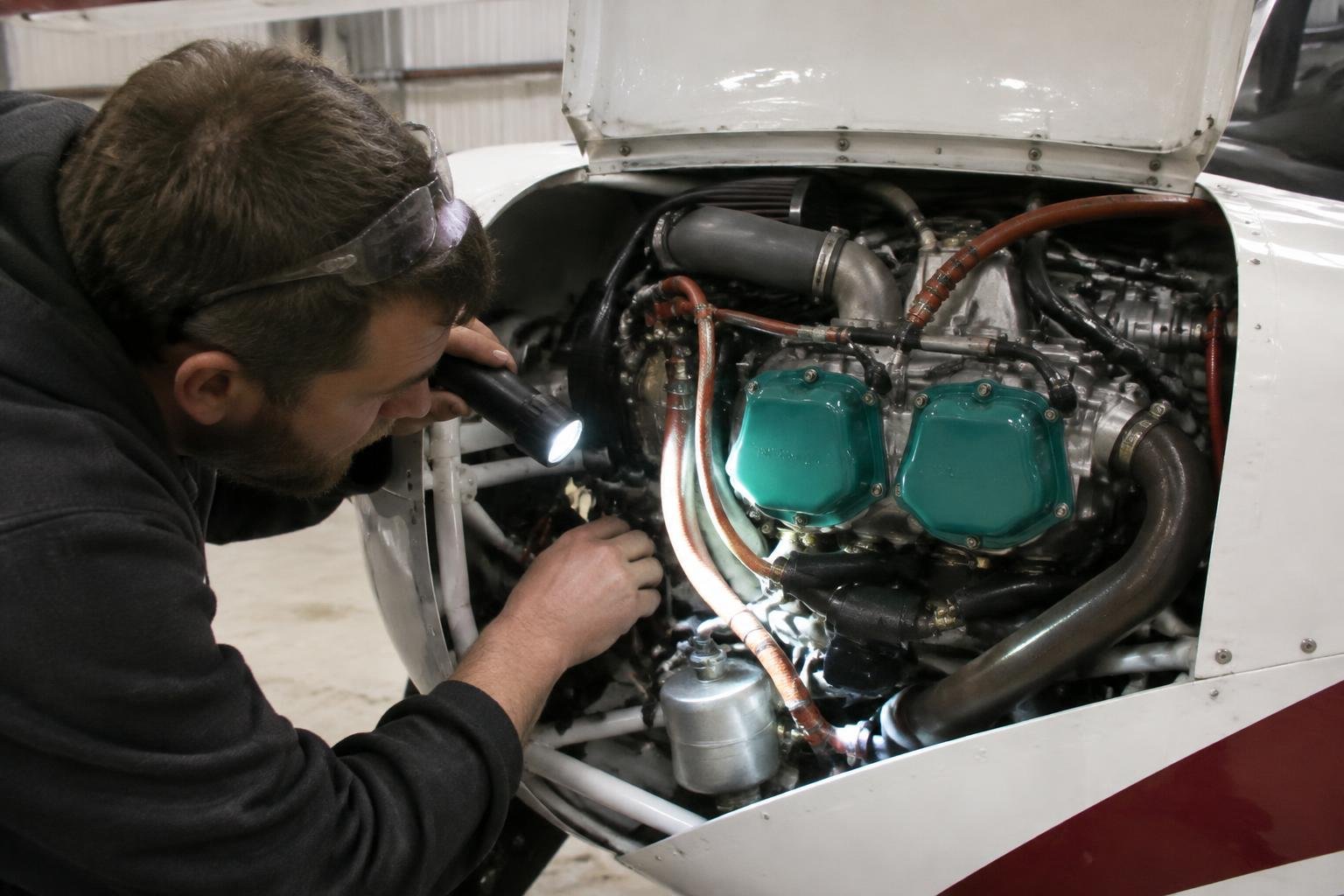
For a listing described as a RANS S-10 Rotax 912 UL, read the engine data plate and reconcile the model and serial number with the logs. A cowling shape or an advertisement that says only “912” is not enough to identify the variant or the applicable service instructions. Establish time in service, calendar age, overhaul history, and how the engine was stored during inactive periods. Have a Rotax-experienced maintainer check the applicable overhaul and calendar intervals and the status of relevant service bulletins using the actual serial number and current documentation. Establish which actions are due and which requirements apply to that aircraft’s operating basis.
Look for dated, identifiable records of hose and other rubber-component servicing, gearbox work, and carburetor maintenance. A parts invoice can support a log entry but may not prove that the work was done or cover every affected component. Ask about overheating, abnormal oil pressure or vibration, and other unusual operating events; look for follow-up that explains the cause and disposition. Record an overdue item separately from a job that cannot be verified, but budget for uncertainty in either case. Low time since overhaul is not a substitute for checking calendar age and what the overhaul actually included.
Inspect the installation as well as the engine. Review mounts and attachment points, cooling ducts and hoses, oil and fuel plumbing, exhaust condition and clearances, and wiring support and chafe protection. Look for seepage and signs of contact, heat exposure, or deteriorated supports with the cowling open. Ask whether the records describe changes to the installation and whether they match what is visible. A serviceable engine still leaves you with an installation problem if, for example, routing or cooling differs from the configuration on which the recorded performance was based.
Identify the propeller and, where applicable, its hub and blades. Verify service status, compatibility with the installed engine and gearbox, and the history of any strike or sudden stoppage. Trace any such event through the applicable engine, gearbox, and propeller inspection requirements rather than assuming a replacement propeller settled the matter. If the Sakota has a non-912 installation, assess it independently against its own documentation, service intervals, parts availability, and local maintenance support. Do not apply the 912 checklist or its cost assumptions to another powerplant.
What a Ground Run and Evaluation Flight Can Confirm
Use a ground run and evaluation flight to answer questions the documents and static inspection cannot, not to work around a discrepancy. Before either, review the findings and agree on who is authorized to operate the aircraft. Confirm owner consent and insurance coverage for the actual pilot and activity. Before flight, establish legal operating status, applicable pilot qualifications and limitations, and whether anyone other than the pilot may be carried. A buyer does not need to be aboard to receive useful observations from a qualified evaluation pilot.
On the ground, note whether the engine is cold before the first start and observe starting behavior, instrument indications, and abnormal vibration. Where taxi is appropriate, assess the brakes and tailwheel steering in a suitable area. Record what happened under what conditions rather than treating a single smooth run as proof of engine health. If a discrepancy appears, stop and have it assessed rather than continuing to see whether it clears in flight.
Brief the evaluation around practical questions: control feel and trim, visibility, cooling indications through normal phases, and performance relative to the aircraft’s documented configuration and the day’s conditions. An evaluation is not the occasion to explore unverified limits or demonstrate aerobatics for a buyer. Defer flight if structural or control findings are unresolved, documentation or authorizations are missing, or weather, runway, pilot readiness, or insurance makes the evaluation unsuitable.
After shutdown, arrange a recheck for leaks, rubbing, loose hardware, or other newly apparent defects where accessible. Record those separately from pre-existing findings so they are not lost in the negotiation. If the aircraft cannot legally or prudently be flown home, obtain a quote for suitable ground transport covering any disassembly, packing, insurance, reassembly, and follow-up inspection. Do not assume a special flight permit is available or appropriate.
Purchase Price, First-Year Costs, and Bid Ceiling
Start with completed sales for genuinely comparable aircraft where you can verify them. Adjust for build quality, documentation, engine and propeller service status, equipment, and location. A well-documented airframe with a near-term engine expense may be a better candidate than one with newer avionics and an uncertain structural repair, but it is not worth the same to you as an otherwise comparable example without that expense. Location matters because inspection access, retrieval, and local support affect what you actually spend.
Keep asking prices, completed private-sale prices, auction results, and appraisals in separate categories. An ask shows what the seller seeks. A posted auction result needs context: verify whether the aircraft sold and whether the amount includes the buyer’s premium. An appraisal is an opinion of value under stated assumptions, not a substitute for inspecting the candidate. If verified sales are sparse, do not stretch weak comparisons into a precise valuation. Let your cost ceiling and the quality of the evidence guide the bid.
Build a first-year budget before making an offer. Include the pre-buy and any required inspection work, immediate corrective items, calendar-driven service, insurance, hangarage, transition training, and transport. Ask local shops whether they can service the installed engine and propeller, and check availability and lead times for airframe parts and covering-system materials. Get written quotes that state what is included and what might only be known after disassembly. A repair you cannot schedule may affect the purchase decision as much as its estimate.
Set the maximum offer by working back from what you can spend to buy, collect, and bring the aircraft into your intended service. Subtract written repair and service estimates, transport, tax and registration costs where applicable, transaction fees, and an uncertainty reserve. If the buyer’s premium is a percentage of the winning bid, calculate the allowable bid with the premium included rather than subtracting it afterward. Keep recurring ownership costs visible in a separate line of the first-year budget. A reserve can absorb uncertain labor or freight; it is not a reason to bid on an unresolved defect with no credible estimate.
The Buy, Renegotiate, or Walk-Away Checklist
- Buy when the aircraft and component identities reconcile, the independent report supports the purchase, the limitations fit your operations, and the first-year budget still works after realistic allowances for service and retrieval.
- Renegotiate when a discrepancy has a defined scope and a workable correction, such as documented calendar service coming due. Use a written estimate and agree who will do the work, when it will be done, and what documentation will establish completion.
- Walk away when structural damage remains unresolved, the aircraft’s identity or legal status cannot be established, or the seller refuses reasonable access needed to evaluate a material issue. A lower price does not answer any of those questions.
Before bidding or signing, confirm inspection permissions and deadlines, any available contingencies, the transfer documents, payment and deposit terms, and collection arrangements. Determine when custody, risk, and insurance responsibility pass to you. If auction terms make the bid binding without an inspection contingency, finish the work that could change your decision before you bid. The right Sakota is the one you can document, maintain, and operate for your actual mission—not just the one you can buy within your headline budget.

Comments
No comments yet
Be the first to share your thoughts!