
 Bad Vöslau
 Kirn
Kirn
 Florida

The Flight Design CTLSi and Ikarus C42 are both two-seat, high-wing light aircraft, but their design priorities are noticeably different. The CTLSi places greater emphasis on aerodynamic efficiency, fuel capacity and touring capability, while the C42 C combines a lighter structure with shorter published take-off figures and a long-established training and recreational role.
For a buyer comparing the Flight Design CTLSi vs Ikarus C42, the most useful differences are not cosmetic. They are fuel capacity, actual useful load, runway requirements, construction method, maintenance support and the legal approval of the individual aircraft.
CTLSi vs Ikarus C42: Quick Comparison
For a reasonably consistent model-level comparison, the table below uses the Flight Design CTLSi 600 kg configuration with the 100 hp Rotax 912 iS and the COMCO IKARUS C42 C with the 100 hp Rotax 912 iS.
| Specification | Flight Design CTLSi 600 | Ikarus C42 C 912 iS |
|---|---|---|
| Seats | 2 | 2 |
| Wing configuration | High wing, cantilever | High wing, strut-braced |
| Primary construction | Carbon/aramid composite | Light metal/tubular structure with fabric-covered elements |
| Engine | Rotax 912 iS, 100 hp | Rotax 912 iS, 100 hp |
| Published MTOW | 600 kg | 560 kg |
| Published empty weight | 326 kg typical | 291 kg* |
| Model-level weight difference before occupants, fuel and baggage | 274 kg based on published typical empty weight | 269 kg published maximum payload* |
| Fuel capacity | 130 L | 65 L |
| Published speed reference | 240 km/h maximum horizontal speed | 182 km/h cruise / 196 km/h maximum |
| Published take-off run | 250 m at 600 kg | Approx. 100–120 m with 912 iS |
| Wingspan | 8.59 m | 8.71 m |
| Published model positioning | Touring, private ownership, clubs and training | Training, touring and utility roles |
*COMCO states that C42 C empty weight and payload depend on interior configuration. Flight Design describes 326 kg as a typical CTLS empty weight. These values are model-level manufacturer references, not guaranteed figures for a used aircraft.
Quick takeaway: the published useful-load potential of the two aircraft is closer than their appearance suggests. The larger difference is that the CTLSi combines its payload capability with roughly twice the published fuel capacity, while the C42 C is substantially lighter and carries much shorter manufacturer take-off-run figures.
Which Aircraft Fits Which Mission?
| Mission | Aircraft to examine first | Reason |
|---|---|---|
| Regular two-person touring | CTLSi | Large fuel capacity, aerodynamic composite design and strong touring emphasis. |
| Training and frequent local flying | C42 | Light structure, established training use and straightforward operating concept. |
| Short-runway operation | C42 deserves strong consideration | Manufacturer reference take-off run is materially shorter. |
| Longer cross-country legs | CTLSi | 130 L published fuel capacity creates greater endurance potential when loading permits. |
| Composite-aircraft preference | CTLSi | Carbon/aramid composite airframe and cantilever wing. |
| Traditional lightweight microlight ownership | C42 | Lighter structure and a long-established European microlight ecosystem. |
These are starting points, not model verdicts. An individual C42 with an unusually useful configuration can suit touring extremely well, while a heavily equipped CTLSi may have less practical payload than its model-level specifications suggest.
Performance: Where the CTLSi Has the Clearer Advantage

The strongest published performance difference is speed and fuel capacity.
Flight Design publishes a maximum horizontal speed of 240 km/h for the CTLS at both its lower and 600 kg reference weights. COMCO publishes 182 km/h cruise and 196 km/h maximum speed for the C42 C with the Rotax 912 iS.
Those are not perfectly matched test conditions: Flight Design is publishing maximum horizontal speed, while COMCO separately publishes cruise and maximum speed. They should therefore not be interpreted as a controlled head-to-head flight test.
They do, however, support the design-level conclusion that the CTLSi places greater emphasis on aerodynamic efficiency and faster touring.
Fuel capacity reinforces that distinction. Flight Design publishes 130 litres, compared with 65 litres for the standard C42 C manufacturer configuration.
CTLSi takeaway: stronger candidate when longer regional trips and higher cruise performance are major priorities.
C42 takeaway: the buyer gives up some speed and standard fuel capacity in exchange for a substantially lighter aircraft and different operating priorities.
Runway and Short-Field Comparison
The manufacturer figures point in the opposite direction when take-off run is considered.
Flight Design publishes a 250 m take-off run at 600 kg for the CTLS, with a 450 m distance over a 15 m obstacle.
COMCO publishes approximately 100–120 m of take-off distance for the C42 C with the 100 hp Rotax configurations.
The exact test conditions are not published in a sufficiently identical format to treat those numbers as a direct operational comparison. Surface, wind, temperature, altitude, propeller, loading and pilot technique all matter.
But the difference is large enough to influence a shortlist. A buyer regularly using shorter airfields should investigate the C42 carefully rather than choosing solely on cruise performance.
Short-field takeaway: manufacturer reference figures favor the C42 C for take-off distance, while the CTLSi favors higher-speed touring.
Payload, Useful Load and the Fuel Trade-Off

The model-level weight figures are surprisingly close.
Flight Design publishes a 326 kg typical empty weight and 600 kg MTOW. The simple difference is 274 kg before occupants, fuel and baggage, although actual aircraft empty weight may be substantially higher depending on equipment.
COMCO publishes a 291 kg empty weight and 269 kg maximum payload for the C42 C with the 912 iS at a 560 kg MTOW.
Consider a simple two-person example using a combined occupant weight of 160 kg:
| Manufacturer-level example | CTLSi 600 | C42 C 912 iS |
|---|---|---|
| Published/model-level load before occupants | 274 kg* | 269 kg |
| Two occupants totaling 160 kg | -160 kg | -160 kg |
| Remaining before fuel and baggage | 114 kg* | 109 kg |
*The CTLSi calculation uses Flight Design's published typical empty weight rather than the measured empty weight of an individual aircraft.
The figures demonstrate why the actual weight-and-balance report matters. The 2020 Flight Design CTLSi 600 Grand Touring currently on CollectAirs, for example, has a documented empty weight of 368.9 kg and useful load of 231 kg at 600 kg MTOW—materially different from the manufacturer's typical model figure.
Fuel capacity creates another distinction. The CTLSi can carry up to 130 L according to the manufacturer, while the standard C42 C figure is 65 L. More fuel capacity increases flexibility, but only if the aircraft's actual weight allows the desired fuel to be carried with occupants and baggage.
Payload takeaway: model-level payload potential is relatively close; the CTLSi's bigger advantage is the ability to carry substantially more fuel when useful load permits it.
Three Real-World Mission Scenarios
1. Two-Person Weekend Touring
For two people flying longer regional routes, the CTLSi deserves the first look. Its larger fuel capacity and higher published speed reduce the need for fuel stops and shorten trip time on paper.
The qualification is useful load. A heavily equipped CTLSi can lose much of the theoretical advantage shown by the standard model figures. Use the current weighing report before planning the trip.
Likely shortlist leader: CTLSi, provided the actual aircraft carries the intended occupants, fuel and baggage legally.
2. Training and Frequent Local Flying
COMCO explicitly lists flight schools among the C42 C's applications. For repeated local sorties, maximum range may matter less than straightforward operation, useful low-speed characteristics, local parts support and the economics of frequent cycles.
Flight Design also positions the CTLS for flight schools and clubs, so the C42 does not automatically win the training mission. Local maintenance experience, insurance and fleet standardisation may decide the result.
Likely shortlist: both, with a strong case for the C42 where local C42 support is already established.
3. Shorter Airfields and Grass-Oriented Operations
The C42's manufacturer take-off figures make it the more obvious aircraft to investigate first when runway length is a recurring constraint.
That does not mean a published 100–120 m figure is automatically available on a wet grass strip with two occupants on a hot summer day. Operational performance must come from the approved documentation for the individual aircraft and the actual conditions.
Likely shortlist leader: C42 for buyers whose operating environment prioritises shorter runway performance over cross-country speed.
Construction: Composite CTLSi vs Lightweight C42 Structure
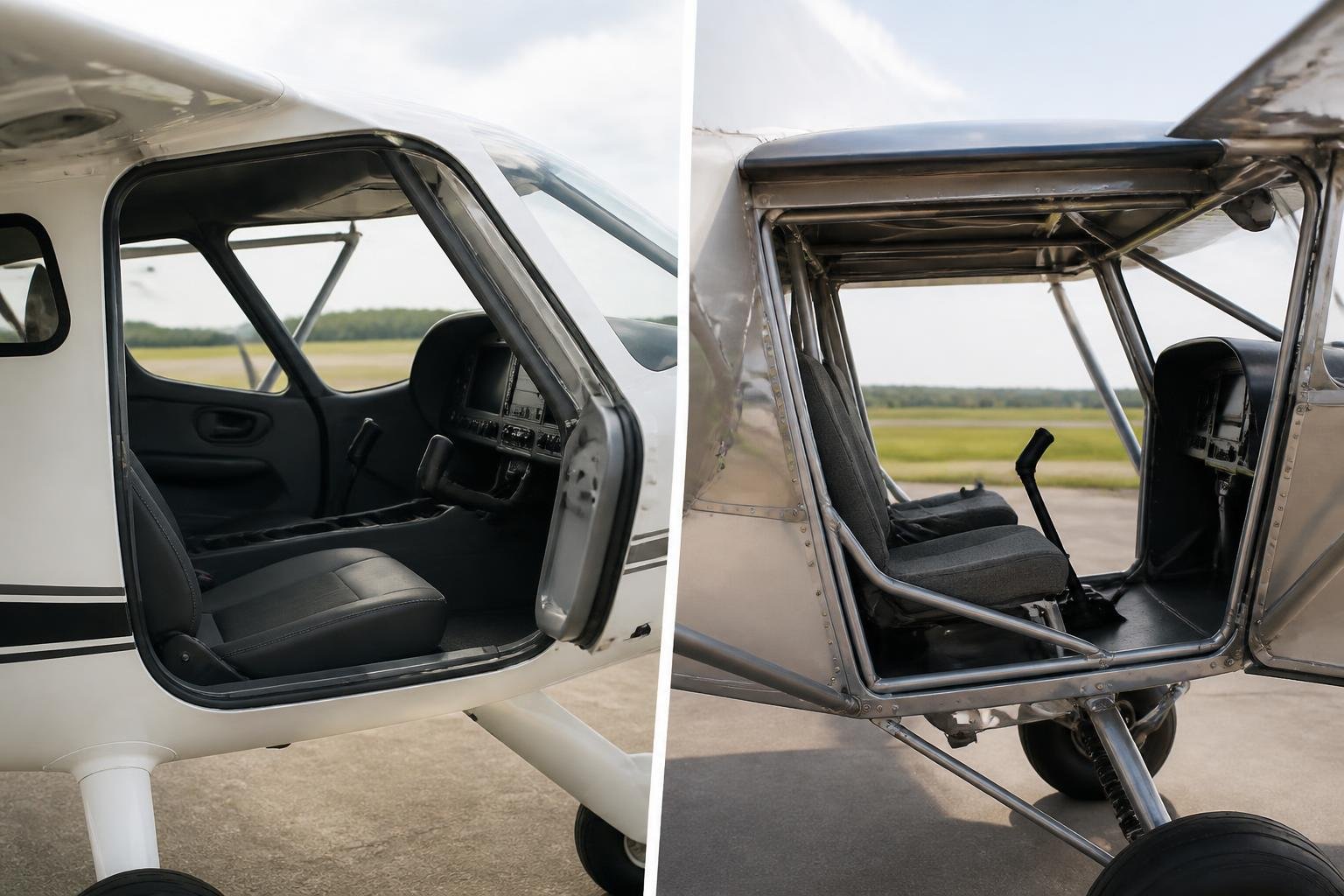
The CTLSi uses carbon/aramid composite construction and a strutless cantilever wing. Its smooth external shape is part of the aircraft's aerodynamic strategy, but composite construction creates specific inspection requirements.
Review impact history, previous repairs, bonding areas and any structural work carefully. Surface appearance alone is not enough to assess a composite repair.
For a detailed inspection framework, see the CollectAirs Composite Aircraft Pre-Buy Inspection Guide.
The C42 C uses a lighter, more visibly conventional structural concept. Buyers should inspect the metal/tubular structure, struts, fittings, corrosion-prone hardware, fabric-covered areas and the quality of any previous repairs or re-covering work.
Construction takeaway: CTLSi buyers need access to competent composite knowledge; C42 buyers should focus more strongly on fabric, tubes, fittings and corrosion condition.
Engine and Maintenance
A useful aspect of this comparison is that both aircraft can be equipped with the same basic engine family.
The CTLSi uses the fuel-injected 100 hp Rotax 912 iS. COMCO also lists the 100 hp Rotax 912 iS as an available C42 C engine.
That makes engine badge alone a weak reason to choose between them. Instead compare:
- Engine total time and calendar age.
- Maintenance continuity.
- Applicable Rotax service information.
- Fuel-system condition.
- Cooling-system condition.
- Electrical and engine-management history.
- Gearbox and propeller records.
- Local Rotax maintenance capability.
The airframe support network may create a larger practical difference than the engine. A buyer with strong local C42 expertise may find the C42 easier to support; another owner may have better access to Flight Design composite and parts expertise.
Certification and Legal Status
Do not assume that two visually similar examples operate under the same rules.
Flight Design states that the CTLS platform can appear under several approval frameworks, including EASA CS-LSA, 600 kg ultralight and SLSA configurations.
COMCO lists the current C42 C at 560 kg under LTF-UL 2019 / BCAR S approvals, while older C42 examples can have different national approvals and maximum weights.
That distinction affects maintenance, pilot privileges, modifications, registration and potentially resale. The certificate and approved documentation for the actual aircraft take precedence over the model name.
Certification takeaway: compare two specific aircraft only after confirming that their legal categories are compatible with the way and country in which you intend to operate them.
Pre-Buy Inspection Differences
| Inspection area | CTLSi priority | C42 priority |
|---|---|---|
| Structure | Composite damage, bonding and documented repairs | Tubes, fittings, struts, fabric and corrosion |
| Weight and balance | Verify equipment-heavy empty weight against current weighing data | Verify exact variant, approved MTOW and actual empty weight |
| Engine | Rotax 912 iS history, electrical system and fuel injection | Confirm exact Rotax installation and maintenance status |
| Fuel | Large-capacity system, leaks, vents and documentation | Standard or modified tank configuration and supporting approval |
| Previous repairs | Composite-specialist review where relevant | Repair/re-covering quality and structural documentation |
| Regulatory status | Confirm exact CTLSi approval basis | Confirm variant, national approval and approved weight |
Whichever model is shortlisted, use an independent inspector familiar with the type and Rotax installation. The CollectAirs Aircraft Pre-Buy Inspection Checklist provides a broader framework for records, condition, compliance and transaction risk.
Compare Real Aircraft, Not Only Brochures
Current CollectAirs inventory shows why model-level comparisons are only the first stage.
The 2020 Flight Design CTLSi 600 Grand Touring has a documented 600 kg MTOW, 368.9 kg empty weight and 231 kg useful load, plus a 100 hp Rotax 912 iS2 and dual-screen Dynon SkyView HDX avionics.
The Ikarus Comco C42 currently listed on CollectAirs is a very different real-world example: a 2000 aircraft substantially rebuilt in 2023, with a 100 hp Rotax, 540 kg approved MTOW and a 100 L long-range tank.
Neither aircraft should be treated as representative of every CTLSi or C42. Instead, they demonstrate how equipment, modifications, approval status and actual empty weight can move a used aircraft away from its standard brochure specification.
For more C42-specific due diligence, see the Ikarus C42 Buyer's Guide.
CTLSi vs C42 Decision Matrix
| If this matters most... | CTLSi | C42 C |
|---|---|---|
| Higher published speed | Advantage | Lower published speed |
| Fuel capacity | 130 L | 65 L standard |
| Short published take-off run | 250 m at 600 kg | Approx. 100–120 m |
| Model-level payload potential | Approx. 274 kg based on typical weight | 269 kg published |
| Composite construction | Yes | No |
| Lightweight tube/fabric-style construction | No | Yes |
| Longer-distance touring focus | Stronger fit | Capable but less performance-focused |
| Shorter-runway mission | Capable | Worth examining first |
| Flight-school use | Manufacturer-supported role | Manufacturer-supported role |
| Best ownership choice | Depends on the individual aircraft, legal category, actual useful load and local support | |
Which One Should You Shortlist?
Shortlist the Flight Design CTLSi first if your priority is efficient two-person touring, higher cruise performance and the flexibility of a large fuel capacity.
Shortlist the Ikarus C42 first if your priority is a lighter aircraft, shorter published runway requirements, frequent training or local flying, and access to an established C42 maintenance ecosystem.
Payload alone is unlikely to decide the comparison at model level because the published numbers are surprisingly close. The more meaningful difference is how each aircraft uses that weight: the CTLSi combines it with a much larger standard fuel capacity and higher speed, while the C42 combines similar theoretical carrying capability with substantially lower empty weight and shorter manufacturer take-off figures.
For a used-aircraft purchase, however, the individual weight-and-balance report matters more than either brochure.
Final Takeaway
The CTLSi and C42 are not simply two high-wing aircraft competing on the same specification sheet.
The CTLSi is the more touring-oriented design: composite, aerodynamically clean, faster on published manufacturer figures and equipped with much greater standard fuel capacity.
The C42 C is the lighter, shorter-runway alternative: its manufacturer figures show a significantly shorter take-off run while retaining similar model-level payload potential in the 912 iS configuration.
The choice becomes clearer once you define the mission:
- Longer regional touring: start with the CTLSi.
- Frequent training and local recreation: compare both closely.
- Shorter-airfield operation: investigate the C42 first.
- Maximum practical payload: ignore the model stereotype and compare the actual weighing records.
Want to compare real aircraft rather than brochure numbers? Review the Flight Design CTLSi 600 Grand Touring and the Ikarus Comco C42 currently on CollectAirs, then compare their actual weights, equipment, maintenance records and approval status before deciding which better fits your mission.
Sources & Further Reading
- Flight Design — CTLS official model information and performance specifications.
- COMCO IKARUS — C42 C official technical data.
- CollectAirs — Flight Design CTLSi 600 Grand Touring listing.
- CollectAirs — Ikarus Comco C42 listing.
- CollectAirs — Ikarus C42 Buyer's Guide
- CollectAirs — Composite Aircraft Pre-Buy Inspection Guide
- CollectAirs — Aircraft Pre-Buy Inspection Checklist
Manufacturer specifications are model-level reference data and may be based on different test conditions. Actual useful load, performance, equipment, fuel capacity and legal operating limits vary by aircraft, modification status and jurisdiction. Always use the approved documentation and current weight-and-balance report for the individual aircraft being evaluated.

Comments
No comments yet
Be the first to share your thoughts!